Optical frequency combs represent a cornerstone of modern precision measurement and advanced photonics, and scientists continually seek ways to miniaturise this powerful technology. Qili Hu, Raymond Lopez-Rios, and Zhengdong Gao, alongside colleagues including Jingwei Ling, Shixin Xue, and Jeremy Staffa, have now achieved a significant breakthrough in chip-scale frequency comb lasers. The team demonstrates a new approach to generating ultrashort soliton pulses directly on a chip, overcoming limitations inherent in existing microcomb technologies. This innovative laser emits broadband light with exceptional coherence and stability, while also dramatically simplifying operation and reducing power requirements to the point where it can run from a standard battery, paving the way for widespread adoption of microcomb technology in diverse applications.
Soliton Microcombs in Tiny Optical Resonators
Research focuses on developing and characterizing soliton microcombs, frequency combs generated within tiny optical resonators using nonlinear optics. Solitons, self-reinforcing waves that maintain their shape over long distances, are central to creating stable and coherent frequency combs with broad applications in precision metrology, optical clocks, spectroscopy, and telecommunications. A key material in this development is lithium niobate, utilized in thin-film photonics to create efficient nonlinear interactions. Scientists are striving for “turnkey” operation, where the comb self-starts with minimal adjustment, and are exploring Brillouin-Kerr soliton combs, a specific type utilizing Brillouin scattering.
Current research encompasses material development to enhance performance, optimized device fabrication techniques, and methods for stabilizing and controlling comb frequency and bandwidth. Scientists are also working to improve comb efficiency and integrate these devices with silicon photonics for more complex systems. Investigations include utilizing quantum dot lasers as a gain medium and exploring novel comb types, including self-starting and bi-chromatic combs, and devices incorporating auxiliary structures or heterogeneous integration for advanced functionality, including active microresonators with gain materials. Key performance metrics include comb linewidth, frequency spacing, bandwidth, and efficiency.
Researchers employ techniques like correlated self-heterodyne methods and optical spectrum analyzers for precise measurements. These advances promise significant impact in optical clocks, high-resolution spectroscopy, high-capacity telecommunications, precision metrology, and sensitive sensing applications. Emerging trends include integrating soliton microcombs with silicon photonics, creating fully integrated on-chip systems, utilizing machine learning to optimize performance, and exploring novel materials beyond lithium niobate to further enhance comb properties.
Lithium Niobate Chip Soliton Laser Fabrication
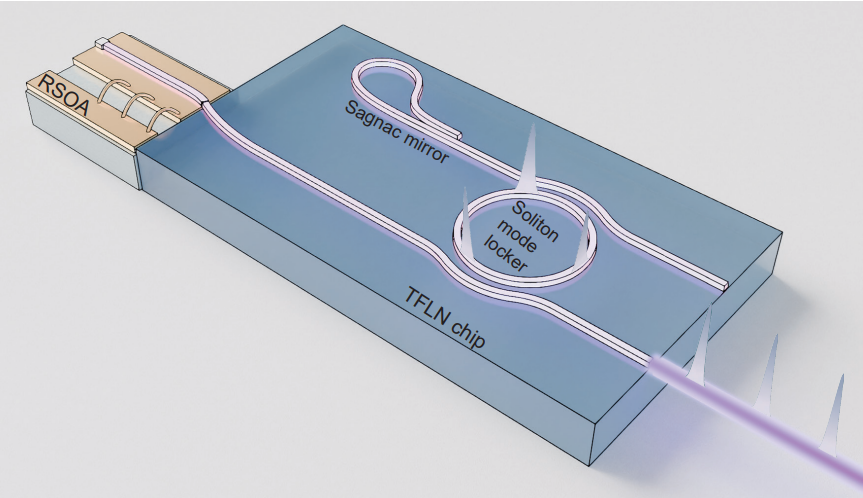
Scientists engineered a new chip-scale soliton laser by directly integrating a thin-film lithium niobate circuit with semiconductor optical gain, overcoming limitations of existing microcomb technologies. The device fabrication process began with a lithium niobate on insulator wafer, upon which waveguide patterns were defined using electron-beam lithography and transferred via argon ion milling. Precise etching and cleaning processes ensured high-quality waveguide structures. To enable tuning of the laser cavity, devices with slightly varying lengths were fabricated and polished to minimize coupling losses, and asymmetric coupling port designs favored unidirectional soliton excitation, ensuring sufficient intracavity power and efficient operation.
The laser operates without active temperature control, and optical alignment optimizes coupling efficiency. Researchers identified the operational range for soliton mode-locking by sweeping the current of a reflective semiconductor optical amplifier. Characterization involved coordinated tuning of the amplifier current and simultaneous recording of the optical spectrum, electrical spectrum, and laser power. Pulse characterization utilized dispersion compensating fiber and an optical amplifier, carefully considering bandwidth limitations. Fundamental linewidth measurements employed a delayed self-heterodyne technique with a fiber delay line and acousto-optic modulator. This innovative approach resulted in a soliton laser directly emitting background-free, ultrashort pulses with a 3-dB bandwidth exceeding 3. 4 terahertz and an ultra-narrow comb linewidth of 53 hertz.
Ultra-Narrowband Microcomb Laser Achieves 3. 4THz Output
Scientists achieved a breakthrough in chip-scale frequency comb technology with a new soliton microcomb laser that directly emits ultrashort pulses with a 3. 4THz bandwidth, corresponding to a pulse width of less than 90 femtoseconds. This represents a significant advancement beyond the limitations of existing semiconductor mode-locked lasers and dissipative Kerr soliton generators. Experiments reveal an ultra-narrow comb linewidth of only 53Hz, the smallest linewidth ever demonstrated for an on-chip soliton microcomb, including both dissipative Kerr soliton and semiconductor technologies. The research team integrated an indium phosphide-based reflective semiconductor optical amplifier with a thin-film lithium niobate photonic integrated circuit to create a laser cavity.
This innovative design enables stable, turnkey operation with near-unity optical efficiency, meaning almost all the input power is converted into useful laser light. Measurements confirm remarkably low soliton generation thresholds, requiring only 1 volt and 75 milliamperes to initiate pulse generation, an order of magnitude lower than previously reported for dissipative Kerr soliton systems. The demonstrated laser operates with a high repetition frequency ranging from 0. 8 to 3 terahertz, significantly exceeding the capabilities of conventional semiconductor mode-locked lasers. This combination of broad bandwidth, narrow linewidth, and low power consumption positions the new soliton microcomb laser as a transformative technology with potential applications in optical communications, sensing, metrology, and computing. The achievement represents a paradigm shift in soliton microcomb generation, paving the way for a new generation of compact and efficient frequency combs.
Electric Soliton Combs Exceed Terahertz Bandwidth
This research demonstrates a new approach to generating chip-scale optical frequency combs, achieving significant advances over existing technologies. Scientists have developed a microchip laser that directly emits ultrashort soliton pulses with a broad bandwidth exceeding 3. 4 terahertz, and an exceptionally narrow comb linewidth of 53 hertz. This achievement overcomes limitations found in current microcomb technologies, which often rely on complex external pumping or suffer from degraded performance due to the mechanisms used to initiate mode-locking. The newly developed laser simplifies soliton generation through fully electric pumping, stable operation, and high efficiency, requiring only a low power input, comparable to that of a standard alkaline battery.
Measurements reveal a wall-plug efficiency on par with existing technologies, but with markedly broader bandwidth and significantly higher repetition rates. This improved performance stems from an ultrafast soliton mode-locking mechanism and the design’s ability to support a wide parametric bandwidth. Researchers acknowledge that under certain conditions, the laser exhibits a complex, partially mode-locked state with an unstable secondary pulse, a phenomenon they intend to investigate further. Despite this, the demonstrated technology represents a substantial step forward in chip-scale frequency comb technology, promising significant impact across a range of applications. The team anticipates this work will pave the way for more compact and efficient devices for metrology, spectroscopy, and other fields reliant on precise optical frequencies.
🗞 Ultrafast broadband soliton microcomb laser
🧠 ArXiv: https://arxiv.org/abs/2510.15146