Josephson diodes, components that allow electrical current to flow more easily in one direction than another, represent a crucial step towards building more complex superconducting quantum circuits, and recent work by A. Rothstein, R. J. Dolleman, and L. Klebl, alongside colleagues at institutions including K. Watanabe’s laboratory, demonstrates a new level of control over these devices. The team reports the creation of two adjacent Josephson junctions within a specially constructed material, magic-angle twisted bilayer graphene, and reveals a significant, gate-tunable diode effect in both. This achievement overcomes a key limitation in current superconducting technology, offering the potential to dynamically adjust and even reverse the direction of current flow within quantum circuits, and paving the way for more sophisticated and efficient designs. The researchers explain that subtle variations within the material itself contribute to this enhanced control, highlighting the importance of precise material engineering in future quantum technologies.
Simulating Correlated Insulators with Josephson Junctions
This research details computational methods used to simulate the behaviour of Josephson junctions, crucial components in superconducting circuits. Scientists employ these simulations to understand correlated insulator behaviour in materials like graphene and hexagonal boron nitride, accurately modelling complex interactions to predict and control their superconducting properties. The team utilizes sophisticated numerical techniques to solve the equations governing the circuit’s behaviour, providing insights into the fundamental physics of these systems. The simulations rely on solving ordinary differential equations that describe the circuit’s dynamics, employing Runge-Kutta methods for accuracy and efficiency.
Calculating modified Bessel functions, essential for describing the current-phase relationship in Josephson junctions, is a key component of the simulation process. The team leverages specialized libraries, such as Boost-C++ and FLINT, to optimize computational performance and handle complex mathematical calculations. The research meticulously details simulation parameters, allowing other researchers to reproduce and verify the results, fostering collaboration and advancing the field. By combining rigorous numerical simulations with advanced computational tools, scientists gain a deeper understanding of correlated insulator behaviour and pave the way for developing novel superconducting devices.
Gate-Tunable Diode Effect in Graphene Junctions
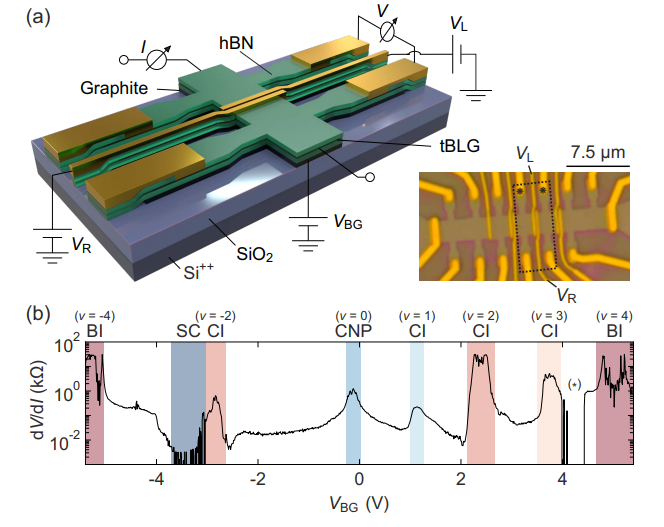
Scientists have demonstrated a prominent Josephson diode effect in two adjacent, gate-defined Josephson junctions within magic-angle twisted bilayer graphene. These junctions, operating near a specific moiré filling factor, exhibit a gate-tunable asymmetry in their supercurrent flow, meaning current passes more easily in one direction than the other. The team estimates the kinetic inductance within the material to be on the order of 10 nanohenries, a key factor contributing to this diode behaviour. Experiments reveal that despite being in close proximity, the two junctions display distinct interference patterns and differing diode characteristics, suggesting that microscopic variations, such as slight differences in twist angle, shape the non-uniform distribution of supercurrent and drive the observed asymmetry.
By carefully tuning the gate voltage, scientists can control the efficiency of the diode and even reverse its polarity while maintaining a fixed magnetic field. The research involved fabricating a multi-probe Hall bar device from MATBG encapsulated in hexagonal boron nitride, allowing for precise control of charge carrier density using metal gates. Measurements of differential resistance revealed the formation of Josephson junctions at the intersection of correlated insulating and superconducting regimes, with sharp maxima corresponding to critical currents tunable with gate voltages. Further analysis revealed distinct regions corresponding to different diode behaviours, with critical currents ranging from approximately 34 to 220 nanoamperes, demonstrating the ability to manipulate the supercurrent flow with high precision. These findings offer potential routes for tailoring Josephson diode performance in superconducting quantum circuits, paving the way for new advancements in quantum technologies.
Tunable Diode Effect in Twisted Bilayer Graphene
Researchers have demonstrated a tunable Josephson diode effect in junctions created within magic-angle twisted bilayer graphene. These Josephson junctions, exhibiting a flow of supercurrent, display a directional current flow, acting as a diode, and the efficiency of this diode can be controlled by applying a gate voltage. The team observed this effect in two adjacent junctions within the same device, revealing that even slight variations in the material’s twist angle significantly influence the supercurrent distribution and, consequently, the diode’s performance. The findings indicate that the unique properties of MATBG, specifically its large kinetic inductance and the non-uniformity of the supercurrent, are key to achieving this effect.
Importantly, the researchers determined that the diode behaviour does not require any intrinsic time-reversal symmetry breaking mechanisms, suggesting that the observed non-reciprocal supercurrent arises from the material’s inherent characteristics and structural irregularities. Simulations of Josephson networks corroborate the experimental results, strengthening the understanding of the underlying physics. The authors acknowledge that the observed sensitivity to twist angle disorder is a limitation, as precise control over this parameter remains challenging. Future work may focus on mitigating the effects of this disorder or exploring methods to engineer more uniform junctions. Nevertheless, these results establish MATBG Josephson junctions as a promising platform for programmable superconducting electronics, with potential applications in energy-efficient rectifiers and reconfigurable circuits, and offer new avenues for investigating non-reciprocal phenomena in correlated two-dimensional materials.
🗞 Gate-tunable Josephson diodes in magic-angle twisted bilayer graphene
🧠 ArXiv: https://arxiv.org/abs/2510.15503
See today’s quantum computing news on Quantum Zeitgeist for the latest breakthroughs in qubits, hardware, algorithms, and industry deals.