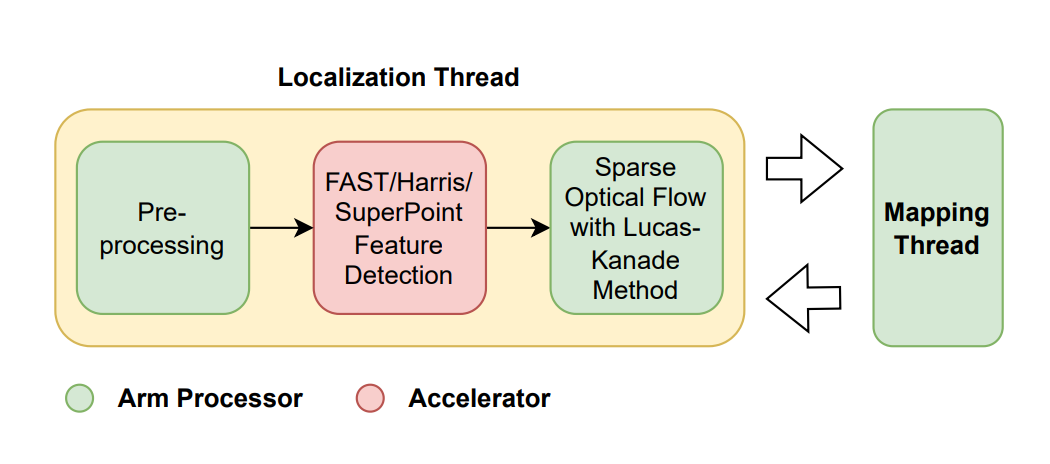
Feature detection represents a significant bottleneck in Simultaneous Localization and Mapping (SLAM) systems, particularly as these technologies find increasing application in power-limited devices like drones. Ruiqi Ye and Mikel Luján investigate the potential of both Graphics Processing Units (GPUs) and Field Programmable Gate Arrays (FPGAs) to accelerate this crucial process within a complete Visual SLAM pipeline. Their comparative study offers new insights into the trade-offs between these two hardware acceleration approaches, revealing that GPUs outperform FPGAs when using traditional feature detectors like FAST and Harris. However, the research demonstrates that FPGAs excel with learning-based detectors such as SuperPoint, achieving substantial improvements in both speed and energy efficiency. This work establishes a clear understanding of how to best leverage hardware acceleration to optimise V-SLAM performance, potentially enabling more frequent global adjustments without compromising accuracy and paving the way for more robust and efficient robotic systems.
This involves using cameras to gather visual data and inertial measurement units (IMUs) to track motion, creating a map of the environment as the agent moves. Crucial to this process is identifying and tracking distinctive points, or features, in images, and then refining these estimates using advanced optimization techniques. FPGAs, with their reconfigurable hardware, offer the potential for real-time performance and energy efficiency, making them attractive for applications where power consumption is critical. Optimization techniques, such as nonlinear optimization with algorithms like iSAM2 and fluid relinearization, are used to refine pose and map estimates. Researchers continually strive to balance speed and energy efficiency, aiming for real-time performance and low-power consumption, particularly for applications like drones where battery life is a key constraint. Recognizing the power limitations of platforms like drones, they investigated how these different hardware platforms perform with key algorithms, meticulously comparing implementations of FAST, Harris, and SuperPoint feature detectors on modern Nvidia Jetson Orin and Versal SoCs. For traditional algorithms like FAST and Harris, GPU implementations consistently outperformed their FPGA counterparts in both runtime and energy efficiency, also delivering superior performance within the broader V-SLAM pipeline. However, when examining the learning-based SuperPoint detector, the FPGA implementation demonstrated a significant advantage, achieving up to a 3.
1times improvement in runtime and a 1. 4times improvement in energy efficiency compared to the GPU version. The FPGA-accelerated V-SLAM, utilizing SuperPoint, achieved comparable runtime performance to the GPU-accelerated system, even surpassing it in frames per second for some tested dataset sequences. The methodology involved a detailed analysis of each detector’s implementation, beginning with image pre-processing, including colour conversion, image blurring, and the creation of image pyramids. For FAST, an online learning method was used to improve repeatability and runtime.
The Harris detector used a Sum of Squared
The Harris detector used a Sum of Squared Differences approach for computational efficiency. SuperPoint, a self-supervised learning framework, jointly computes feature points and descriptors in a single pass, incorporating a homographic adaptation technique to enhance repeatability. Researchers integrated and evaluated FAST, Harris, and SuperPoint feature detectors within the ICE-BA V-SLAM pipeline, utilizing the EuRoC dataset. For non-learning-based detectors like FAST and Harris, GPU implementations achieved superior runtime performance and energy efficiency. However, with the learning-based SuperPoint detector, the FPGA implementation delivered up to a 3. 1times improvement in runtime and a 1.
4times enhancement in energy efficiency. The FPGA-accelerated V-SLAM system achieved comparable runtime performance to the GPU-accelerated system, exhibiting a higher Frames Per Second (FPS) in some dataset sequences. Importantly, the study highlights that employing hardware acceleration for feature detection can reduce the frequency of global bundle adjustment module invocations, thereby improving V-SLAM performance without compromising accuracy. For traditional, non-learning-based feature detectors like FAST and Harris, GPU-accelerated implementations currently achieve superior runtime performance and energy efficiency. However, when employing learning-based detectors such as SuperPoint, FPGA acceleration offers significant improvements in both speed and energy consumption, exceeding GPU performance by up to 3. 1 and 1.
4times respectively. Researchers also found that hardware acceleration of feature detection can reduce the frequency with which computationally expensive global bundle adjustment steps are required, potentially improving the overall runtime of V-SLAM pipelines without compromising accuracy. While GPU-accelerated V-SLAM generally exhibits greater accuracy than FPGA-accelerated systems, the team achieved comparable performance in some test sequences, demonstrating the potential of FPGA implementations. This work establishes a valuable benchmark for evaluating hardware acceleration strategies in V-SLAM and informs the development of more efficient and power-conscious robotic and autonomous systems.
👉 More information🗞Accelerated Feature Detectors for Visual SLAM:
🗞 Accelerated Feature Detectors for Visual SLAM: A Comparative Study of FPGA vs GPU
🧠 ArXiv: https://arxiv.org/abs/2510.13546



See today’s quantum computing news on Quantum Zeitgeist for the latest breakthroughs in qubits, hardware, algorithms, and industry deals.