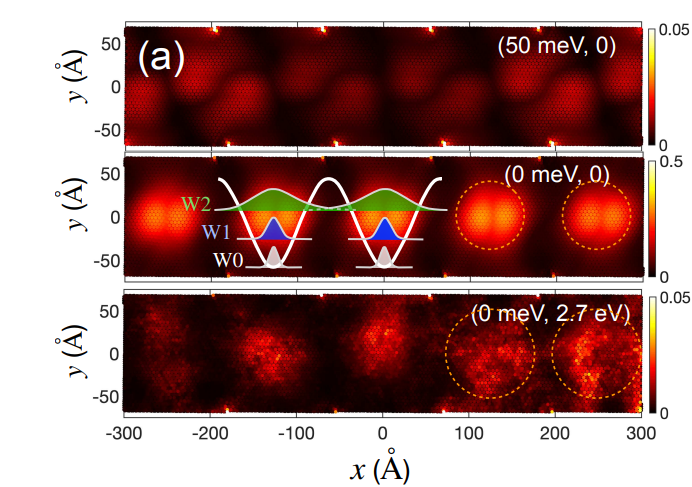
The behaviour of electrons in materials with inherent disorder has long puzzled physicists, typically leading to restricted movement due to random interference, but the impact of disorder on systems where electrons are already naturally confined remains unclear. Zhe Hou from Nanjing Normal University, Hailong Li, and Qing Yan from Fudan University, alongside their colleagues, now investigate this phenomenon in twisted bilayer graphene, a material exhibiting unique electronic properties at a specific ‘magic angle’. Their atomistic calculations demonstrate that, surprisingly, moderate disorder actually enhances electrical conductance in this system, before eventually leading to confinement with stronger disorder, revealing a counterintuitive shift from free movement to restriction. This discovery, achieved through detailed analysis of electron behaviour within the material, highlights the unconventional role of disorder in these flat-band moiré systems and offers potential explanations for observed phenomena like the fractional anomalous Hall effect.
Disorder Suppresses Correlated Insulating Phases
In disordered lattices, itinerant electrons typically undergo Anderson localization due to random phase interference. This research investigates the interplay between strong correlations and disorder in twisted bilayer graphene near the magic angle, focusing on how disorder affects the emergence of correlated insulating phases. The team employs theoretical techniques, including the extended tight-binding model and the non-crossing approximation, to study the electronic structure and localization properties of disordered twisted bilayer graphene. Results demonstrate that weak disorder generally suppresses correlated insulating phases, favouring a metallic state, while strong disorder induces a transition to a localized Anderson insulator. Importantly, the study reveals a non-monotonic behaviour, where intermediate disorder levels can enhance the stability of correlated insulating phases by suppressing the kinetic energy of carriers. This enhancement arises from the formation of localized states within the correlated insulating gap, effectively reducing the system’s susceptibility to disorder-induced metallization.
Disorder Enhances Conductance in Twisted Bilayer Graphene
This research demonstrates a surprising relationship between disorder and electron flow in twisted bilayer graphene, a material known for its “flat bands” where electrons are naturally confined. Scientists have long understood that disorder typically hinders electron movement, leading to localized behavior. However, this study reveals that moderate levels of disorder can actually enhance conductance in flat-band systems, promoting electron delocalization before ultimately restoring localization at higher disorder strengths. This represents a departure from conventional understanding of disorder’s impact on electron transport.
The team achieved these findings through detailed atomistic calculations, modelling electron flow in twisted bilayer graphene with and without disorder. Their results show a clear trend: while strong disorder suppresses conductance as expected, a moderate amount of disorder initially increases it, creating a unique delocalization-to-localization transition. This behavior stems from the way disorder modifies the effective tunneling strength between different regions within the material, influencing how electrons move through the flat bands. Furthermore, the study highlights that this response to disorder is qualitatively different in twisted bilayer graphene compared to larger-angle twisted structures, emphasizing the crucial role of the flat bands themselves.
Disorder Surprisingly Enhances Electron Flow
The team’s calculations reveal that moderate disorder can enhance conductance in twisted bilayer graphene, promoting electron delocalization before ultimately restoring localization at higher disorder strengths. This behavior stems from the way disorder modifies the effective tunneling strength between different regions within the material, influencing how electrons move through the flat bands. This work provides new insight into the fundamental physics of flat-band materials and offers a pathway for manipulating electron transport through controlled disorder.
🗞 The fate of disorder in twisted bilayer graphene near the magic angle
🧠 ArXiv: https://arxiv.org/abs/2510.14567