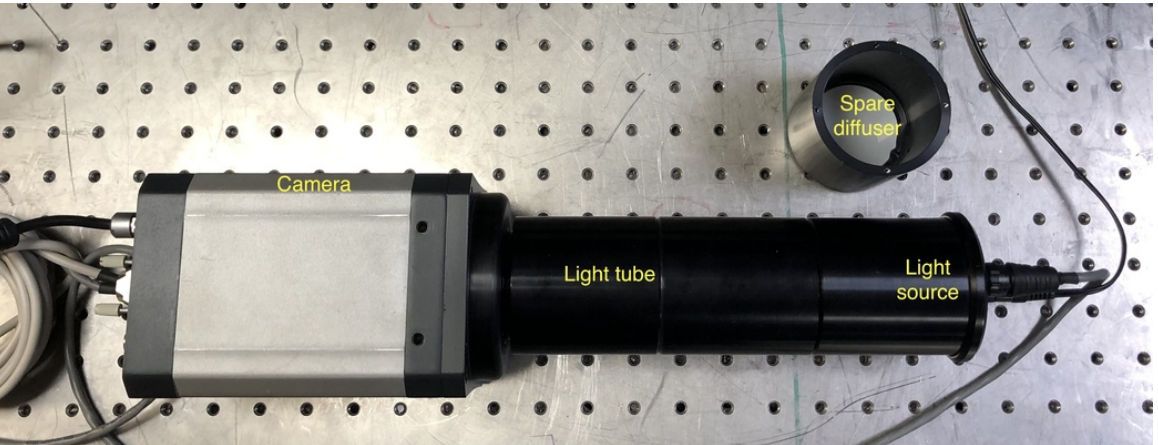
Modern astronomical observations increasingly rely on scientific CMOS cameras, and a team led by Ioannis Apergis, Daniel Bayliss, and Leonidas Asimakoulas from the University of Warwick and Andor Technology Ltd, rigorously assesses the capabilities of this technology with a detailed laboratory evaluation of the Marana 4. 2BV-11 CMOS camera. The researchers characterise the camera’s performance in both Fastest Frame Rate and High Dynamic Range modes, focusing on key metrics for precise photometry. Their tests reveal exceptionally low read noise, reaching 1. 577 electrons in FFR mode, alongside a large pixel well capacity and a dynamic range of 93 dB in HDR mode, demonstrating the camera’s ability to capture faint signals with high fidelity. These results indicate the Marana camera possesses the potential to significantly advance the precision of photometric measurements, crucial for a wide range of astronomical investigations.
Scientific CMOS cameras are becoming increasingly prevalent in modern observational astronomy. This work assesses the ability of CMOS image sensors technology to perform high-precision photometry with a detailed laboratory characterization of the Marana 4. 2BV-11 CMOS camera. Researchers meticulously evaluated the camera’s behaviour, focusing on parameters like dark signal, dark current, quantum efficiency, and calibration. This detailed analysis provides a thorough understanding of the camera’s capabilities for demanding imaging applications. The camera’s bias signal was carefully measured and corrected for row and column variations, significantly reducing temporal noise. Measurements were conducted at a temperature of -25°C.
Quantum efficiency, the efficiency with which the camera converts photons into electrons, was determined using a photodiode as a reference standard, showing how efficiently the camera detects light across different wavelengths. Dark signal, the signal produced even without light, was analysed in relation to exposure time and temperature, revealing a linear relationship between dark signal and exposure time. Dark current, the flow of electrons due to thermal effects, was also investigated, revealing a logarithmic relationship between dark current and temperature, with variations observed across different regions of the image sensor. These detailed measurements provide a comprehensive characterization of the camera’s performance.
Calibration is crucial for reducing noise in images. Lower temperatures consistently result in lower dark signal and dark current. The dark signal exhibits a linear response to exposure time, while the dark current follows a predictable logarithmic relationship with temperature. Regional variations in dark current are present across the sensor. 2BV-11 CMOS camera demonstrates high potential for precise photometric measurements, confirmed by detailed laboratory characterization of its performance. Experiments reveal a read noise of 1. This wide dynamic range allows the camera to capture both bright and faint objects in a single image. Measurements confirm excellent linearity, with errors of only 0. 099% in FFR mode and 0. 122% in HDR mode, ensuring accurate signal reproduction across a wide brightness range.
Analysis of the image arrays shows a photo response non-uniformity of 0. 294% in FFR mode and a reduced 0. 131% in HDR mode, demonstrating consistent sensitivity across the sensor. Dark current measurements, conducted at -25°C, reveal mean levels for both FFR and HDR modes, while characterization of the dark current glow pattern provides insight into sensor behaviour. Further tests demonstrate high efficiency across the visible spectrum, peaking at over 95% at 560 nanometers, maximizing light capture. These results establish the Marana camera as a strong candidate for demanding photometric applications, offering a compelling alternative to traditional CCD detectors.
Marana Camera Excels in Photometry Performance
The Marana 4. 2BV-11 CMOS camera demonstrates strong potential for high-precision photometry, confirmed by detailed laboratory testing of its key characteristics. The camera achieves a read noise of approximately 1. 6 electrons, and exhibits excellent linearity with errors below 0.
13%, indicating accurate signal reproduction. Furthermore, the sensor delivers a peak quantum efficiency exceeding 95% at 560nm, maximizing light detection capability. The investigation reveals a pixel well capacity reaching over 69,000 electrons in HDR mode, providing a wide dynamic range of 93dB. Photo response non-uniformity remains low, at approximately 0. 13% in HDR mode, ensuring consistent measurements across the image array.
While a slight glow pattern was observed in dark current measurements, the camera maintains stable performance at temperatures down to -25°C. These findings establish the Marana camera as a promising instrument for astronomical observations requiring precise photometric measurements. The authors acknowledge that dark current behaviour warrants further investigation, and that faster beams may cause vignetting. Future work could focus on mitigating these effects and exploring the camera’s performance under extended operational conditions. This detailed characterization provides a valuable baseline for future studies utilizing this advanced CMOS technology in astronomical research.
🗞 High-Precision Photometry with a scientific CMOS Camera: I Lab Testing of the Marana camera
🧠 ArXiv: https://arxiv.org/abs/2510.14484


See today’s quantum computing news on Quantum Zeitgeist for the latest breakthroughs in qubits, hardware, algorithms, and industry deals.