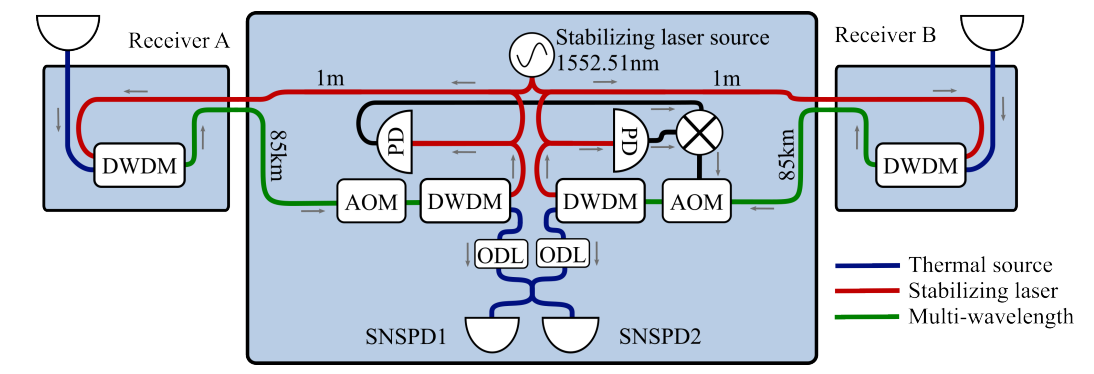
Astronomical interferometry pushes the boundaries of resolution, but achieving extremely long baselines presents significant challenges due to signal attenuation and phase noise. Joshua J. Collier, David R. Gozzard, John S. Wallis, and Benjamin P. Dix-Matthews, from the International Centre for Radio Astronomy Research at The University of Western Australia, and the ARC Centre of Excellence for Engineered Quantum Systems, now demonstrate a breakthrough in phase stabilization techniques. The team successfully implements off-band phase stabilization across two fibre links totalling 170km in length, effectively reducing phase noise by four to five orders of magnitude. This achievement allows the interferometer to resolve subtle phase shifts and, crucially, recover both first and second-order photon correlations from an incoherent light source, paving the way for significantly more powerful and expansive astronomical interferometers.
Atmospheric Turbulence and Phase Estimation Techniques
Advanced Methods for Mitigating Phase Noise in Interferometry
Mitigating Phase Noise in Long Baseline Interferometry
Maintaining clear signals across vast distances is crucial for long baseline interferometry, a technique used to achieve extremely high resolution in astronomy. This research addresses the challenge of preserving signal coherence over extended baselines, investigating a new approach to estimating and correcting for atmospheric distortions, specifically designed for sources that lack strong, well-defined spectral features. This method overcomes difficulties associated with traditional fringe fitting techniques, which rely on bright, narrow spectral lines. The approach models atmospheric turbulence as a series of locally stationary phase screens, allowing the development of a statistical estimator for the differential piston phase, which represents the distortion of the wavefront.
This estimator, based on the covariance of phase fluctuations, effectively predicts and compensates for atmospheric distortions that degrade the interference signal. The research demonstrates the ability to achieve a residual differential piston error of 24. The authors aim to build a quantum telescope capable of surpassing traditional resolution boundaries, leveraging techniques developed for quantum key distribution (QKD) to improve the stability and precision of phase measurements in interferometry. The core principle of the research is interferometry, combining light waves from multiple telescopes to create an interference pattern that reveals fine details. Spatial mode demultiplexing (SMD) separates and analyzes different spatial modes of light, improving resolution.
Integrating Quantum Protocols for Enhanced Stability
Quantum Protocols for Enhancing Interferometry Stability
Twin-field quantum key distribution (TF-QKD), a QKD protocol using correlated photon pairs, is adapted to improve phase stability in interferometry. Maintaining a precise and stable phase relationship between signals from different telescopes is critical for successful interferometry, as any phase fluctuations introduce noise and degrade the image. The research focuses on reducing various sources of noise, including electromagnetic and quantum noise, and exploring techniques to push beyond the diffraction limit, potentially using quantum entanglement. The experimental setup involves multiple telescopes, optical components to manipulate and combine light signals, sensitive detectors to measure the interference pattern, and a crucial phase stabilization system drawing heavily on TF-QKD techniques.
Advanced algorithms process the interference data and reconstruct the image. Key findings demonstrate that adapting concepts from TF-QKD significantly improves phase stability in the interferometric setup, a major contribution, leading to improved image quality and suggesting the potential for achieving super-resolution imaging. The improved phase stability makes long-baseline interferometry more feasible, allowing for the creation of much larger effective apertures. The research has significant implications for astronomy, potentially enabling the construction of next-generation telescopes capable of resolving finer details in the universe, leading to breakthroughs in understanding exoplanets, galaxies, and other celestial objects.
Beyond Astronomy: Diverse Technological Applications
Applications Across Medical, Security, and Imaging Science
This work also has implications for imaging technology, potentially leading to advanced systems for medical imaging, materials science, and security. Advancing the field of quantum technology by demonstrating the practical application of quantum concepts in a real-world setting and improving the performance of quantum communication systems by enhancing phase stability and reducing noise are further benefits. Scientists successfully implemented off-band phase stabilization, reducing phase noise by four to five orders of magnitude between 1 and 100 Hertz. This allowed for the resolution of phase shifts as small as 0. 16 cycles per second with continuous measurement, greatly enhancing signal-to-noise ratios. Importantly, the system recovered both first and second-order photon correlations, confirming the technique’s effectiveness for quantum interferometry as well as conventional optical interferometry.
These findings establish the feasibility of building extremely large interferometers for astronomical observations. The current work is limited by chromatic dispersion within the fibre, a challenge the researchers acknowledge and propose addressing with dispersion compensating modules. Future development will focus on implementing these modules to fully realize the potential for wide-band observations and achieving even greater stability through group delay actuators or periodic phase resets, potentially achieving sub-microarcsecond resolution with a 400-kilometre baseline, exceeding the capabilities of existing instruments like the Event Horizon Telescope and enabling detailed studies of exoplanets, star formation, and black holes.
🗞 Phase stabilization for long baseline interferometry of incoherent optical sources
🧠 ArXiv: https://arxiv.org/abs/2510.13263
The implementation of off-band stabilization across such vast fiber lengths necessitates active compensation for inherent environmental drifts, such as temperature gradients and mechanical vibrations that induce subtle changes in the refractive index. These physical effects manifest as path length fluctuations that must be measured with picometer precision. The successful deployment of this technique relies on precise phase monitoring loops that continuously sample the phase stability reference channel, allowing feedback mechanisms to correct the optical delay lines faster than the decoherence time of the quantum signals.
Furthermore, recovering second-order photon correlations moves the system beyond classical interference measurements; it enables the study of multi-particle quantum states. These correlations are essential for enhancing the signal-to-noise ratio in quantum imaging and are directly related to the Hong-Ou-Mandel effect. By demonstrating the retrieval of these higher-order moments from an originally incoherent source, the researchers confirm the capability to utilize advanced quantum metrology principles within astronomical observation.
A key technical hurdle addressed by this research is the practical integration of quantum protocols with macro-scale classical astronomical infrastructure. Specifically, the adaptation of TF-QKD principles suggests that the phase stability improvements are not merely incremental, but fundamentally shift the operational paradigm from classical wavefront sensing to quantum phase estimation, offering potential immunity to certain types of atmospheric or instrumental noise sources.

See today’s quantum computing news on Quantum Zeitgeist for the latest breakthroughs in qubits, hardware, algorithms, and industry deals.