

The pursuit of novel materials for spintronic devices drives innovation in electronics, and recent advances in altermagnetism offer promising new pathways. Ning-Jing Yang, Zhigao Huang, and Jian-Min Zhang from Fujian Normal University demonstrate a spin-corner locking mechanism that generates unique topological states within two-dimensional altermagnetic systems. Their work establishes that applying strain to these materials creates spin-resolved corner modes, transforming the system into a corner-polarized second-order topological insulator. This breakthrough not only identifies viable material candidates, including CrO and CrSeO, but also predicts the existence of an altermagnetic Weyl semimetal, opening exciting possibilities for coupling topological spintronics with a new field called cornertronics and paving the way for advanced device design.
Corner States in Altermagnetic Two-Dimensional Materials
Research into higher-order topology and cornertronics explores unique electronic states localized at the corners of two-dimensional materials, building upon established knowledge of topological insulators and semimetals. A key focus lies on altermagnetic materials, which exhibit non-collinear magnetic order and offer new possibilities for topological phenomena. Higher-order topological insulators possess conducting states not on the surface, but on corners, creating opportunities for novel device designs. Spin space groups, a mathematical framework classifying magnetic materials, are crucial for understanding their topological properties, while topological invariants characterize these phases and protect their unique states.
This research focuses on identifying and designing two-dimensional materials capable of hosting higher-order topological phases, highlighting altermagnetic materials as ideal platforms due to their unique magnetic order. The interplay between spin-orbit coupling and symmetry is critical for realizing these states, and scientists are actively exploring ways to manipulate these factors to control material properties. Engineering the properties of corner states, such as their energy, spin polarization, and transport characteristics, is a central goal, with potential applications in topological transistors, spin filters, and even quantum computing. Researchers are investigating materials like pentagonal altermagnets and metal-organic frameworks, relying on computational methods like density functional theory to predict and verify their properties.
This work uniquely emphasizes altermagnetism as a promising route to higher-order topology, a relatively unexplored area. The use of spin space groups to systematically classify and predict topological properties is a key contribution, as is the exploration of novel ways to engineer corner states. The proposed device concepts, based on corner states, could pave the way for new electronic and quantum technologies.
Strain-Induced Corner Polarization in Altermagnets
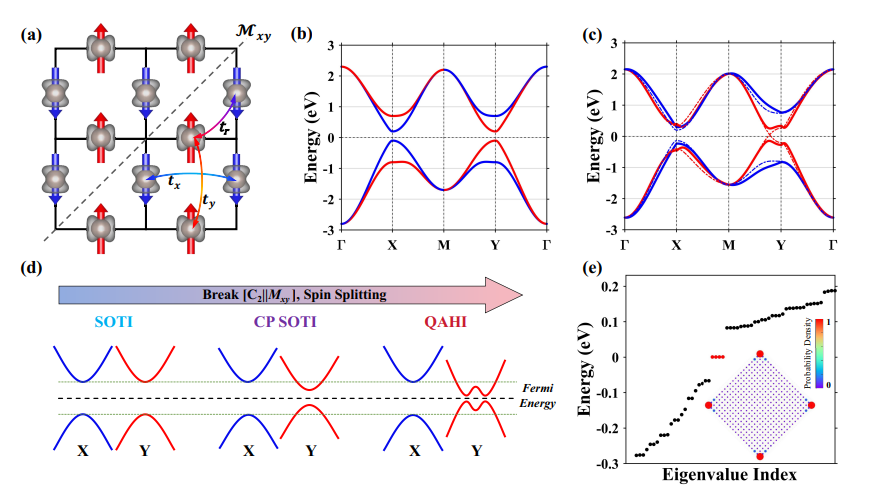
Recent research reveals a spin-corner locking mechanism in altermagnets, leading to the discovery of second-order topological states in two-dimensional systems. Scientists demonstrate that applying uniaxial strain breaks a specific symmetry, creating spin-resolved corner modes and driving the material into a corner-polarized second-order topological insulator. This breakthrough offers a new pathway for manipulating spin and charge at material corners, potentially revolutionizing device design. Through first-principles calculations, the team identified chromium oxide and chromium selenium oxide as promising materials exhibiting this behavior.
Experiments show that beyond a critical strain level, the material undergoes a topological transition, resulting in quantized conductance, a hallmark of robust electronic transport. Researchers constructed a topological diagram for chromium oxide, predicting the existence of an altermagnetic Weyl semimetal, a material with unique electronic properties. Detailed analysis confirms the presence of four corner-localized states within the material’s energy gap, which are spin-resolved, meaning electrons with different spins occupy different corners, and each corner carries a fractional charge. The energy splitting between these spin-resolved corner states reaches up to 33 meV, offering a pathway for tuning the corner charge with external control.
This configuration establishes a clear distinction between the corner degrees of freedom, opening possibilities for novel spintronic devices. Furthermore, the research demonstrates that breaking this symmetry induces a rare corner-polarized second-order topological insulator phase, situated between other topological phases. In systems preserving mirror symmetry and lacking spin-orbit coupling, the team predicts the emergence of staggered magnetic Weyl semimetals, materials with unique electronic band structures, as confirmed by calculations. These findings open technological avenues in altermagnetism and higher-order topology, providing opportunities to couple topological spintronics with corner-based electronics.
Strain-Induced Topology and Quantized Conductance
This research establishes a novel mechanism for generating second-order topological states within two-dimensional altermagnetic materials, driven by a spin-corner locking effect. Through detailed analysis and first-principles calculations, scientists demonstrate that applying uniaxial strain creates spin-resolved corner modes, resulting in a corner-polarized second-order topological insulator. Beyond a critical strain level, the system transitions into an anomalous Hall insulator exhibiting quantized conductance. The team identified chromium oxide and chromium selenium oxide as viable materials to realize these predicted states, and also predict the existence of an altermagnetic Weyl semimetal.
This work expands understanding of magnetic topological phases by revealing a spin-corner-momentum entanglement, and opens technological avenues for coupling topological spintronics with cornertronics. The stability of the observed states depends on the specific symmetry of the materials and fabrication techniques, and further investigation is needed to explore the broader applicability of this design strategy to other two-dimensional altermagnetic systems. Future research will likely focus on experimentally verifying these findings and exploring the potential for device applications leveraging the unique spin-corner coupling.
🗞 Spin-Selective Second-Order Topological Insulators Enabling Cornertronics in 2D Altermagnets
🧠 ArXiv: https://arxiv.org/abs/2510.13319




See today’s quantum computing news on Quantum Zeitgeist for the latest breakthroughs in qubits, hardware, algorithms, and industry deals.



