Solving linear systems of equations is a fundamental challenge in many areas of science and engineering, and researchers continually seek more efficient methods, particularly for implementation on emerging quantum computers. Siddharth Hariprakash, Roel Van Beeumen, Katherine Klymko, and Daan Camps investigate whether randomised algorithms offer a practical path towards solving these systems on near-term quantum hardware. Their work rigorously assesses the resource demands of a randomised approach that combines sampling techniques with a Hamiltonian simulation, deriving precise limits on the resulting error. The team’s analysis of different computational kernels reveals that, despite theoretical promise, the sampling complexity can increase dramatically, casting doubt on the practicality of this randomised method for solving linear systems and providing a crucial benchmark for comparing it to other, more established quantum algorithms.
Rigorous Analysis of Quantum Resource Requirements
This document presents a detailed analysis of the resources, number of quantum gates, qubits, and classical computation, needed for a quantum algorithm designed to approximate certain operators and compute their eigenvalues. It establishes how much quantum hardware is required to achieve a desired level of accuracy, employing a hybrid quantum-classical approach where quantum computations evaluate functions and classical computations optimize parameters. The algorithm utilizes techniques similar to Variational Quantum Eigensolver or Quantum Subspace Expansion, involving a parameterized quantum state and optimization to minimize energy. The research focuses on resource estimation, error analysis, and mathematical techniques like truncated cumulant expansion and polynomial factorization to improve accuracy.
The work progresses systematically, starting with an introduction outlining the problem and contributions, then detailing the algorithm itself, and culminating in a rigorous analysis of resource requirements and potential errors. The key findings establish bounds on the resources needed for a specific level of accuracy, providing formulas for qubit count, gate count, and classical computation. This research has broad applications in quantum chemistry, materials science, drug discovery, financial modeling, and machine learning, representing a significant contribution to quantum algorithm design and providing a framework for evaluating the feasibility of algorithms on near-term quantum hardware.
Fourier Series and Hamiltonian Simulation for Matrix Inverses
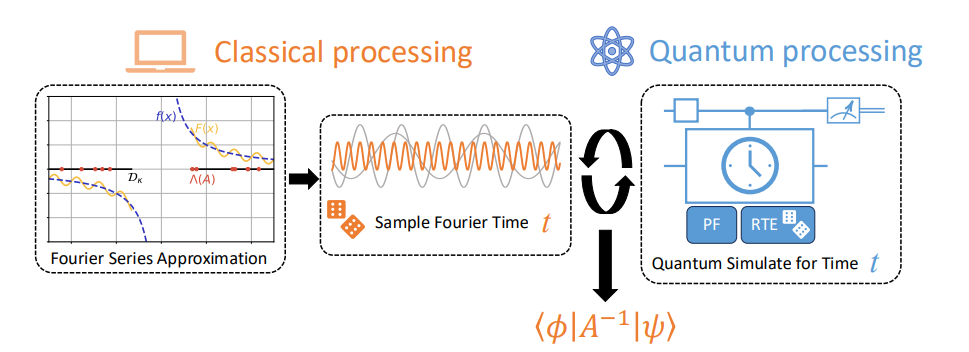
Scientists have developed a new framework for estimating properties of a matrix inverse, combining Fourier series sampling with Hamiltonian simulation to address challenges in quantum linear algebra. The method begins by constructing a highly accurate Fourier series approximation using classical computation, preparing the data for subsequent quantum processing. This classical step determines optimal sampling times, ensuring the accuracy of the final result. The quantum processing stage utilizes a minimal number of qubits to measure the expectation value for each sample, allowing for statistical averaging across multiple samples to converge towards an accurate estimation of the desired property. The team rigorously analyzed the algorithmic parameters controlling total error, deriving explicit bounds to ensure reliability and enable fair comparisons to alternative algorithms. Despite a potential limitation, exponential growth in sampling complexity, the detailed analysis of resource requirements and error bounds provides valuable insights for designing efficient quantum algorithms and evaluating their performance on near-term quantum computers, highlighting the importance of balancing algorithmic complexity with practical implementation constraints.
Logarithmic Qubit Complexity For Linear Systems
Scientists have created a randomized quantum algorithm for estimating properties of matrix functions, focusing on solving quantum linear systems. Building upon previous research, this work provides explicit bounds on all relevant algorithmic parameters, enabling a detailed analysis of end-to-end resource requirements. The method utilizes a Fourier series approximation combined with Hamiltonian simulation, achieving minimal qubit complexity for problems of a given dimension, requiring only a single ancilla qubit. Experiments demonstrate that the accuracy of the Fourier series approximation is crucial for overall performance.
Researchers derived explicit bounds controlling total error, allowing for precise evaluation of the method’s reliability. The team analyzed two kernels for Hamiltonian simulation, a second-order product formula and random Taylor expansion, assessing their impact on computational efficiency. While the algorithm offers reduced circuit complexity for each sample, the total number of samples required to achieve a certain precision can become substantial. Measurements confirm that the method’s performance is sensitive to the accuracy of the initial Fourier series construction, highlighting the importance of efficient classical pre-processing, and bridging the gap between theoretical proposals and efficient hardware implementations.
Randomized Algorithms, Sampling Complexity, and Quantum Cost
This work presents a rigorous analysis of randomized algorithms designed to solve linear systems, focusing on their practical resource requirements for early-stage fault-tolerant quantum computing. Researchers developed explicit bounds on the error associated with estimating properties of a matrix inverse using a method that combines sampling from a Fourier series with Hamiltonian simulation. The team investigated two approaches to Hamiltonian simulation, a second-order product formula and random Taylor expansion, to determine their impact on overall computational cost. The results demonstrate that while theoretically promising, the randomized Fourier series-based approach can suffer from exponential growth in sampling complexity, raising questions about its practicality for solving linear systems.
By establishing clear bounds on algorithmic parameters, this research bridges the gap between theoretical proposals and the demands of efficient hardware implementation, allowing for fair comparisons with alternative algorithms. Future work could explore strategies to mitigate the exponential growth in sampling complexity, potentially through adaptive sampling techniques or improved methods for approximating the inverse function. This research provides a valuable contribution to the field by offering a detailed assessment of the trade-offs involved in using randomized algorithms for linear systems, and by highlighting the challenges that must be addressed to realize their full potential in quantum computing.
🗞 Are Randomized Quantum Linear Systems Solvers Practical?
🧠 ArXiv: https://arxiv.org/abs/2510.13766