Charge disorder within nanoscale semiconductor structures presents a major challenge to building reliable quantum technologies, causing unpredictable variations in the behaviour of individual quantum bits. Saeed Samadi, Łukasz Cywiński, and Jan A. Krzywda, from the Institute of Physics, Polish Academy of Sciences, and Leiden University, investigate the statistical nature of this disorder in silicon-silicon-germanium quantum dots. Their work demonstrates that these fluctuations are not random, but exhibit significant correlations, meaning that changes in one property of a dot predictably affect others. By generating a large dataset using computer modelling and applying advanced statistical analysis, the team reveals the dominant patterns through which disorder influences device characteristics, offering a pathway to improve the design and performance of future spin qubit devices and enhance their operational yield by systematically addressing electrostatic disorder.
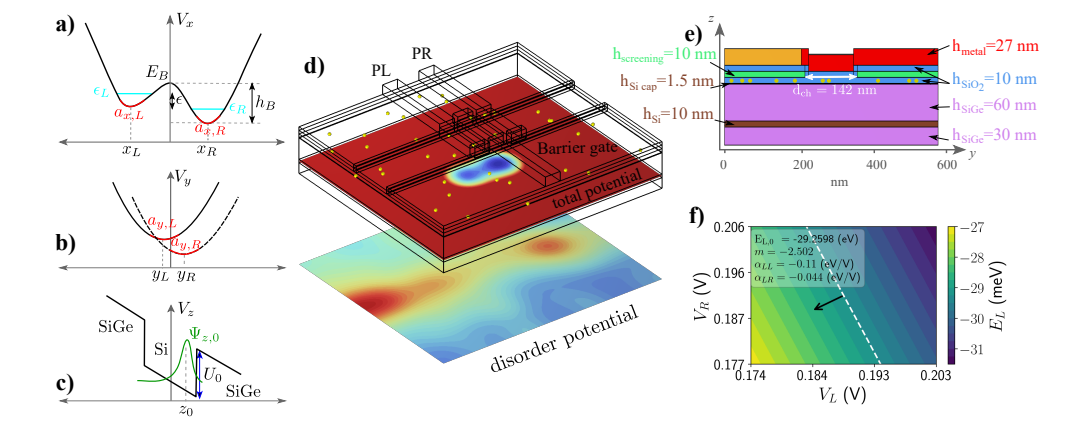
The source of variability lies in charge disorder at the semiconductor-oxide interface, causing unpredictable, yet correlated, fluctuations in essential quantum dot properties like their mutual tunnel couplings and electronic confinement energies. This study presents a systematic approach to characterise and mitigate these effects. Researchers utilise finite element modelling of a Si/SiGe double quantum dot to generate a large statistical ensemble of devices, simulating the impact of trapped interface charges. This work results in a predictive statistical model capable of generating realistic data for training machine learning algorithms designed to optimise qubit performance.
Silicon Quantum Dot Qubit Fabrication and Growth
This research project focuses on silicon-based quantum dots for use as qubits, with a strong emphasis on material science and device engineering. Key themes include achieving high material quality, controlling valley splitting, understanding decoherence mechanisms, and developing techniques for qubit control and manipulation. A significant portion of the work focuses on the growth of silicon and silicon-germanium heterostructures, emphasising the need for material purity, isotope enrichment, precise strain engineering, and layer control to enhance qubit coherence. Controlling valley splitting, the energy difference between different valleys in the silicon conduction band, is vital for qubit manipulation and achieving long coherence times.
The research also investigates factors limiting qubit coherence and explores ways to minimise charge noise, hyperfine interactions, and other sources of decoherence. References cover techniques for controlling and manipulating the qubit state using electric and magnetic fields, and potentially spin-orbit interactions, alongside the design and fabrication of double quantum dots and more complex architectures. A substantial number of references involve computational modelling and simulation of quantum dot behaviour, including material properties, electron transport, and decoherence mechanisms. The use of automated control systems and advanced characterisation techniques to optimise quantum dot performance is also present.
The sheer number of references related to material growth and characterisation highlights the critical importance of achieving high-quality Si/SiGe heterostructures for qubit coherence. Addressing decoherence is paramount, and computational modelling is heavily used to guide experimental efforts. The inclusion of references on machine learning and automation suggests a move towards more sophisticated control and optimisation of quantum dot devices. Many of the references are recent, indicating an active and rapidly evolving field of research. In conclusion, this bibliography represents a comprehensive overview of the current state of research on silicon-based quantum dots for quantum computing, demonstrating a strong focus on material quality, valley splitting control, decoherence mitigation, and the use of advanced simulation and automation techniques.
Predicting Qubit Variability with Interface Charge Models
Researchers have achieved a significant breakthrough in understanding and mitigating variability in silicon-based quantum dot qubits, a promising platform for scalable quantum computing. By employing finite element modelling of a Si/SiGe double quantum dot, scientists generated a large statistical ensemble of devices, simulating the impact of trapped charges at the semiconductor-oxide interface. This approach resulted in a predictive statistical model capable of generating realistic data for training machine learning algorithms designed to optimise qubit performance. The study meticulously quantified the statistical distribution of several critical parameters, including interdot tunnel coupling, interdot distance, and interdot barrier height.
Measurements reveal strong correlations between these parameters, notably a robust quantitative relationship between interdot distance and tunnel coupling. Researchers also characterised orbital energies, confinement lengths within the dots, and disorder-induced electric fields, providing a comprehensive picture of how interface charges affect qubit behaviour. Beyond simply measuring variations, the team uncovered the underlying “modes” of disorder using Principal Component Analysis. This analysis demonstrates that parameter fluctuations are not random, but concentrated along a few principal axes, indicating significant correlations between many device properties.
For example, a strong correlation exists between interdot distance and barrier height. This discovery allows for more effective control and optimisation of qubit devices, paving the way for enhanced controllability and improved operational yield in future quantum computing architectures. The research provides a framework for systematically addressing electrostatic disorder and improving the reliability of silicon-based quantum dot qubits.
Disorder Correlates Key Qubit Parameters
This research presents a comprehensive investigation into the effects of electrostatic disorder on silicon-germanium double quantum dots, structures crucial for developing spin qubits. Scientists generated a large statistical ensemble of double dot devices using detailed computer modelling, simulating the impact of trapped charges at the material interface. Analysis of this data reveals that variations in key qubit parameters, such as tunnel coupling and confinement energies, are not random but exhibit significant correlations with each other, particularly between interdot distance and barrier height. The team employed Principal Component Analysis to identify the dominant modes through which disorder influences device properties, demonstrating that the parameter space is concentrated along a few principal axes.
This finding suggests that controlling a limited number of parameters can effectively address the impact of disorder, enhancing the reliability and yield of qubit devices. While the study focused on electrostatic disorder, the authors acknowledge that other sources of variability, such as atomic-scale imperfections, also contribute to overall device performance. Future work could explore the interplay between these different sources of disorder and develop strategies for mitigating their combined effects, ultimately paving the way for more robust and scalable quantum technologies.
🗞 Statistical Structure of Charge Disorder in Si/SiGe Quantum Dots
🧠 ArXiv: https://arxiv.org/abs/2510.13578



See today’s quantum computing news on Quantum Zeitgeist for the latest breakthroughs in qubits, hardware, algorithms, and industry deals.