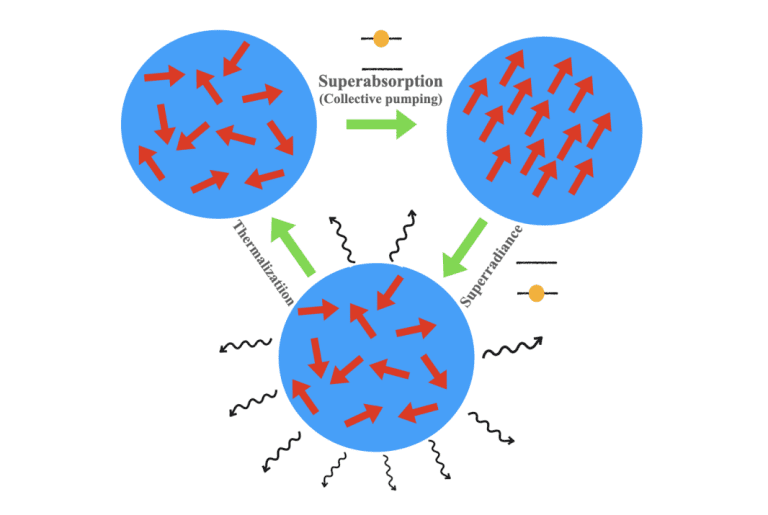
The pursuit of highly efficient heat engines receives a significant boost from new research into the collective behaviour of atoms, demonstrating a pathway towards near-unity efficiency. L. F. Alves da Silva, from the Instituto de Física de São Carlos, Universidade de São Paulo, alongside H. Sanchez, M. A. Ponte, M. H. Y. Moussa, and Norton G. de Almeida from the Instituto de Física, Universidade Federal de Goiás, present a thermal engine that harnesses the principles of cooperative superradiance and superabsorption within a system of two-level atoms. This innovative engine operates with a single cold reservoir, utilising cycles of collective pumping and subsequent decay, and achieves a power output that scales quadratically with the system’s size. The team’s analytical model, validated through numerical simulations, reveals a figure of merit indicating that this ‘superengine’ can approach unprecedented levels of efficiency, potentially paving the way for scalable and highly effective heat engines based on collective atomic phenomena.
This engine functions with a single cold reservoir through cycles of collective pumping followed by decay. Employing an effective mean-field Hamiltonian to describe the collective behaviour, the researchers designed optimised drive pulses that preserve adiabaticity and achieve a power output scaling quadratically with system size, expressed as P ∝ N². An experimentally measurable figure of merit demonstrates that the efficiency of this superengine can approach unity. The resulting analytical model, validated by numerical simulations, yields a representative Hamiltonian for the sample within the mean-field formalism.
Coherent Emission From Atomic Ensembles Explored
This collection of research papers comprehensively explores superradiance and Dicke superradiance, outlining core concepts, experimental realisations, theoretical frameworks, and potential applications. The foundational work by Dicke describes the collective emission of photons from an ensemble of atoms, leading to a significantly enhanced emission rate. Papers highlight the difference between ordinary spontaneous emission and superradiance, where the emission is coherent and directed, resulting in a much stronger signal. Collective operators simplify the description of the system, highlighting the collective nature of the emission. Achieving the strong coupling regime, where the interaction between the atoms and the electromagnetic field exceeds dissipation rates, is emphasised.
Superradiance is being explored for applications in quantum information processing, including quantum gates and memories, and as a resource for quantum repeaters. It also holds promise for new laser technologies, highly sensitive sensors, and brighter, more efficient light sources. Key themes include Dicke narrowing, non-classical light emission, topological superradiance, and hybrid systems combining different emitters. This research provides a platform for studying many-body physics and collective phenomena, with further exploration focusing on scalability, minimising decoherence, controlling and manipulating the emission, integrating with other quantum technologies, and investigating novel materials and systems.
Superradiant Thermal Engine Scales Quadratically with Atoms
Scientists have developed a novel thermal engine that harnesses the cooperative superradiance and superabsorption of a collection of two-level atoms, achieving performance characteristics previously unattainable. This work demonstrates a scalable engine where the power output scales quadratically with the number of atoms, N, represented as P ∝ N². The engine operates via cycles of collective pumping and decay, utilising a single cold reservoir to drive the process. Researchers designed optimised drive pulses that maintain adiabaticity, crucial for efficient energy transfer, and validated the resulting analytical model through detailed numerical simulations.
The team developed an effective mean-field Hamiltonian to describe the collective dynamics, simplifying the complex problem of superradiance into a manageable model of a single atom interacting with a self-consistent mean field. This Hamiltonian accurately captures key transient features, including the delay time and peak intensity of the superradiant pulse. The engine achieves this high efficiency through a process where both superradiance and superabsorption are integral parts of the unitary expansion and compression strokes, allowing for maximized energy extraction. Researchers precisely characterised the pulse shape, demonstrating a sech² profile with a peak intensity directly proportional to the square of the atomic number. This breakthrough delivers a pathway toward highly efficient and scalable quantum heat engines based on collective effects, opening new possibilities for energy conversion and thermal management.
Cooperative Superradiance Powers Quantum Engine Cycle
This work demonstrates a novel quantum engine cycle that harnesses cooperative superabsorption and superradiance to generate power. Researchers designed a cycle exploiting collective atomic behaviour, achieving a power output that scales quadratically with the number of atoms involved. By mapping the complex many-body interactions onto a simplified mean-field Hamiltonian, the team numerically confirmed the engine’s potential to operate with efficiencies approaching unity. Importantly, the cycle exhibited robust performance under repeated operation, rapidly converging to a stable and predictable output. The engine’s design leverages the unique properties of cooperative superabsorption and superradiance, allowing for efficient energy conversion. Through detailed modelling, scientists established that the engine’s performance is not limited by atom number, paving the way for scalable and highly efficient heat engines.
🗞 Superradiance and Superabsorption Engine of Two-Level Systems: -Power Scaling at Near-Unity Efficiency
🧠 ArXiv: https://arxiv.org/abs/2510.12017


See today’s quantum computing news on Quantum Zeitgeist for the latest breakthroughs in qubits, hardware, algorithms, and industry deals.