

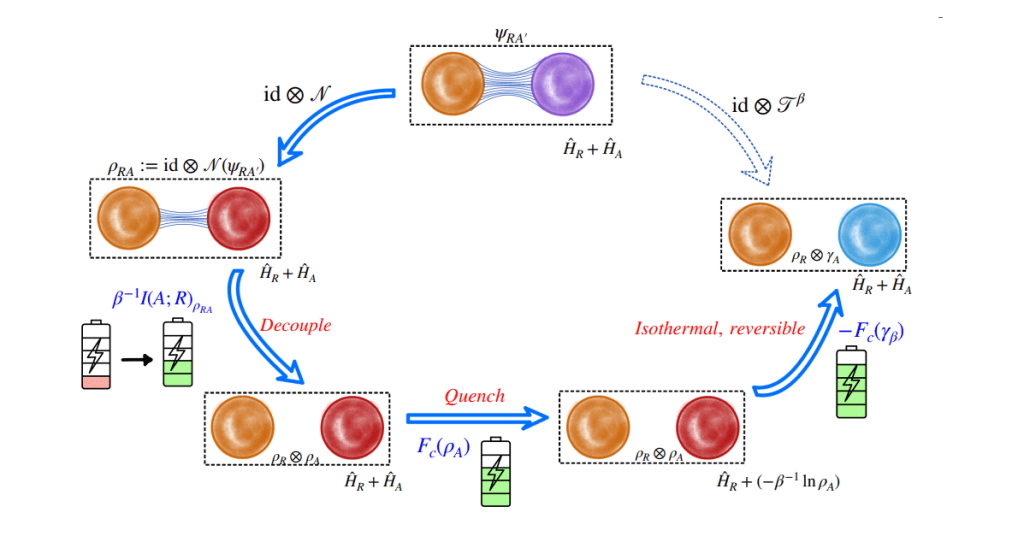
The fundamental laws governing energy transfer and efficiency in quantum systems remain a central challenge in physics, and recent work by Himanshu Badhani, Dhanuja G S, and Siddhartha Das from the International Institute of Information Technology, Hyderabad, offers a significant step forward. The team establishes a new framework for understanding the thermodynamics of quantum processes, introducing a definition of free energy directly linked to a system’s ability to perform tasks. This research demonstrates that free energy governs both the distillation of valuable quantum states and the potential for extracting work, revealing a deep connection between a process’s inherent energy characteristics and its practical capabilities. By precisely characterizing these relationships, the scientists prove the asymptotic reversibility of athermality, a measure of deviation from thermal equilibrium, and establish a powerful new tool for optimising quantum technologies.
This free energy is defined using quantum relative entropy, comparing the channel to a perfectly thermal channel in equilibrium with a thermal reservoir. The definition is supported by its practical applications in quantum information processing and thermodynamic tasks, establishing a strong link between energy, entropy, and information handling capabilities.
Quantum Information, Entropy and Communication Limits
This extensive collection of papers demonstrates significant research focused on the foundations of quantum information theory. Studies cover entropy measures, channel capacities, and the limits of quantum communication, providing a comprehensive understanding of information processing at the quantum level. A substantial body of work also explores quantum thermodynamics, investigating the relationship between information, entropy, work, and heat in quantum systems, including the energetic cost of erasing information. Researchers have extensively investigated non-Markovian dynamics and quantum memory, examining how memory effects influence information processing.
They have also focused on channel discrimination and comparison, developing methods to distinguish between quantum channels and quantify their differences. Operational resource theories are central to this research, treating quantum resources like entanglement and coherence as quantifiable and manipulable entities. Establishing rigorous mathematical bounds and relationships between different entropy measures is also a key focus. This research encompasses several key areas, including foundational quantum information theory, quantum thermodynamics, non-Markovianity, operational resource theories, channel discrimination, and mathematical foundations.
Studies have explored the limits of sending entanglement through noisy channels, the capacity of quantum channels, and the comparison of these channels using advanced mathematical tools. Researchers have also investigated the energy cost of erasing information and the role of entropy production in nonequilibrium systems. Several papers focus on quantifying and characterizing non-Markovianity, exploring its impact on quantum speed limits and coherence. Studies have also investigated the connection between non-Markovianity and ergotropy, a measure of useful work. Researchers have developed resource theories for quantum resources, explored hypothesis testing, and investigated the operational aspects of quantum channels.
They have also established connections between quantum secret key distillation and channel discrimination. This body of work suggests several active research areas, including bridging quantum information and thermodynamics, characterizing and utilizing non-Markovianity, developing robust quantum communication protocols, and establishing fundamental limits of quantum information processing. Researchers are actively exploring resource theories for quantum technologies, aiming to develop a unified framework for quantifying and manipulating quantum resources. This comprehensive research represents a significant contribution to the field, providing a strong foundation for future advancements in quantum technologies.
Quantum Channel Free Energy and Resource Theory
Scientists have extended the concept of free energy, traditionally used in thermodynamics, to encompass quantum processes and channels. This allows for a detailed analysis of the energetic properties of these channels. Researchers defined this generalized free energy using quantum relative entropy, comparing the channel to a perfectly thermal channel in equilibrium with a thermal reservoir. The team demonstrates that this free energy has a clear operational meaning within quantum information processing and thermodynamic tasks, establishing a rigorous link between energy, entropy, and information handling capabilities.
Measurements confirm that the resource-theoretic generalized free energy of a quantum channel is defined by the inverse temperature multiplied by the channel’s divergence from a thermal channel. The research establishes a direct relationship between elementary thermodynamic quantities, free energy, energy, and entropy, and operational quantities like extractable work, shedding light on the thermodynamics of quantum processes. Specifically, the team quantified the resource of athermality, identifying the thermal channel as a free object within their framework. Researchers proved that the free energy of a quantum channel is minimized only when it is a unitary channel, and this minimum is achieved under specific conditions.
They further defined golden units within this resource theory as resource channels, demonstrating equivalence between all unitary resource channels. Crucially, the distillation and formation rates of a quantum resource channel are precisely quantified, establishing a direct connection between the resource-theoretic free energy and its processing capabilities. Experiments reveal that the asymptotic distillation and formation rates of a quantum resource channel are equal to a specific function of the channel’s divergence, establishing a direct connection between the resource-theoretic free energy and its processing capabilities. The team’s results demonstrate that the asymptotic rates are directly proportional to the resource-theoretic free energy, providing an exact operational interpretation for the free energy of a quantum channel and solidifying the connection between quantum information theory and foundational thermodynamic principles.
Quantum Channel Free Energy and Athermality
This work establishes a foundational connection between thermodynamics and quantum information processing by introducing a rigorous definition of free energy for quantum channels. Researchers axiomatically defined this free energy using relative entropy with respect to a thermal channel, demonstrating its validity through operational interpretations in key tasks. The team constructed a quantifiable resource of athermality, characterizing the distillation and formation of channels using hypothesis testing and max-relative entropy, and proving that these rates converge to the channel free energy. These findings reveal a direct relationship between athermality and tasks such as private randomness and purity distillation, as well as thermodynamic processes like erasure and work extraction. Importantly, the research connects core thermodynamic concepts, free energy, energy, entropy, and maximal extractable work, to the processing capabilities of quantum channels, establishing a framework for understanding how quantum systems can be utilized for thermodynamic tasks.
🗞 Thermodynamics of quantum processes: An operational framework for free energy and reversible athermality
🧠 ArXiv: https://arxiv.org/abs/2510.12790



See today’s quantum computing news on Quantum Zeitgeist for the latest breakthroughs in qubits, hardware, algorithms, and industry deals.



