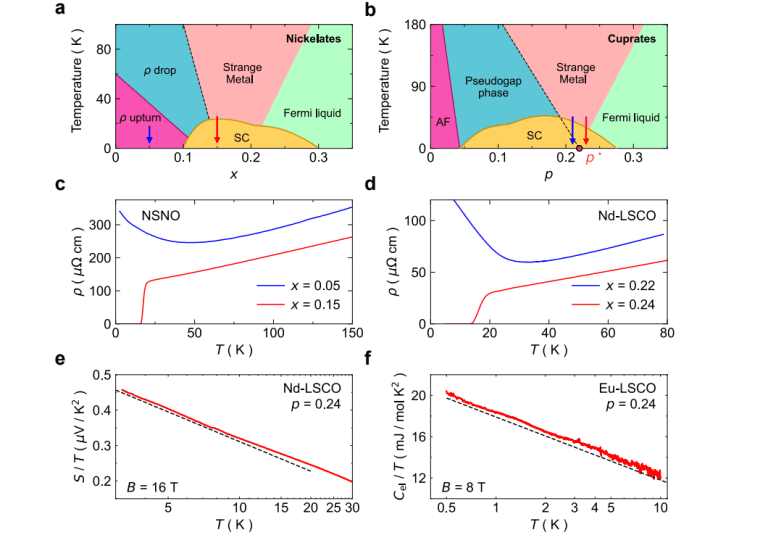
The search for the origins of high-temperature superconductivity drives investigations into materials exhibiting strange metallic behaviour, and a key question concerns the link between this behaviour and underlying critical phenomena. C. Iorio-Duval, E. Beauchesne-Blanchet, F. Perreault, and colleagues, including J. L. Santana González from Laboratoire des Solides Irradiés, alongside W. Sun and Y. F. Nie, now present compelling evidence for a critical point terminating a pseudogap-like phase in superconducting infinite-layer nickelates. Their work establishes a clear signature of criticality through measurements of the Seebeck coefficient, revealing a logarithmic divergence at the onset of linear resistivity, and demonstrates a collapse of carrier density without magnetic ordering, mirroring observations in cuprate superconductors. This achievement unifies the understanding of correlated superconductors, suggesting that strange metal behaviour consistently arises from proximity to a critical point, and provides a new platform for exploring the fundamental mechanisms behind high-temperature superconductivity.
Nickelate Superconductivity, A Cuprate Analogue
This research investigates infinite-layer nickelates, materials sharing striking similarities with high-temperature cuprate superconductors. Scientists are exploring whether these nickelates can provide a new platform to understand the fundamental physics governing unconventional superconductivity, focusing on their electronic structure, magnetic properties, and phase diagrams. Like cuprates, NdNiO2 exhibits a reconstruction of its Fermi surface and changes in carrier density with doping, suggesting similar underlying mechanisms. Researchers carefully tune the material’s properties through doping, observing the emergence of a pseudogap phase, a region where electronic density of states is suppressed, potentially preceding superconductivity.
They are exploring whether this pseudogap is connected to quantum critical behavior, a state tuned to a quantum phase transition, and investigating the interplay between magnetism and superconductivity. The observed changes in Hall number and Fermi surface reconstruction are linked to transitions involving changes in the volume occupied by electrons, a concept central to understanding cuprate superconductors. Understanding the interplay between magnetism and superconductivity and the impact of material imperfections are key areas of focus. This research aims to create a material that mimics the key features of high-temperature superconductors, but is potentially easier to study and manipulate, offering a new avenue for exploring the fundamental physics of unconventional superconductivity.
Quantum Criticality in Infinite-Layer Nickelates
Scientists have identified a critical point at the end of a pseudogap-like phase in infinite-layer nickelates, strengthening our understanding of correlated superconductors and their strange-metal behavior. The research team measured the Seebeck coefficient in La1−xSrxNiO2, discovering a logarithmic divergence coinciding with the onset of linear resistivity, a hallmark of quantum criticality. Experiments revealed that the high-temperature Seebeck coefficient is directly linked to the particle-hole asymmetry of the electronic bands, confirmed by Boltzmann transport calculations based on angle-resolved photoemission spectroscopy data. These calculations accurately reproduce the observed temperature dependence and sign of the Seebeck coefficient, demonstrating that the effective mass of electrons at the Fermi level is threefold higher than initially predicted. This transition occurs without the emergence of long-range magnetic order, further solidifying the connection between infinite-layer nickelates and the universal pattern of unconventional superconductivity.
Logarithmic Divergence Links Quantum Criticality and Metals
This research establishes a critical point at the end of a pseudogap-like phase in infinite-layer nickelates, thereby strengthening the broader understanding of correlated superconductors and their strange-metal behavior. Scientists demonstrated a logarithmic divergence in the Seebeck coefficient coinciding with the onset of linear resistivity, reinforcing the link between quantum criticality and this unusual metallic state, a connection previously observed in diverse materials including heavy fermion systems and cuprates. Through analysis of Hall data and a two-band model, the team revealed that the strongly correlated d-band exhibits linear temperature-dependent scattering, while a separate s-band behaves more conventionally. This dichotomy mirrors observations in cuprates, where similar distinctions exist between electronic behavior in different parts of the material.
🗞 Quantum criticality at the end of a pseudogap phase in superconducting infinite-layer nickelates
🧠 ArXiv: https://arxiv.org/abs/2510.12786