The behaviour of light and matter in non-Hermitian systems, where energy is not necessarily conserved, continues to reveal surprising phenomena, and recent work explores how these systems exhibit unusual localization patterns. Zhao-Fan Cai and Tao Liu, both from South China University of Technology, alongside their colleagues, now demonstrate a new pathway to observe these effects within conventional, energy-conserving systems. They achieve this by incorporating quantum squeezing into a two-dimensional model, effectively mimicking non-Hermitian behaviour without relying on external energy sources. This research establishes a framework for creating and controlling higher-dimensional non-Hermitian physics in platforms like superconducting circuits and photonic lattices, and importantly, reveals an extraordinary sensitivity to even the smallest impurities, potentially amplifying signals through the careful application of quantum squeezing.
Quantum squeezing, a technique manipulating quantum fluctuations, induces unique algebraic properties in quantum systems, leading to a novel form of localization and enhanced spectral sensitivity. Researchers demonstrate that in a two-dimensional system, quantum squeezing causes eigenstates to confine according to a power law, resulting in ultra-high sensitivity to changes in the frequency of incident radiation. This discovery reveals a new pathway for controlling and enhancing light-matter interactions, with potential applications in sensing and optical devices.
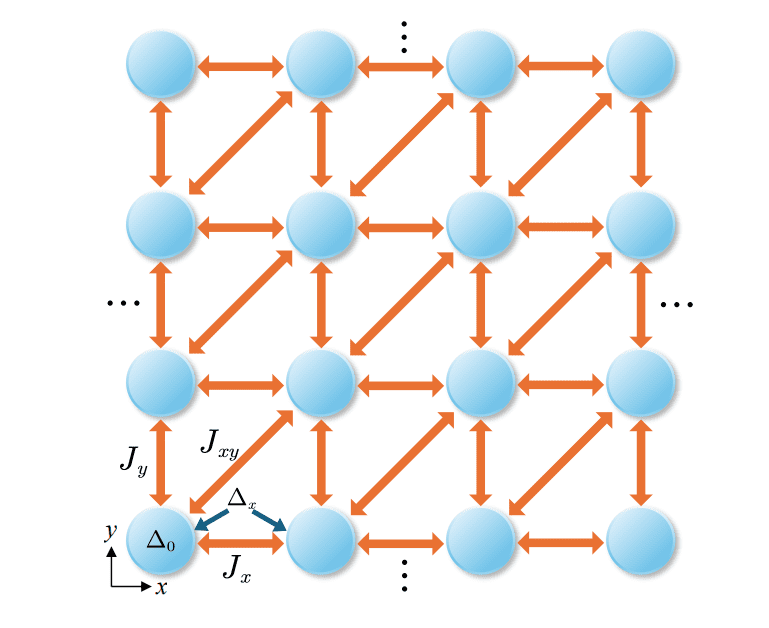
The team extends these concepts to Hermitian bosonic quantum systems, offering a genuine quantum framework to explore non-Hermitian phenomena without external reservoirs. By constructing a two-dimensional bosonic lattice model with two-mode squeezing, they study the spectral properties of bosonic excitations. The results demonstrate an algebraic non-Hermitian skin effect, characterized by quasi-long-range power-law localization of complex eigenstates. The system exhibits ultra-spectral sensitivity to pairs of infinitesimal on-site and long-range hopping impurities, while remaining insensitive to single impurities.
Non-Hermitian Topology in Quantum Systems
Recent research extensively explores non-Hermitian physics and topological physics, particularly their intersection with quantum optics and mechanical systems. This work focuses on understanding how systems deviate from traditional quantum behavior when energy is not conserved, and how these deviations can lead to novel phenomena. A central theme involves the breakdown of conventional Bloch’s theorem in non-Hermitian systems, leading to the emergence of skin effects where quantum states localize at the boundaries of the system. Researchers investigate topological invariants, which characterize the fundamental properties of these systems, and how they differ from their Hermitian counterparts.
They also explore the impact of long-range interactions on non-Hermitian skin modes, revealing how these interactions can modify the localization behavior. Symmetry plays a crucial role, with studies examining how symmetries, or the lack thereof, influence the emergence of topological phases in non-Hermitian systems. A significant portion of this research focuses on driven-dissipative systems, where both driving forces and dissipation are present. These systems are crucial for realizing non-Hermitian effects in experiments, as they allow researchers to engineer systems that deviate from traditional equilibrium behavior.
Researchers explore how to derive effective non-Hermitian Hamiltonians from more complex, Hermitian systems, enabling the application of non-Hermitian physics to a wider range of physical systems. Quantum squeezing and amplification are employed to enhance non-Hermitian effects and realize novel quantum phenomena. The goal of realizing topological edge modes in driven-dissipative systems and using them for amplification of quantum signals is a key focus. Several experimental platforms are being utilized, including optomechanical systems, superconducting circuits, nanophotonic devices, and mechanical resonators.
These platforms allow researchers to create and control quantum systems with the precision needed to observe and manipulate non-Hermitian effects. Research also extends to condensed matter systems, exploring the application of non-Hermitian concepts to magnonic crystals and many-body localization phenomena, as well as topological insulators and superconductors. Theoretical tools such as the Bogoliubov-de Gennes equation and effective field theories are employed to analyze these systems. A systematic classification of topological phases in non-Hermitian systems is also being developed. Current trends highlight the importance of bridging theory and experiment, with quantum optics and optomechanical systems emerging as leading platforms for exploring non-Hermitian physics. Amplification and sensing are promising applications, and the ability to engineer non-Hermitian Hamiltonians in driven-dissipative systems is crucial for experimental progress. Exploiting topological protection to create robust quantum devices remains a key objective.
Impurity Sensitivity and Nonlocal Bound States
Researchers demonstrate a remarkable sensitivity to impurities within Hermitian bosonic quantum systems, achieved by constructing a two-dimensional bosonic lattice model incorporating quantum squeezing. The team reveals that bosonic excitations exhibit quasi-long-range power-law localization of complex eigenstates, a departure from the exponential localization observed in one-dimensional systems. This system proves insensitive to individual, infinitesimal impurities, yet displays pronounced spectral sensitivity when confronted with pairs of such impurities or long-range hopping imperfections. The underlying mechanism for this ultra-spectral sensitivity stems from the formation of nonlocal bound states between impurities, leading to a divergence in the associated nonlocal Green’s function. This discovery establishes a foundation for exploring exotic non-Hermitian phenomena within readily accessible Hermitian quantum systems, potentially realized using platforms like superconducting circuits, photonic lattices, and optomechanical arrays. Furthermore, the demonstrated sensitivity could pave the way for novel applications in quantum sensing and amplification, leveraging bosonic squeezing as a key physical resource.
🗞 Quantum-Squeezing-Induced Algebraic Non-Hermitian Skin Effects and Ultra Spectral Sensitivity
🧠 ArXiv: https://arxiv.org/abs/2510.10632
See today’s quantum computing news on Quantum Zeitgeist for the latest breakthroughs in qubits, hardware, algorithms, and industry deals.