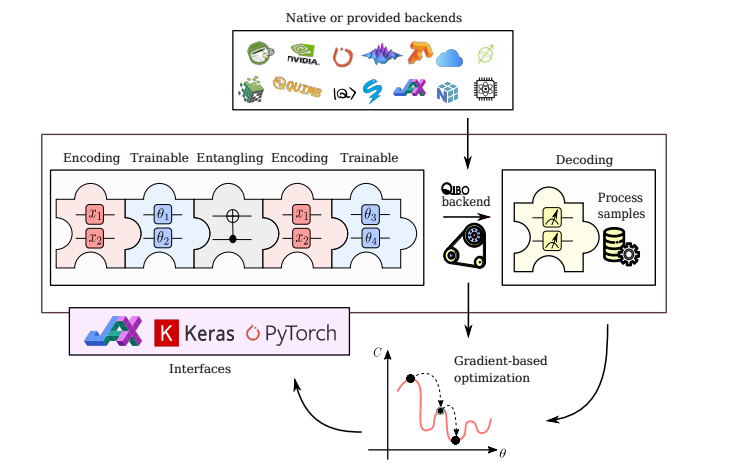
The increasing potential of quantum computing promises to revolutionise machine learning, but realising this requires seamless integration with existing classical infrastructure. Matteo Robbiati, Andrea Papaluca, and Andrea Pasquale, from the Dipartimento di Fisica at the Università degli Studi di Milano, along with colleagues including Renato M. S. Farias and Alejandro Sopena from CERN, address this challenge with Qiboml, a new open-source software library. Qiboml orchestrates the interplay between quantum and classical components, building upon the capabilities of Qibo and integrating with widely used frameworks like TensorFlow and PyTorch. This allows researchers to construct and run hybrid quantum-classical models across diverse computing platforms, from standard CPUs and GPUs to specialised quantum processing units, ultimately accelerating the development and deployment of quantum-enhanced machine learning algorithms.
Qiboml, A Hybrid Quantum-Classical Workflow Library
Qiboml is a new open-source software library that simplifies the combination of quantum and classical computing in machine learning workflows. It addresses the challenge of integrating diverse quantum and classical resources, allowing researchers to focus on algorithm development rather than complex infrastructure management. Qiboml provides a unified interface for accessing various quantum backends, including simulators and actual quantum hardware, and works seamlessly with established classical machine learning frameworks. This accelerates the prototyping and evaluation of hybrid quantum-classical algorithms for a wide range of applications.
The library’s modular design enables users to easily extend its functionality with new components. It incorporates a flexible data handling system, supporting various data formats and enabling efficient data transfer between quantum and classical processors. Furthermore, Qiboml features automated resource management, optimising the allocation of both quantum and classical resources to maximise performance and minimise execution time. The library’s architecture promotes scalability, enabling the development of complex hybrid algorithms that leverage the strengths of both quantum and classical computing paradigms. Qiboml abstracts away the complexities of hybrid system integration, providing a user-friendly platform for experts in both quantum and classical machine learning. It supports a wide range of quantum algorithms, including variational quantum eigensolvers, quantum support vector machines, and quantum neural networks, and offers tools for optimising algorithm parameters and analysing results.
Variational Quantum Algorithms and Neural Networks
Recent research focuses on quantum machine learning, particularly variational quantum algorithms (VQAs) and quantum neural networks (QNNs), and their applications in fields like high-energy physics and condensed matter physics. This work explores methods to improve the efficiency and expressiveness of these algorithms. A central theme is the importance of incorporating symmetries, such as Lorentz symmetry, into QNNs and VQAs. Using equivariant architectures, which transform consistently with the symmetries of the problem, is crucial for improving performance and reducing the number of parameters needed.
Researchers are also combining tensor network methods, a classical technique for representing quantum states, with quantum circuits to improve the efficiency of VQAs and QNNs. Tensor networks can be used for pre-training quantum circuits or for representing the ansatz itself. Applications of these techniques are being explored in several areas, including high-energy physics, condensed matter physics, and quantum chemistry. In high-energy physics, QNNs are being investigated for jet tagging and particle identification. In condensed matter physics, researchers are using these algorithms to find ground states of quantum many-body systems and simulate materials.
Improving the expressibility and trainability of quantum circuits is a key focus, alongside techniques like data re-uploading to enhance circuit performance. Researchers are exploring equivariant quantum neural networks, designing QNNs that respect the symmetries of the problem using equivariant layers. Geometric deep learning techniques, inspired by data on non-Euclidean spaces, are also being applied to QNNs. Pre-training quantum circuits with tensor networks is proving beneficial, and researchers are exploring Lie-equivariant QNNs using representation theory. Quantum attention mechanisms and geodesic transport are being incorporated into QNNs, and quantum diffusion models are being applied to generate quantum states.
Current research focuses on improving the scalability of VQAs, developing more expressive and trainable quantum circuits, and leveraging symmetries to enhance performance. Combining classical and quantum techniques, such as tensor networks and VQAs, is a promising approach. QML has the potential to revolutionise physics by solving problems intractable for classical computers.
Hybrid Quantum-Classical Workflows with Qiboml
This work introduces Qiboml, an open-source software library designed to orchestrate both quantum and classical components within hybrid workflows. Leveraging Qibo’s computational capabilities and integrating with frameworks like TensorFlow and PyTorch, Qiboml enables the construction of hybrid models that can run on diverse backends, including multi-threaded CPUs, GPUs, and processing units available on-premise or through cloud providers. Researchers demonstrated Qiboml’s functionalities through various training setups, including simulations with and without noise, and with real-time error mitigation and calibration. In a one-dimensional regression example, the team aimed to approximate the function f(x) = sin²(x) − 0.
3 cos(x). Four distinct training configurations were tested: exact simulation, simulation with shots, simulation with shots and noise, and simulation with shots, noise, and real-time error mitigation. Results show that real-time error mitigation recovers a good approximation of the target function, demonstrating the effectiveness of the mitigation strategy. Expanding to a multi-qubit example, the researchers investigated Variational Quantum Eigensolvers (VQEs) to approximate the ground state energy of a three-qubit non-interacting Pauli-Z Hamiltonian. The team observed that real-time error mitigation significantly improved the accuracy of the energy approximation, confirming that Qiboml effectively orchestrates quantum and classical resources, and that real-time error mitigation can enhance the quality of results even in the presence of noise and limited measurement shots.
Hybrid Quantum-Classical Machine Learning with Qiboml
Qiboml represents a significant advancement in the field of quantum machine learning, delivering an open-source software library designed to integrate quantum and classical computing components within hybrid workflows.
🗞 Qiboml: towards the orchestration of quantum-classical machine learning
🧠 ArXiv: https://arxiv.org/abs/2510.11773




See today’s quantum computing news on Quantum Zeitgeist for the latest breakthroughs in qubits, hardware, algorithms, and industry deals.