The challenge of building optimal investment portfolios, where selecting the right combination of assets requires navigating countless possibilities, frequently relies on complex mathematical optimisation. Sebastian Schlütter from Mainz University of Applied Sciences, Tomislav Maras and Alexander Dotterweich from PricewaterhouseCoopers GmbH, alongside Nico Piatkowski from LAMARR Institute, Fraunhofer IAIS, present a new method that significantly improves how quantum computers tackle this problem. Their research addresses a key limitation of existing quantum optimisation techniques, which fail to fully utilise information gained from traditional, continuous mathematical solutions. By intelligently narrowing the search space for potential portfolios, the team reduces the computational demands on quantum hardware and achieves demonstrably better results than current state-of-the-art methods, both in software simulations and on a real quantum processor.
integer quantities. Although optimal solutions to the associated smooth problem can be computed efficiently, existing adiabatic quantum optimisation methods cannot leverage this information. Moreover, while various warm-starting strategies have been proposed for gate-based quantum optimisation, none of them explicitly integrate insights from the relaxed continuous solution into the QUBO formulation.
Warm-Starting Improves Quantum Portfolio Optimisation
This research addresses the challenge of constructing optimal investment portfolios, benefiting from the potential speedups offered by quantum computing. Researchers explored the use of quantum annealers, acknowledging the limitations of current quantum hardware, and introduced warm-starting, a technique using classical pre-processing to find a good initial solution for the quantum annealer, helping it converge faster and find better results. The team’s methodology uses classical optimization techniques to identify a promising initial portfolio, serving as the starting point for the quantum annealer and guiding its search for the optimal investment strategy. The portfolio optimization problem is formulated as a Quadratic Unconstrained Binary Optimization (QUBO) problem, suitable for quantum annealers, and performance was evaluated through simulations and experiments on the D-Wave Advantage quantum annealer. Results demonstrate that warm-starting improves the performance of the quantum annealer in solving the portfolio optimization problem, likely due to the reduced search space and faster convergence. The warm-starting approach helps the quantum annealer find better solutions, portfolios with higher returns and/or lower risk, compared to running the quantum annealer without warm-starting, and is expected to be scalable to larger and more complex problems, applicable to a wide range of other optimization problems.
Discrete Search Reduces Qubit Requirements Significantly
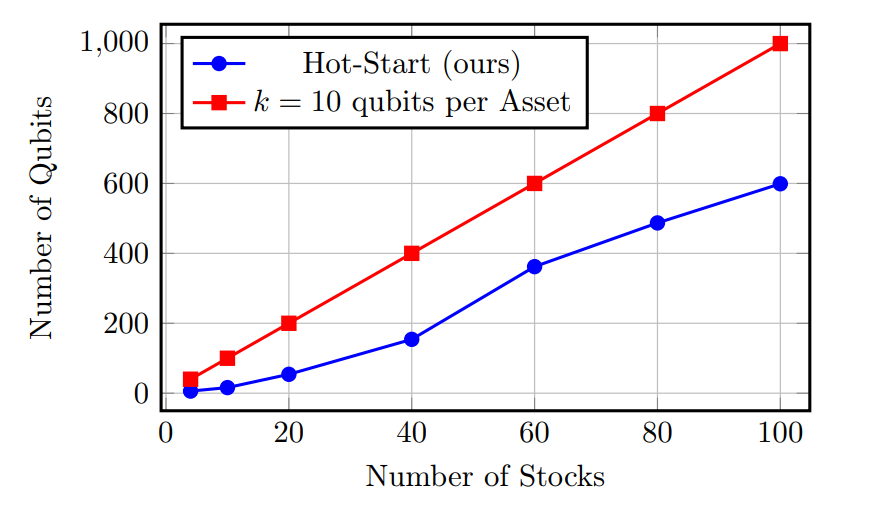
This research presents a new approach to combinatorial optimization, significantly reducing the number of qubits required for solving complex problems, particularly in portfolio optimization. Researchers developed a method that restricts the search space to discrete solutions located near the optimum of a relaxed convex Quadratic Program, constructing a more compact Hilbert space and allowing for tackling larger problem instances with limited quantum hardware. The method focuses the search on a defined neighborhood around a continuous solution, rather than exhaustively exploring all possibilities, dramatically lowering the computational burden and making previously intractable problems solvable. The team conducted experiments using real-world S and P 500 stock market data, evaluating the new formulation on both software solvers and a D-Wave Advantage quantum annealer.
Results confirm the efficacy of the method in reducing the size of the QUBO formulation, a critical step in translating optimization problems into a format suitable for quantum computation. By focusing the search, the researchers achieved a demonstrable improvement in efficiency and scalability, constructing a Hilbert space that endogenously determines relevant investment bands, a significant advancement over existing methods. This allows for a more flexible and accurate representation of the optimization landscape, and the method’s ability to reduce the search space while guaranteeing the inclusion of the optimal solution represents a key breakthrough in quantum optimization techniques.
Continuous Relaxation Guides Quantum Optimization
This research introduces a new method for tackling complex combinatorial optimization problems, particularly those arising in financial portfolio optimization. The team demonstrates that by first solving a relaxed, continuous version of the problem, they can significantly reduce the search space for the discrete solution, ultimately requiring fewer qubits. This is achieved by constructing a new formulation of the Quadratic Unconstrained Binary Optimization problem, incorporating the optimal solution from the continuous relaxation to define relevant investment bands and guide the search process. Experiments conducted using both software solvers and the D-Wave Advantage quantum annealer demonstrate the effectiveness of this approach, showing performance improvements over existing state-of-the-art techniques, and applying this method to real-world stock market data from the S and P 500, further validating its practical potential. The size of the reduced search space depends on the specific problem instance and may require careful tuning. Future work could explore methods for automatically determining the optimal size of this space, and extending the approach to other types of combinatorial optimization problems beyond portfolio optimization.
🗞 Hot-Starting Quantum Portfolio Optimization
🧠 ArXiv: https://arxiv.org/abs/2510.11153
See today’s quantum computing news on Quantum Zeitgeist for the latest breakthroughs in qubits, hardware, algorithms, and industry deals.