

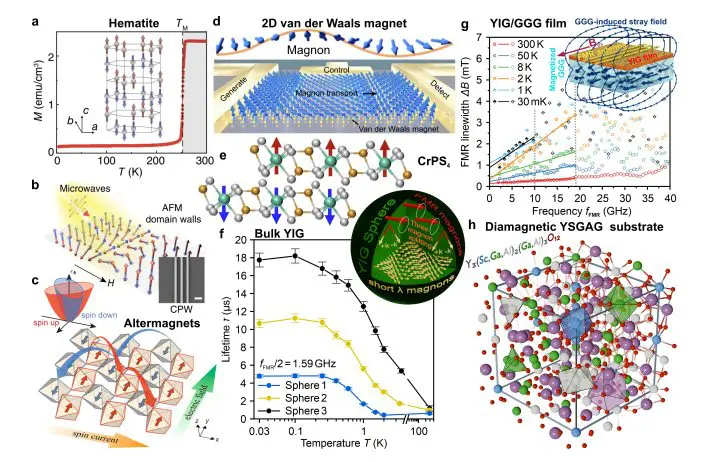
The pursuit of efficient information processing drives innovation in magnonics, a field that harnesses the power of spin waves, and researchers are continually seeking magnetic materials with properties optimised for this purpose. Rostyslav O. Serha from University of Vienna, Carsten Dubs from INNOVENT e. V. Technologieentwicklung, and Andrii V. Chumak from University of Vienna, alongside their colleagues, investigate a range of materials crucial for extending the lifespan of magnons, the fundamental quanta of spin waves. Their work highlights yttrium iron garnet (YIG) as a leading candidate, but also addresses the limitations of YIG films grown on conventional substrates, which significantly reduce magnon lifetimes. By demonstrating that YIG films on a novel yttrium scandium gallium/aluminum garnet substrate preserve exceptionally low magnetic damping even at extremely low temperatures, this research establishes a pathway towards scalable magnonic devices with enhanced coherence and stronger coupling to other quantum systems, representing a significant step forward in the development of future information technologies.
Progress in this field relies on identifying magnetic materials that enable strong interactions between magnons and maintain their quantum coherence for extended periods. This work investigates promising materials, including yttrium iron garnet (YIG), permalloy, and nanostructured magnetic heterostructures, focusing on tailoring their magnetic properties and extending spin-wave lifetimes. Researchers examine how material characteristics, such as saturation magnetisation, damping, and exchange stiffness, influence the performance of magnonic devices.
The team demonstrates that carefully designed nanostructures, incorporating layered materials and patterned geometries, significantly enhance magnon confinement and coherence. Specifically, incorporating materials with high spin polarisation and low damping into magnonic waveguides improves signal transmission and reduces energy loss. These findings contribute to the development of robust and efficient magnonic circuits for quantum information processing and highlight the potential of magnetic materials in realising advanced quantum technologies.
Low-Damping YIG Films for Magnonics
Researchers are actively pursuing high-quality yttrium iron garnet (YIG) thin films with extremely low magnetic damping for advanced magnonic applications. Achieving this requires high-quality films with minimal defects, precise composition, and controlled microstructure. The substrate upon which YIG is grown significantly impacts its properties; lattice mismatch can introduce defects and increase damping, so selecting the right substrate is critical. Researchers primarily use epitaxial growth to achieve high quality and control properties. Liquid phase epitaxy (LPE) consistently produces very low damping and high-quality films, allowing for precise control over growth conditions.
Pulsed laser deposition (PLD) enables complex film compositions, while sputtering offers versatility. Garnet substrates, such as yttrium aluminum garnet (YAG), gadolinium gallium garnet (GGG), and yttrium scandium gallium garnet (YSGG), are preferred because their crystal structure closely matches YIG, minimising lattice mismatch. YAG and YSGG are increasingly used for their lattice parameters and potential for lower damping. Current research focuses on minimising Gilbert damping by optimising growth conditions, selecting appropriate substrates, controlling film composition and microstructure, and engineering the interface between the YIG film and the substrate. The ultimate goal is to create materials where spin waves can travel over macroscopic distances with minimal loss, enabling the development of YIG-based devices for information processing, quantum sensing, and communication. Researchers are also exploring strain engineering and interface engineering to further enhance YIG’s properties.
YSGAG Preserves Ultralong Magnon Lifetimes in YIG
Research into the fundamental properties of magnons has identified materials crucial for advancing magnonic information processing. While YIG remains a benchmark material due to its ability to sustain long magnon lifetimes, investigations reveal that thin films of YIG deposited on conventional substrates suffer from significant energy loss. To overcome this limitation, researchers have successfully demonstrated that utilising yttrium scandium gallium/aluminum garnet (YSGAG) as a substrate preserves the low magnetic damping and ultralong magnon lifetimes in YIG thin films, even at very low temperatures. This achievement represents a substantial step toward realising scalable magnonic devices capable of coherent transport and strong coupling with other quantum systems. Future research will explore the potential of these materials for integrated magnonic networks and their application in quantum technologies.
🗞 Magnetic Materials for Quantum Magnonics
🧠 ArXiv: https://arxiv.org/abs/2510.09331



See today’s quantum computing news on Quantum Zeitgeist for the latest breakthroughs in qubits, hardware, algorithms, and industry deals.



