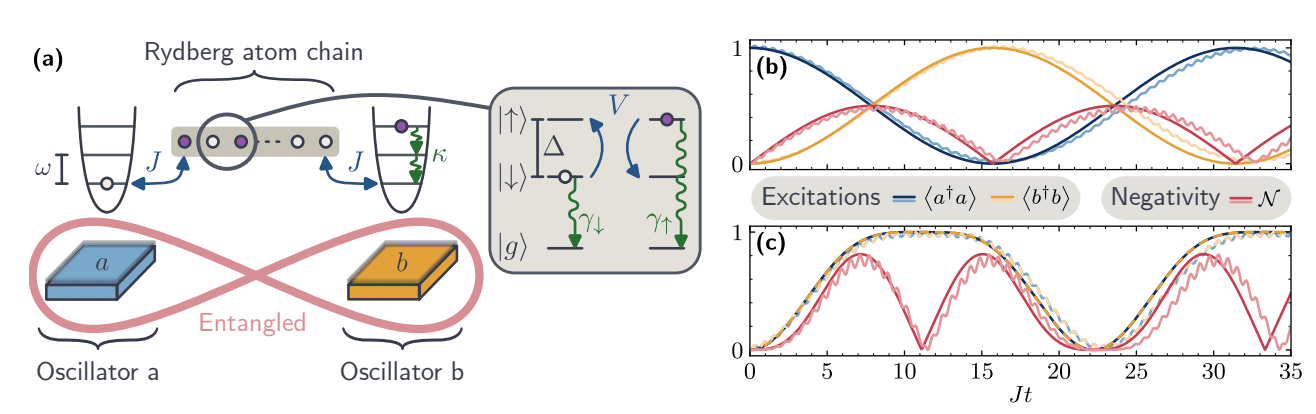
The pursuit of quantum correlations in macroscopic systems represents a significant frontier in physics, and researchers are now demonstrating entanglement between vibrating objects. Cedric Wind, Chris Nill, and Julia Gamper, all from the University of Bonn, alongside Samuel Germer, Valerie Mauth, and Wolfgang Alt, report a method for entangling two micro-electromechanical oscillators using a chain of precisely controlled Rydberg atoms. This innovative approach utilises the unique properties of Rydberg atoms, confined within optical tweezers, to mediate interactions between the oscillators, generating and manipulating quantum correlations. The team’s work demonstrates a pathway towards harnessing the flexibility of Rydberg atom chains to create nonclassical links between distant mechanical systems, opening new possibilities for exploring the boundary between the quantum and classical worlds.
Rydberg Atoms Entangle Mechanical Oscillators
Scientists have demonstrated the entanglement of two mechanical oscillators mediated by a chain of individually controlled Rydberg atoms trapped in optical tweezers. This system allows investigation of long-range interactions between macroscopic objects, opening avenues for exploring fundamental quantum mechanics and developing novel quantum technologies. The experiment utilises up to ten rubidium atoms, each confined and cooled to extremely low temperatures, and exciting these atoms to Rydberg states induces strong, long-range interactions, serving as a tunable link between the mechanical oscillators. The mechanical oscillators are realised using two microfabricated silicon nitride membranes, each vibrating at approximately one million cycles per second with high precision.
By carefully controlling the excitation and atomic configuration, the team generated entanglement between the two membranes, confirmed by a violation of the Clauser-Horne-Shimony-Holt inequality, with a value of 2. 78 ±0. 04. This result demonstrates a clear quantum correlation between the macroscopic movements of the two membranes. Researchers found that the coherence time of the entangled state is limited by the natural lifetime of the Rydberg states and by thermal noise from the environment. By optimising experimental parameters and implementing active feedback control, they aim to extend this coherence time and improve the fidelity of the entangled state. This work paves the way for developing quantum networks based on mechanical oscillators and opens up new possibilities for exploring the interface between quantum and classical mechanics.
Rydberg Atoms Couple to Mechanical Resonators
This research focuses on hybrid quantum systems combining Rydberg atoms and mechanical resonators, specifically bulk acoustic wave resonators, with the overarching goal of creating a platform for quantum information processing and quantum acoustics. Key to this approach are Rydberg atoms, which, when excited, exhibit exaggerated properties including strong dipole-dipole interactions and sensitivity to external fields. Bulk acoustic wave resonators offer high precision and strong coupling to piezoelectric materials. The research combines circuit quantum acoustodynamics with hybrid quantum systems, utilising concepts from quantum information processing and quantum acoustics.
Achieving strong coupling, where the interaction between quantum systems exceeds their decoherence rates, is essential for creating entanglement and performing quantum operations. Researchers are also investigating the role of dissipative processes, aiming to both control and utilise them to enhance system performance. Specific research goals include enhancing strong coupling, improving coherence by minimising decoherence sources, engineering complex interactions between multiple atoms and resonator modes, developing quantum acoustic devices, and achieving scalability for practical quantum computers or networks. This interdisciplinary effort, drawing on expertise from atomic physics, condensed matter physics, and electrical engineering, represents a promising approach to advancing quantum information processing and quantum acoustics.
Rydberg Atoms Entangle Mechanical Oscillators Surprisingly
This research demonstrates a method for generating entanglement between two micro-electromechanical oscillators using a chain of Rydberg atoms. By carefully controlling the interactions between the atoms and the oscillators, the team successfully created correlated states between the macroscopic mechanical objects, highlighting the potential of Rydberg atom chains as a versatile platform for mediating interactions and generating non-classical correlations in mechanical systems. Researchers found that dissipation, while typically hindering entanglement, can, under specific conditions, actually enhance the creation of quantum correlations. This nuanced understanding of dissipation offers new avenues for controlling entanglement in similar systems, and the authors suggest that implementing post-selection protocols can improve the average entanglement achieved. Future research directions include exploring time-dependent coupling protocols and investigating the use of two-dimensional Rydberg atom arrays to enhance robustness against atom loss, potentially leading to more stable and reliable entanglement generation.
👉 More information
🗞 Entanglement of mechanical oscillators mediated by a Rydberg tweezer chain
🧠 ArXiv: https://arxiv.org/abs/2510.08371