

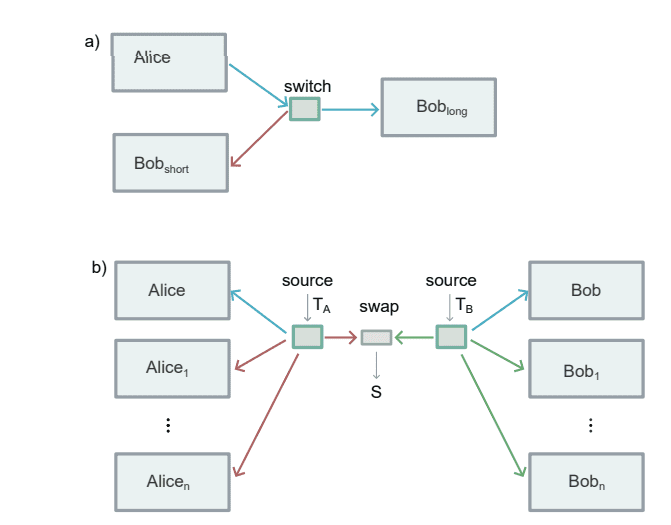
The challenge of secure long-distance communication receives a significant boost from new research into the foundations of cryptography, as Gereon Koßmann, Mario Berta, and René Schwonnek from RWTH Aachen University and Leibniz Universität Hannover demonstrate a pathway to overcome key limitations. Their work addresses a critical vulnerability in device-independent key distribution, where the security of encryption relies on verifying the devices themselves, a process hampered by practical imperfections. The team introduces a refined method using ‘routed Bell tests’ that allows both communicating parties to locally verify their own devices, a crucial step previously lacking in the field. This advancement reveals that, with robust self-testing, the achievable key rate in secure communication protocols improves dramatically, potentially bypassing the limitations imposed by imperfect detection technology and bringing truly secure long-distance communication closer to reality.
Trustless Key Distribution via Device Independence
This research establishes a comprehensive framework for device-independent quantum key distribution (DIQKD), a method for secure communication that eliminates the need to trust the devices used by communicating parties. DIQKD aims to establish a secure key based solely on observed statistics and the fundamental laws of quantum mechanics, relying on Bell tests to verify non-local correlations incompatible with classical explanations. The study presents results advancing DIQKD protocols and security proofs, establishing a general framework linking device statistics to key security and demonstrating that, under specific conditions, a DIQKD protocol can be modeled as a pure quantum state, simplifying analysis. A security proof based on conditional entropy shows that a secure key can be extracted if the conditional entropy of Alice’s measurements, given Bob’s, is sufficiently high.
The research meticulously defines the mathematical tools underpinning DIQKD, including quantum states, measurements, conditional entropy, and Bell inequalities. Positive Operator-Valued Measures (POVMs) generalize quantum measurements, while Purifications represent mixed quantum states as pure states. This work provides a rigorous mathematical framework for analyzing DIQKD protocols and proving their security, with important implications for secure communication technologies.
Four-Party DIQKD Overcomes Detection Loophole
This study addresses a critical limitation in long-distance device-independent key distribution (DIQKD): the detection-efficiency loophole. Researchers engineered an experimental setup incorporating additional parties, Fred and George, alongside Alice and Bob, creating a more robust framework for self-testing the security of the communication channel. The experiment employs genuine randomness for both source operation and measurement selection, enabling rigorous security analysis. To extract a secret key, the team utilized the asymptotic Devetak-Winter formula, focusing on bounding the conditional von Neumann entropy.
The core innovation lies in a sophisticated polynomial optimization approach to solve this complex problem, circumventing limitations of existing methods due to the non-linear nature of the conditional entropy. Researchers developed a technique to relax the optimization problem, reducing the number of required non-commutative variables, improving resource efficiency. This combination of experimental design and analytical techniques represents a significant advancement in DIQKD, potentially enabling secure communication over greater distances and with higher key rates.
Local Self-Testing Boosts Device-Independent Security
This research presents a breakthrough in device-independent key distribution (DIQKD) by overcoming limitations imposed by detection efficiency. Scientists developed a novel framework enabling local self-testing of devices for both parties involved in the communication. The core of this work lies in replacing traditional switches with local sources that randomly distribute quantum states, allowing for an arbitrary number of local parties on each side. Experiments demonstrate that this new approach can, in principle, overcome the detection-efficiency barrier. With perfect local Bell tests, the asymptotic key rate is limited only by standard bit-flip errors, mirroring the performance of device-dependent key distribution systems. To quantify this improvement, scientists employed a sophisticated mathematical technique involving polynomial optimization and the Navascués, Pironio, Acín (NPA) hierarchy, establishing lower bounds on the achievable key rate. The results confirm that this approach offers a pathway to realizing the full potential of DIQKD, paving the way for future advancements in secure communication technologies.
Local Tests Guarantee Key Distribution Security
This research introduces a new framework for device-independent key distribution, addressing limitations imposed by detection efficiency in long-distance quantum communication. The team developed a modified protocol utilising local Bell tests, enabling self-testing of both communicating parties, Alice and Bob, within their respective laboratories. This advancement builds upon previous work employing routed Bell tests, extending the concept to allow for an arbitrary number of local testing parties on each side, enhancing the robustness of the system. The key achievement lies in demonstrating that, through these local self-tests, the resulting key rate in a BB84-type protocol is directly linked to the success probability of these local tests. Importantly, the researchers show that achieving perfect local Bell tests can, in principle, overcome the limitations previously imposed by detection efficiency, allowing the key rate to be limited only by standard bit-flip errors, mirroring the performance of device-dependent quantum key distribution.
👉 More information
🗞 Routed Bell tests with arbitrarily many local parties
🧠 ArXiv: https://arxiv.org/abs/2510.08405

