Many natural problems involve systems with a limited number of possible states, but representing these on current quantum computers often requires a significantly larger number of quantum bits. Shakib Daryanoosh from Curtin University, along with colleagues, tackles this challenge by developing a new approach to quantum optimisation that avoids inefficiently expanding the problem size. The team proposes a method that directly excludes invalid solutions during the optimisation process, using carefully designed quantum operations to guide the search. Their results demonstrate that a standard quantum mixing technique performs optimally for one particular encoding method, while other approaches dramatically increase the complexity of the calculation, and they successfully apply this framework to model the behaviour of interacting particles in both strong and weak conditions, offering a pathway to simulating complex physical systems more efficiently.
The challenge of avoiding infeasible solutions in quantum computation often requires penalizing the objective function, but this strategy becomes inefficient as the size of the illegitimate solution space increases. This research proposes employing the Hamiltonian-based quantum approximate optimization algorithm (QAOA) by designing appropriate mixing Hamiltonians that effectively exclude these invalid configurations. The team investigates binary, symmetric, and unary mapping techniques to achieve this, focusing on how these methods restrict computations to feasible solution spaces. Results demonstrate that the standard mixing Hamiltonian, comprising a sum of bit-flip operations, represents the optimal option for symmetric mapping, where implementation cost is measured by the number of controlled-NOT gates required.
Quantum Algorithms, Simulation and Error Correction
Scientists are continually refining techniques for quantum computation, simulation, and error correction, building upon a foundation of quantum physics and information theory. Research in this area focuses on developing and analyzing quantum algorithms, exploring the fundamental principles of quantum mechanics, and addressing the challenges of maintaining quantum information. A significant portion of current work centers on variational quantum algorithms (VQAs), which offer a promising approach to solving complex problems on near-term quantum devices. These algorithms combine classical optimization techniques with quantum computations, allowing researchers to explore a wide range of applications, from materials science to machine learning.
Further advancements are being made in quantum simulation, where quantum computers are used to model physical systems, and in quantum error correction, which aims to protect fragile quantum information from noise and decoherence. This interdisciplinary field draws from diverse areas, including condensed matter physics, cold atom physics, and optimization techniques. Recent research emphasizes the development of robust algorithms and the exploration of new quantum architectures. The field is characterized by a rapid pace of innovation, with new discoveries and advancements constantly pushing the boundaries of what is possible.
Symmetric Mapping Optimizes Qubit Resource Use
Scientists have achieved a significant breakthrough in quantum computation by developing encoding techniques that efficiently map complex problems onto qubit-based quantum hardware. The research addresses the challenge of representing systems with many states, which often requires exponentially larger qubit spaces. The team investigated binary, symmetric, and unary mapping techniques to avoid this expansion, focusing on devising mixing Hamiltonians that restrict computations to feasible solution spaces. Results demonstrate that the standard mixing Hamiltonian, utilizing bit-flip operations, is optimal for symmetric mapping, requiring the fewest computational resources.
Experiments revealed a substantial performance advantage for symmetric mapping, showing it requires significantly fewer controlled-NOT (CNOT) gates, a key measure of implementation cost, compared to binary and unary approaches. Specifically, for a system employing a 10-layer quantum approximate optimization algorithm, the binary and unary schemes exhibited a tenfold increase in CNOT gate requirements. The team applied this framework to quantum approximate thermalization, successfully finding the ground state of the repulsive Bose-Hubbard model in both strong and weak interaction regimes. Detailed analysis of CNOT gate counts across different system dimensions confirms the efficiency of symmetric mapping. While binary mapping shows a steady increase in required gates, symmetric mapping maintains a minimal gate count, particularly when the system dimension is even. The team observed that for certain dimensions, the mapping is one-to-one, eliminating the need to penalize the cost function to avoid invalid solutions.
Symmetric Mapping Optimizes Quantum Algorithm Performance
This research presents a new approach to mapping high-dimensional problems onto existing qubit-based quantum hardware, addressing the challenge of efficiently representing systems with many states. The team successfully demonstrated that carefully designing the ‘mixing Hamiltonian’ within the quantum approximate optimization algorithm (QAOA) restricts calculations to feasible solution spaces, avoiding inefficient searches of invalid configurations. Through investigations using binary, symmetric, and unary encoding techniques, the researchers identified the standard mixing Hamiltonian as optimal for symmetric mapping, requiring minimal computational overhead. The study demonstrates the effectiveness of this method by applying it to quantum approximate thermalization and accurately determining the ground state of the repulsive Bose-Hubbard model across a range of interaction strengths.
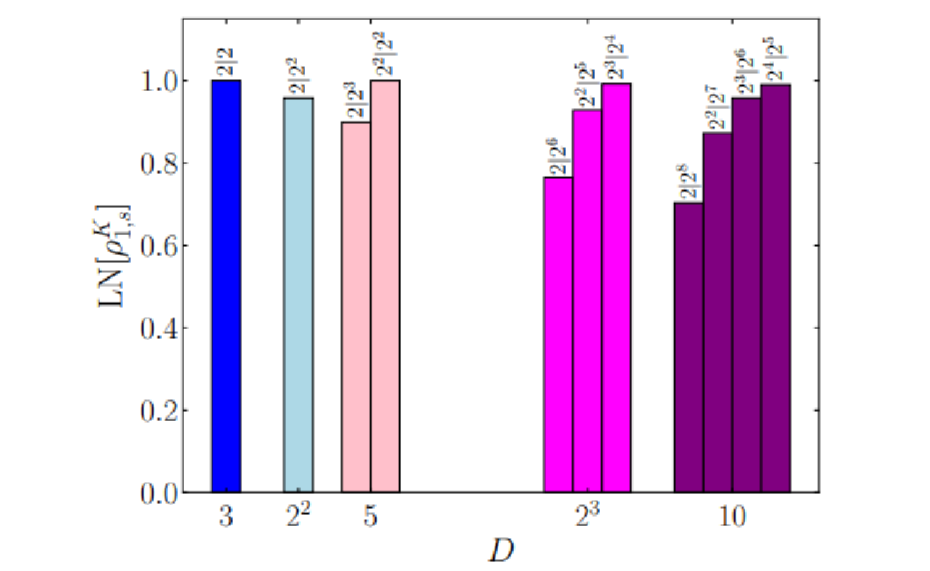
Notably, the symmetric mapping technique achieved high fidelity, reaching 0. 99 in certain configurations, when compared to the desired entangled state. The authors acknowledge limitations related to the complexity of the optimization landscape as the number of layers in the QAOA increases, and that the performance of the classical optimizers used could be further improved. Future research directions include developing robust QAOA algorithms incorporating error mitigation and exploring the potential of emerging qudit-based quantum architectures. The team also suggests investigating the impact of various experimental imperfections through simulations and testing on actual quantum devices, and exploring the use of diverse binary-encoded mixing Hamiltonians within the QAOA framework.
🗞 Quantum approximate optimization of bosonic finite-state systems
🧠 ArXiv: https://arxiv.org/abs/2510.05576
See today’s quantum computing news on Quantum Zeitgeist for the latest breakthroughs in qubits, hardware, algorithms, and industry deals.