The fundamental laws of quantum physics offer intriguing possibilities for creating secure financial systems, but current proposals for quantum money often compromise either long-term security or user privacy. Dmytro Gavinsky from the Institute of Mathematics of the Czech Academy of Sciences, along with Dar Gilboa, Dmitri Maslov, Jarrod R. McClean, and Siddhartha Jain from Google Quantum AI and The University of Texas at Austin, now present a new approach to constructing single-use quantum money that overcomes these limitations. Their system allows users to actively detect any attempt by the issuing authority to track their transactions, while maintaining unconditional security through an innovative auditing procedure. Crucially, the method relies on classical verification, eliminating the need for long-term memory or complex infrastructure, and opens doors to applications beyond finance, such as truly anonymous communication and secure voting systems.
Quantum Tokens with Classical Verification and Anonymity
This research presents a new scheme for quantum tokens, a form of quantum money, designed to combine the inherent security of quantum mechanics with practical features crucial for real-world application. The system aims to create currency that is impossible to counterfeit, can be verified using standard, classical computers, and importantly, protects user privacy by preventing tracking by the issuing authority. This anonymity feature distinguishes this work from many previous quantum money proposals. Quantum money leverages the no-cloning theorem to guarantee unforgeability. This new approach utilizes quantum fingerprinting to verify authenticity without fully measuring the quantum state.
Tokens are designed for one-time use, simplifying security analysis and preventing fraudulent reuse. The system encodes information within a high-dimensional quantum state, making it exceptionally difficult for an attacker to determine the correct state without the secret key. The security of the scheme is directly related to the number of quantum queries an attacker would need to make to distinguish a valid token from a counterfeit. A key contribution is the addition of a robust anonymity feature, allowing users to actively challenge the issuer and detect any attempts at tracking. This work opens possibilities for secure digital transactions, privacy-preserving systems for applications like voting and auctions, and integration into future quantum networks.
Quantum Tokens Validate Via Classical Measurement
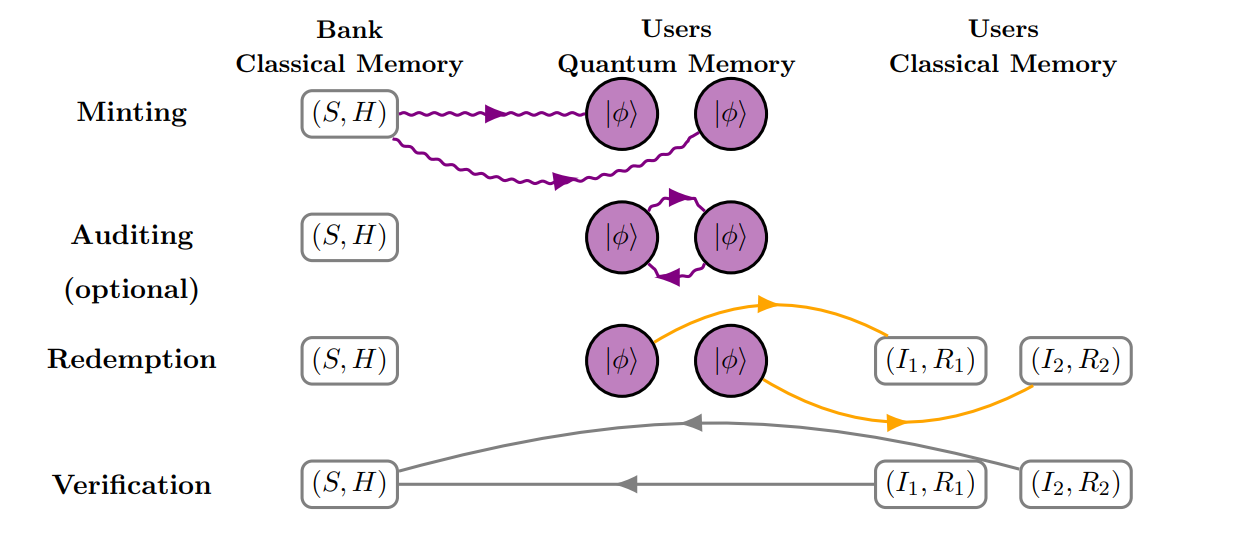
This work introduces a novel approach to quantum money, constructing single-use tokens that guarantee unforgeable currency while simultaneously protecting user privacy. The researchers developed a system where a bank distributes identical quantum states to users, representing the currency, and these tokens can be validated through classical measurements, eliminating the need for long-term quantum memory. This overcomes a significant technological hurdle present in earlier schemes. Users perform measurements on the received quantum tokens, generating classical bit strings sent to the bank for verification.
This confirms the token’s validity without requiring a quantum communication infrastructure. Quantum communication is only required during initial token issuance. A crucial innovation lies in the ability of users to detect potential tracking by the bank through a quantum comparison, known as a “swap test”. Because the initial tokens are identical, users can perform a swap test to determine if the bank is differentiating between tokens, indicating surveillance. The system allows for optional auditing, where users can actively verify the bank’s honesty. The researchers rigorously proved the unconditional security and anonymity of their scheme, demonstrating that it is resource-independent, meaning the security guarantees hold regardless of the adversary’s computational power.
Anonymous Quantum Tokens Guarantee User Privacy
This research introduces a novel quantum token scheme designed to create unforgeable and anonymous currency, addressing limitations in existing proposals. Current systems either require long-term memory for verification or compromise user privacy by allowing tracking of individual tokens. This work presents a system where users can detect if the issuing authority is attempting to track them, with security guaranteed through an auditing procedure. Importantly, token validation is classical, simplifying practical implementation and removing the need for long-term quantum memory. The team defines an anonymous quantum token scheme with specific properties: correctness, unforgeability, and anonymity.
Experiments demonstrate that valid tokens are reliably verified by the bank. The system is designed such that the probability of verification passing more than the number of tokens is kept small, ensuring unforgeability. Anonymity is achieved because all tokens appear identical to honest banks, and any attempt to modify tokens for tracking can be detected by users through a quantum comparison, known as a “swap test”. The swap test plays a crucial role in verifying anonymity. This test determines if two quantum states are identical, and in this scheme, it allows users to confirm that their tokens haven’t been altered for tracking purposes.
Measurements confirm that the swap test accurately identifies any modifications made by a dishonest bank. The team proves that the scheme satisfies all desired properties, including correctness and unforgeability, through rigorous mathematical analysis. The research establishes resource-independent security guarantees, meaning the system’s security doesn’t rely on limitations to an adversary’s computational power. This scheme addresses limitations found in existing digital currency proposals, specifically the need for long-term memory to verify transactions or the potential for tracking users. The team’s construction allows users to detect if an issuing authority is attempting to monitor their spending, guaranteeing unconditional security through an auditing procedure. The core achievement lies in a quantum protocol that ensures anonymity while maintaining unforgeability, a difficult balance to strike in currency design.
Validation of the digital tokens is performed using classical methods, making the system relatively practical for implementation. Beyond currency, the researchers suggest potential applications for this technology in areas such as creating anonymous one-time pads for secure communication and developing privacy-preserving voting systems. The authors acknowledge that the practical implementation of the scheme may introduce complexities not fully addressed in the theoretical model. Future work could focus on optimizing the protocol for real-world deployment and exploring its scalability for wider adoption.
🗞 Anonymous Quantum Tokens with Classical Verification
🧠 ArXiv: https://arxiv.org/abs/2510.06212