The nature of black holes and the information they contain continues to challenge our understanding of fundamental physics, and recent research delves into this mystery by examining the entanglement and complexity within these enigmatic objects. Sanhita Parihar from the Indian Institute of Technology Hyderabad and Gurmeet Singh Punia from the University of Science and Technology of China, along with their colleagues, investigate these properties in a specific type of black hole known as a dyonic quantum black hole, exploring how information is encoded in its structure. Their work demonstrates that the emergence of ‘islands’, regions connected to the black hole’s interior, significantly impacts the measurement of entanglement, revealing how information capacity grows and ultimately stabilises. Furthermore, the team’s analysis of complexity, a measure of the information needed to describe a system, reveals distinct behaviours between black holes and other quantum systems, offering new insights into the fundamental limits of information processing in the universe.
Researchers have extensively investigated how to calculate complexity using gravitational tools, particularly within the framework of the AdS/CFT correspondence, a duality between gravity and quantum field theories. A significant focus lies on understanding black hole entropy, Hawking radiation, and the information paradox, the apparent loss of information when matter falls into a black hole, with holographic complexity offering potential resolutions. The research also delves into the idea that spacetime itself might emerge from quantum entanglement, suggesting a fundamental connection between quantum information and the structure of the universe. Recent studies have expanded the investigation to include black hole chemistry and the island formula, a key development in resolving the information paradox. This formula proposes that the entropy of Hawking radiation is related to the area of a specific surface within the black hole interior.
Island Formation and Entanglement Entropy Growth
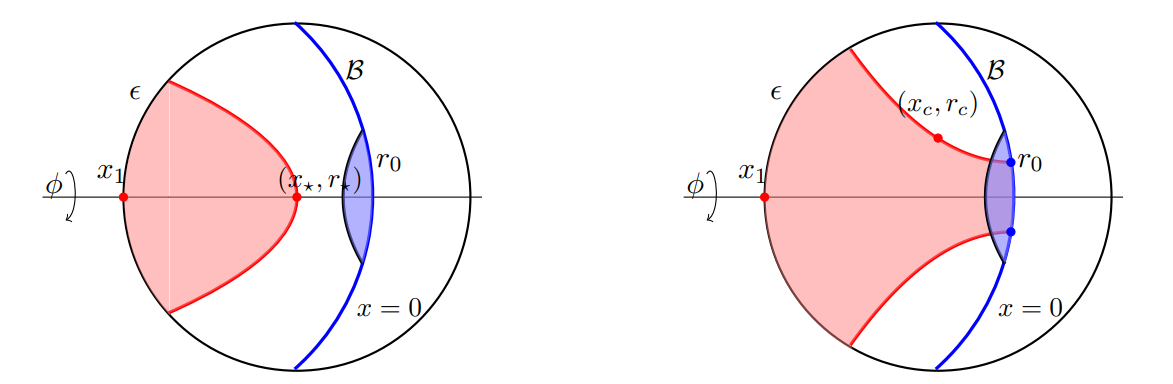
This work investigates holographic entanglement entropy and holographic complexity for three-dimensional dyonic black holes, employing a double holographic framework that incorporates quantum corrections from bulk fields. Researchers utilized the holographic Ryu-Takayanagi prescription and the island prescription to evaluate entanglement entropy, revealing the emergence of “islands”, disconnected extremal surfaces that appear when standard calculations fail. They found that entanglement entropy increases with the size of the region being examined, eventually reaching a limit for both black holes and related structures, confirming the island proposal through minimization of entanglement entropy. The team also analyzed holographic complexity using both the volume and action conjectures, discovering that leading corrections exhibit universal behavior and late-time growth obeys generalized Lloyd-type bounds for quantum dyonic black holes.
The action prescription, which captures exact non-perturbative contributions, proved more tractable than the perturbative volume prescription. Interestingly, quantum dressed defects exhibited vanishing late-time complexity growth, consistent with extremal Reissner-Nordström behavior. These measurements confirm that quantum black hole geometries inherently encode universal quantum corrections from boundary matter backreaction, impacting both holographic entanglement entropy and complexity, and demonstrate a clear connection between complexity growth and thermodynamic quantities.
Braneworld Black Holes, Entanglement and Complexity
This research investigates the holographic properties of three-dimensional dyonic black holes within a braneworld framework, exploring how entanglement and complexity manifest in this system. Scientists calculated the holographic entanglement entropy using both standard and “island” approaches, discovering that entanglement grows with the size of the region being examined and eventually reaches a limit for black holes and related structures. The team also analyzed holographic complexity, a measure of the information needed to describe a system, using two different methods, revealing universal behavior in the leading corrections and a unique late-time growth pattern that adheres to established bounds. The findings demonstrate a connection between gravity, quantum information, and the geometry of spacetime, offering insights into the nature of black holes and the information they contain. Notably, the analysis of “dressed defects”, specific configurations within the model, showed a different late-time behavior, with complexity growth ceasing, highlighting the sensitivity of these measures to the system’s characteristics. While the calculations rely on certain approximations, this work contributes to a deeper understanding of non-perturbative aspects of these systems and may shed light on the firewall paradox and the nature of quantum gravity.
🗞 Entanglement Entropy and Complexity in Dyonic Quantum Black Holes
🧠 ArXiv: https://arxiv.org/abs/2510.05264




See today’s quantum computing news on Quantum Zeitgeist for the latest breakthroughs in qubits, hardware, algorithms, and industry deals.