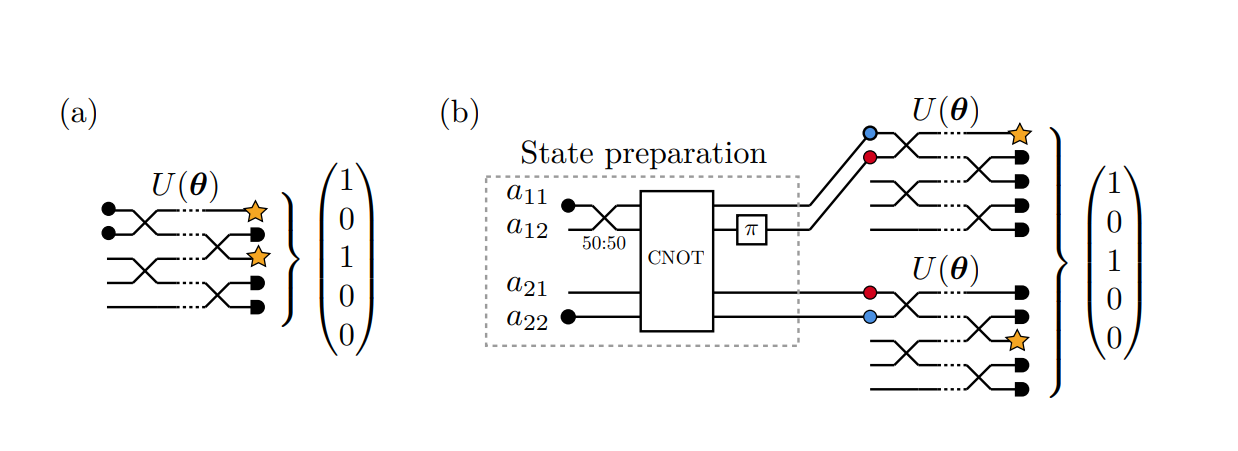
The challenge of ‘barren plateaus’, situations where the optimisation of quantum circuits stalls due to vanishing gradients, significantly hinders progress in many quantum computing applications. Matthew D. Horner, from Aegiq Ltd, and colleagues now demonstrate a substantial acceleration of discrete variable boson sampling by strategically limiting the possible settings of key components within the quantum circuit. This innovative approach creates a more manageable optimisation landscape, effectively reducing the prevalence of barren plateaus irrespective of the specific problem, circuit design, or layout. Importantly, this method requires no classical pre-processing and enables the use of efficient, gradient-free optimisation techniques, ultimately outperforming existing boson sampling methods across a range of tests and paving the way for more robust and scalable quantum algorithms.
The research addresses limitations arising from reliance on classical pre-processing within variational quantum algorithms, enabling the use of a fast, gradient-free algorithm called Rotosolve. To overcome these limitations, the team proposes three distinct approaches, utilising non-linear optics, measurement-induced non-linearities, or entangled resource states that simulate fermionic statistics. Importantly, the latter two methods require only linear optics, facilitating implementation with currently available technology. Results demonstrate that this approach outperforms the best-known boson sampling variational algorithm across all tests conducted.
Linear Optics Realise Dual-Valued Phase Shifting
Scientists have developed a method for creating a dual-valued phase shifter, a device that alters the phase of a photon based on its quantum state, using only linear optical elements and ancillary photons. This device is crucial for building scalable quantum computers because it enables controlled-NOT gates, fundamental building blocks of quantum circuits. The team demonstrates that by carefully arranging beam splitters and phase shifters, and utilising additional photons, they can reliably control the phase of a photon. The research highlights the importance of the polynomial representation of the phase shift operation, finding that a second-degree polynomial offers greater flexibility and potentially higher success rates.
In essence, this work provides a pathway to reliably control individual photons using readily available optical components. By employing an extra helper photon and carefully designing the optical arrangement, the team achieves a reasonable chance of success in altering the photon’s phase. This advancement represents a significant step towards building more complex and scalable quantum computers.
Simplified Cost Landscapes Speed Variational Algorithms
Scientists have achieved a significant speedup in variational quantum algorithms that utilise discrete variable boson sampling, demonstrating improved performance without reliance on classical pre-processing. The research focuses on mitigating the barren plateau problem, a key obstacle to scaling these algorithms for real-world applications, by reshaping the cost landscape to reduce local minima. This was accomplished by constraining parametrised phase shifters to possess only two distinct eigenvalues, resulting in a simplified cost landscape applicable to any problem, ansatz, or circuit layout. Experiments reveal that this approach allows for the implementation of the gradient-free Rotosolve algorithm, offering a considerable improvement over traditional optimisation methods.
The team proposes three distinct methods for realising this non-linear phase shifting, including direct implementation with non-linear optics, measurement-induced non-linearities using linear optics, and simulating fermionic statistics with entangled resource states. Notably, the latter two methods require only single photon sources, linear optics, and single photon detectors, technologies widely available today. The research demonstrates that all three methods yield cost landscapes of the same form, allowing for focused numerical analysis using the fermionic resource state to compare the performance of fermion sampling with boson sampling. Results show a substantial reduction in susceptibility to barren plateaus, and successful application of the Rotosolve algorithm to boson sampling, indicating a pathway towards more efficient and scalable quantum optimisation. The team’s work provides a significant advancement in variational quantum algorithms, offering a promising solution to the challenges of barren plateaus and paving the way for practical applications in fields such as combinatorial optimisation and machine learning.
Nonlinear Phase Shifters Bypass Barren Plateaus
Scientists have made a significant advancement in variational quantum algorithms, specifically those implemented with discrete variable boson sampling. They have successfully mitigated the problem of barren plateaus, which hinders the performance of these algorithms as problem size increases, without relying on classical pre-processing. The team achieved this by replacing standard parametrised phase shifters with non-linear alternatives possessing only two distinct eigenvalues, effectively simplifying the cost landscape and reducing the occurrence of local minima. This approach proves effective regardless of the specific problem being addressed, offering a broadly applicable solution to a key challenge in quantum optimisation.
The results consistently outperform existing boson sampling methods across all tests conducted. Researchers explored three distinct methods for implementing these dual-valued phase shifters, including designs utilising non-linear optics, measurement-induced non-linearities, and entangled resource states simulating fermionic statistics. While the team acknowledges that implementing these designs requires specific hardware capabilities, the use of linear optics in two of the proposed methods offers a pathway to implementation with currently available technology.
🗞 Mitigating the barren plateau problem in linear optics
🧠 ArXiv: https://arxiv.org/abs/2510.02430