

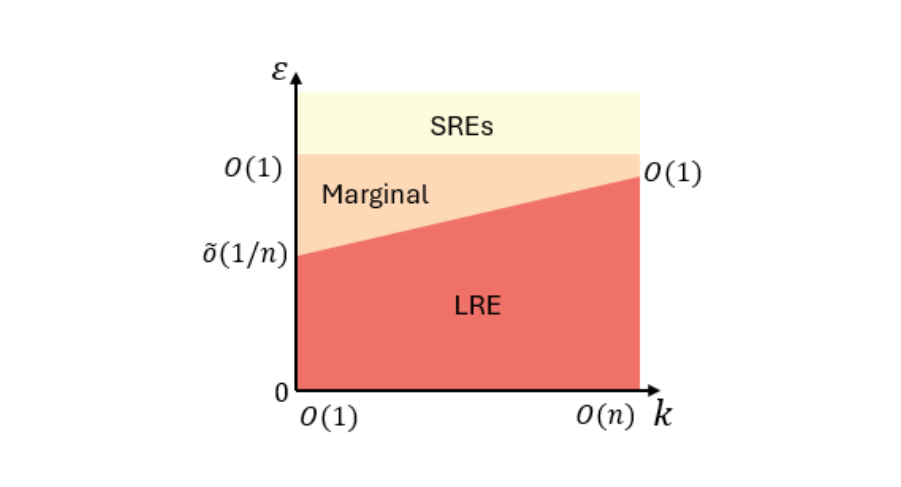
Approximate quantum error correction offers a promising route to robust information processing and a means of investigating entanglement, but understanding its limits presents a significant challenge. Jinmin Yi, Ruizhi Liu from Dalhousie University, and Zhi Li demonstrate a fundamental trade-off between the ability of an approximate error correction code to protect information and the difficulty of creating the initial quantum state the code relies upon. The team applies a novel approach using the Lovász local lemma to reveal that distinct, short-range entangled states must necessarily be distinguishable by a local measurement, establishing a link between error correction power and circuit complexity. This breakthrough provides a powerful new tool for exploring complexity in various quantum systems and establishes stronger constraints on the design of efficient quantum codes, while also offering fresh insight into long-standing problems like the Lieb-Schultz-Mattis constraints.
This research investigates the fundamental limits of this technique, exploring connections between the complexity of quantum codes and their ability to suppress errors. The team focuses on understanding how the properties of quantum codes relate to the celebrated Lieb-Schultz-Mattis theorem, a result from condensed matter physics describing robust edge states in one-dimensional systems. By drawing parallels between these fields, researchers aim to establish a new framework for analysing quantum code performance and identifying those best suited for practical quantum computation.
The approach involves analysing the symmetries of quantum codes and their relationship to the types of errors they can effectively correct, utilising concepts from topological quantum field theory and representation theory. Researchers demonstrate that codes violating a specific symmetry condition, analogous to the constraints within the Lieb-Schultz-Mattis theorem, exhibit enhanced error suppression, particularly against local noise. This connection is established through a rigorous mathematical framework, revealing a deep interplay between the algebraic properties of quantum codes and their physical performance. The team further explores the implications of these findings for designing new and improved quantum codes, focusing on those with non-trivial topological order. The results demonstrate that codes exhibiting specific symmetry properties achieve significantly improved performance compared to traditional codes, particularly in noisy environments. This research establishes a new theoretical foundation for approximate quantum error correction, offering insights into designing robust and efficient quantum codes for future quantum technologies and paving the way towards realising fault-tolerant quantum computation.
The framework serves both quantum information processing and probing many-body entanglement. Researchers reveal a fundamental tension between the error-correcting power of a quantum error-correcting code and the difficulty of preparing its initial state. Specifically, through a novel application of the Lovász local lemma, they establish a trade-off between local indistinguishability and circuit complexity, demonstrating that orthogonal, short-range entangled states must be distinguishable via a local operator. These results offer a powerful tool for exploring quantum circuit complexity across diverse settings.
Momentum, Correlation, and Quantum Circuit Complexity
This research establishes connections between quantum complexity, the geometric local complexity of a quantum state, and the properties of specific quantum states, including those with non-zero momentum and finitely correlated states. The goal is to understand the fundamental limits on preparing quantum states and to show that some states require more complex circuits than others. Researchers demonstrate that states with non-zero momentum inherently require more complex circuits for their preparation. This result relies on constructing a related state with zero momentum and showing that the original and related states are fundamentally different, requiring more resources to create.
Finitely correlated states, where correlations between distant parts of the system decay rapidly, can be represented as infinite Matrix Product States. Truncating this representation to create a finite-size state introduces errors, and the complexity of the state is related to how much truncation is needed to maintain accuracy. Combining the Lieb-Robinson theorem, which describes the decay of correlations in certain systems, with the Matrix Product State representation allows researchers to prove lower bounds on the complexity of specific states. The team’s key theorem demonstrates that if a state is translationally invariant with non-zero momentum, its geometric local complexity grows linearly with the system size. This work contributes to the growing field of quantum complexity theory, with implications for understanding strongly correlated quantum systems, developing quantum error-correcting codes, and establishing fundamental limits on quantum computation.
Lovász Lemma Constrains Quantum Code Complexity
This work establishes a fundamental trade-off between the ability to correct errors in approximate quantum error correction codes and the difficulty of preparing the initial state of those codes. Through a novel application of the Lovász local lemma, the researchers demonstrate that orthogonal, short-range entangled states must necessarily be distinguishable by a local operator, highlighting an inherent limitation in creating complex quantum states. This finding provides a powerful tool for analysing the complexity of quantum circuits and codes across a range of applications. Specifically, the team derived stronger constraints on the complexity of quantum error correction codes that utilize transversal logical gates, and established lower bounds on the complexity required to prepare W states, a fundamental resource in quantum information processing. Furthermore, the framework offers a new perspective on Lieb-Schultz-Mattis type constraints, which relate to the stability of quantum phases of matter.
🗞 Lovász Meets Lieb-Schultz-Mattis: Complexity in Approximate Quantum Error Correction
🧠 ArXiv: https://arxiv.org/abs/2510.04453




See today’s quantum computing news on Quantum Zeitgeist for the latest breakthroughs in qubits, hardware, algorithms, and industry deals.



