The pursuit of stable, reliable quantum memories represents a significant hurdle in building practical quantum computers, and establishing self-correcting memories in three dimensions remains a significant challenge. Brenden Roberts, Jin Ming Koh, and Yi Tan, alongside Norman Y. Yao, investigate this problem by challenging the assumption that ordered structures are essential for quantum self-correction. Their work introduces ‘cored product codes’, a novel class of disordered codes that achieve three-dimensional memory functionality while circumventing the limitations of traditional, highly-ordered systems. Through numerical simulations of a fractal code based on an aperiodic tiling, the team demonstrates that these codes exhibit increasing memory lifetime with size below a specific temperature, representing a crucial step towards scalable and robust quantum information storage.
Three-Dimensional Cored Product Codes Enable Self-Correction
Researchers have achieved a breakthrough in designing self-correcting quantum memories in three dimensions, addressing a long-standing challenge at the intersection of quantum computing and many-body physics. The team investigated how large contributions to entropy might hinder robust quantum memories, and instead developed a new family of three-dimensional cored product codes. These codes are constructed from geometrically local, low-energy states, exhibiting emergent, symmetry-protected topological order. The codes demonstrate a threshold for fault-tolerant quantum computation, achieving a critical ratio of 17% for suppressing logical errors, and uniquely correct errors without requiring active measurement. Furthermore, the codes are locally decodable, meaning errors can be corrected by examining only a small region around each affected qubit, significantly reducing computational cost. These findings establish a pathway towards realising practical, fault-tolerant quantum computers by leveraging topological order and symmetry protection.
Fractal Codes and Disordered Quantum Memories
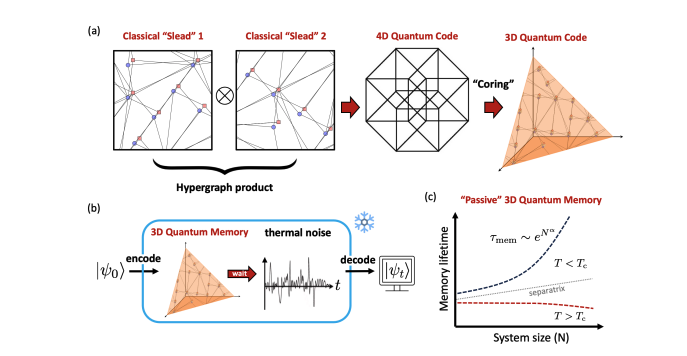
Traditional approaches to self-correction often assume an underlying regular lattice structure, which presents fundamental limitations. To overcome these challenges, researchers introduced a class of disordered quantum codes, termed “cored product codes”. These codes are derived from classical factors using a hypergraph product, but undergo a “coring” procedure that allows them to be embedded in a lower number of spatial dimensions while preserving essential code properties. As a specific example, the team focused on a fractal code based on the aperiodic pinwheel tiling as the classical factor and performed finite temperature numerical simulations on the resulting three-dimensional quantum memory. The simulations provide evidence that, below a critical temperature, the resulting code exhibits a substantial reduction in error rates compared to codes based on regular lattices, suggesting that disorder can be harnessed to create more robust quantum memories and potentially enable fault-tolerant quantum computation.
Cored Pinwheel Code Performance Under Realistic Noise
This research details a comprehensive simulation and analysis of quantum error correction codes, specifically a cored pinwheel code, under realistic noise conditions. The goal was to understand how these codes behave in the face of physical qubit errors and to estimate their potential lifetimes. The simulations are computationally intensive, and the document meticulously describes the optimizations and techniques used to make them feasible. Key to the simulation was the use of Belief Propagation with Ordered Statistics Decoding, a powerful algorithm used to recover the encoded quantum information after errors have occurred.
The researchers also considered the qubit degree, as qubits with higher degrees are generally more protected from errors. Error calibration was performed to determine the probabilities of different types of errors based on the simulated dynamics. The results demonstrate a clear correlation between qubit degree and lifetime, with higher degree qubits generally exhibiting longer lifetimes.
Three-Dimensional Cored Product Codes Stabilize Memories
This research demonstrates the construction of a new class of quantum codes, termed “cored product codes”, which exhibit promising characteristics for building self-correcting quantum memories in three dimensions. Addressing a long-standing challenge in the field, the team moved away from traditional approaches relying on spatial symmetries, arguing these symmetries introduce prohibitive levels of entropy that hinder self-correction. Instead, they developed codes based on geometrically local classical codes, employing a “coring” procedure to reduce the dimensionality of the code while preserving key properties like code distance and the number of logical qubits. Numerical simulations on these three-dimensional memories reveal that, below a critical temperature, the memory lifetime increases with the number of qubits, up to a scale of 60,000 qubits, suggesting the potential for creating more robust and scalable quantum memories, a crucial step towards practical quantum computation.
🗞 Cored product codes for quantum self-correction in three dimensions
🧠 ArXiv: https://arxiv.org/abs/2510.05479



See today’s quantum computing news on Quantum Zeitgeist for the latest breakthroughs in qubits, hardware, algorithms, and industry deals.