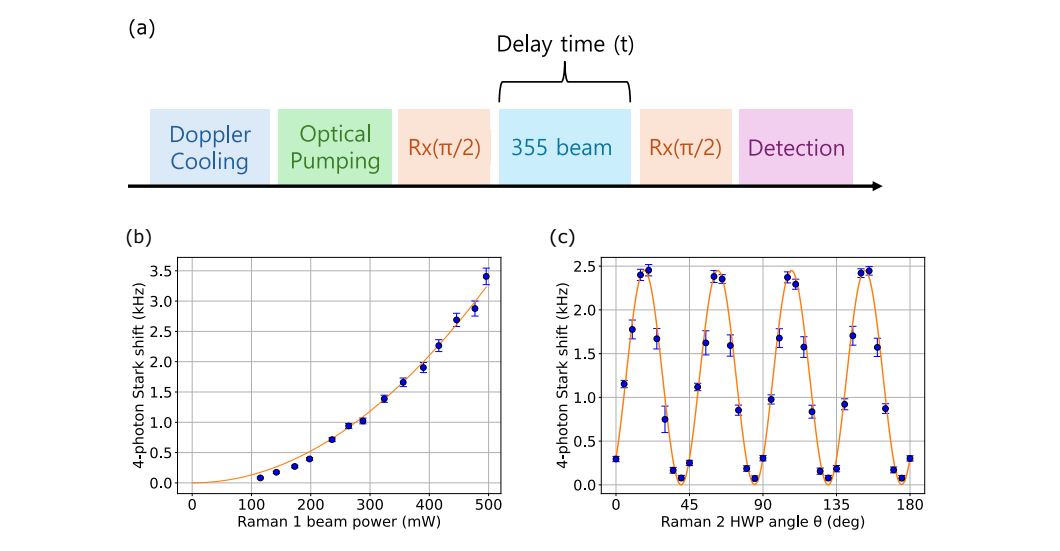
Trapped ions represent a promising platform for building powerful quantum computers, yet precisely controlling the lasers used to manipulate these ions remains a significant challenge. Ilyoung Jung, Frank G. Schroer, and Philip Richerme, all from Indiana University’s Department of Physics, have developed a novel method that utilises the ions themselves to characterise the laser beams essential for quantum operations. The team demonstrates how the ions respond to laser light, specifically through a phenomenon called the four-photon Stark Shift, to directly measure beam profiles, alignment, and polarisation within the ultra-high vacuum environment. This innovative approach not only provides a more accurate way to assess laser performance, but also enables optimisation of individual laser parameters, ultimately leading to faster and more reliable quantum gates with reduced error rates, and showcases the potential for trapped ions to actively monitor and improve their own operating conditions.
Accurate characterisation of laser beam properties, including intensities and polarizations, is central to predicting and optimizing gate speeds and stability. It is challenging, however, to accurately measure these properties at the ion location within an ultra-high vacuum chamber. This work demonstrates how ions themselves may be used as sensors to directly characterise the laser beams needed for quantum gate operations. By making use of the four-photon Stark shift effect in Yb+ ions, the team measures the profiles, alignments, and polarizations of the lasers driving counter-propagating Raman transitions. The results show that optimising the parameters of each laser individually leads to higher-speed Raman-driven gates with smaller susceptibility to error.
Four-Photon Stark Shift Derivation and Calculation
This work presents a comprehensive derivation of the equations used to calculate the four-photon Stark shift, accounting for arbitrary magnetic field directions and polarization states. The derivation logically progresses, providing a clear understanding of the underlying physics and adaptability to different scenarios. Consistent notation and explicit coordinate transformations ensure the derivation is easy to follow and correctly accounts for the magnetic field and light polarization. Detailed explanations accompany each step, making the derivation accessible to those familiar with quantum optics and polarization.
This comprehensive approach covers all necessary components, resulting in a well-organized and easily understandable derivation. The team explicitly states all assumptions made during the derivation, enhancing clarity, and directly connects to the equations presented in the main text. The derivation uses consistent units throughout, ensuring accuracy and facilitating comprehension.
Ions Probe Laser Beams with Stark Shift
Scientists have developed a technique to characterize and optimize the laser beams used in controlling trapped ions, which are promising candidates for building quantum computers. This work addresses the challenge of accurately measuring laser properties within the ultra-high vacuum environment required for trapping ions. Instead of relying on external measurements, the team ingeniously uses the ions themselves as probes, exploiting the four-photon Stark shift, a phenomenon where the energy levels of the ions are altered by the laser light. By carefully analyzing how the ions respond to the laser beams, they can determine the beams’ profiles, alignments, and polarization states.
Specifically, they observed a differential energy shift between qubit levels that scales quadratically with beam intensity and is sensitive to both polarization and magnetic field orientation. This allows for precise characterization of each Raman beam independently. Experiments using 171Yb+ ions revealed that optimizing these laser parameters leads to significant improvements in gate performance. The team implemented single and two-qubit gates by driving two-photon Raman transitions with a mode-locked laser emitting pulses lasting approximately 15 picoseconds at a repetition rate of 80 megahertz.
They demonstrated the ability to achieve Stark shifts of up to 10 megahertz using 200 milliwatts of 355 nanometer light focused to a 3 micrometer spot, a shift nearly three orders of magnitude larger than typical two-photon effects. The technique is broadly applicable to any species of Zeeman or hyperfine qubit, offering a powerful method for correcting experimental imperfections and enhancing the fidelity of quantum operations. This innovative approach not only provides a means to characterize laser beams in situ but also paves the way for higher-speed Raman-driven gates with reduced susceptibility to errors.
Ytterbium Ions Probe Laser Beam Characteristics
This research demonstrates a novel technique for characterizing the laser beams used in controlling trapped ions for quantum computing. By utilizing the four-photon Stark shift effect in ytterbium ions, scientists have developed a method where the ions themselves act as sensitive probes of the laser beams’ properties, including polarization, spot size, and alignment. This approach allows for precise measurement of these parameters within the ultra-high vacuum environment where trapped-ion experiments take place, a challenge for traditional measurement methods. The team extended the theoretical understanding of the Stark shift to account for real-world experimental conditions, such as imperfect laser polarization and magnetic fields. Importantly, they showed that optimizing laser alignment using data from the Stark shift measurements leads to improvements over conventional optimization techniques based on Rabi frequency measurements, resulting in higher-speed and more reliable quantum gates. This work establishes that trapped ions are not merely passive components in quantum operations, but can actively participate in calibrating and enhancing experimental performance.
🗞 Ion-Based Characterization of Laser Beam Profiles for Quantum Information Processing
🧠 ArXiv: https://arxiv.org/abs/2510.03966