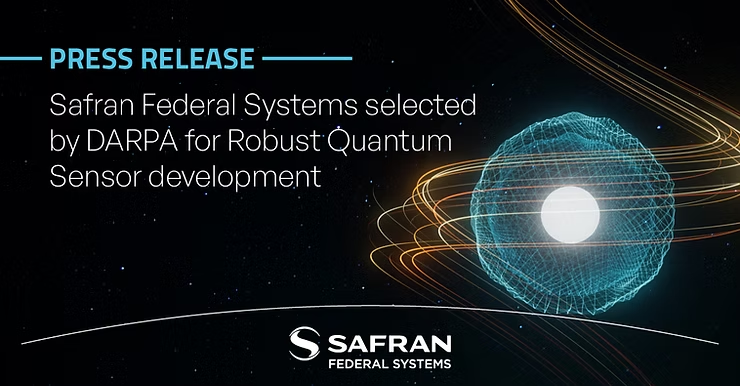
In a move that signals a new chapter for military navigation, Safran Federal Systems has secured a DARPA contract to build quantum sensors that promise reliable position, navigation and timing (PNT) even when GPS signals are jammed or denied. The award, part of the Robust Quantum Sensor (RoQS) programme, will see the Rochester‑based team develop, ruggedise and test a prototype on a military helicopter , a platform that routinely operates in the most hostile electromagnetic environments. If successful, the sensors could become a cornerstone of the U.S. and allied forces’ ability to maintain situational awareness without relying on satellite navigation.
Quantum Sensors for the Modern Battlefield
Quantum technology harnesses the behaviour of subatomic particles to measure time and motion with unprecedented precision. Unlike conventional inertial systems that drift over hours, quantum sensors maintain accuracy by counting the oscillations of atoms or photons. For a soldier on the ground, this means a navigation system that never loses its bearings, even when a jammer cuts off satellite signals or when a storm distorts magnetic fields. Safran’s design focuses on making these delicate devices robust enough for field use. Engineers are encapsulating the quantum core in shock‑absorbing housings, shielding it from temperature swings and electromagnetic interference that would otherwise corrupt the measurements.
The test on a military helicopter will push the prototype through real‑world turbulence, rapid altitude changes and intense radio frequency noise. Helicopters are notoriously unforgiving for navigation equipment, as they hover, tilt and manoeuvre through complex airspaces. By demonstrating that the quantum sensor can keep accurate time and position data under such conditions, Safran will provide evidence that the technology can survive the rigours of combat operations. The same principles apply to ground vehicles, unmanned aerial systems and naval platforms, all of which will benefit from a PNT system that does not depend on external satellites.
From Lab to Warzone: Accelerating Deployment
DARPA’s RoQS programme is built on a collaborative model that brings together sensor developers and platform integrators. The idea is to cut the time between a laboratory prototype and a field‑ready system. Safran’s experience in simulation, navigation warfare (NAVWAR) and open‑systems architecture positions the company to bridge that gap. By integrating the quantum sensor into existing DoD platforms early in the development cycle, potential compatibility issues can be identified and resolved before the sensors reach operational units.
The first phase of the contract includes a series of field demonstrations. These trials will not only validate performance but also generate data that informs the next iteration of the hardware. The rapid feedback loop reduces the typical multi‑year development cycle of advanced military technology to a matter of months. Moreover, the cost‑effective approach,leveraging existing infrastructure and open‑source design principles,means that the sensors can be produced at a fraction of the price of traditional high‑precision navigation suites.
Strategic Implications for U.S. and Allies
The United States has long been dependent on the Global Positioning System for military operations. However, the proliferation of anti‑satellite weapons and sophisticated jamming devices threatens to undermine that dependency. A quantum‑based PNT system offers a resilient alternative that is immune to satellite denial. By ensuring that aircraft, ships and ground forces can navigate accurately without external signals, the sensors enhance operational readiness and reduce the risk of mission failure in contested theatres.
Beyond tactical advantages, the technology has broader strategic implications. Allies operating in regions with unstable satellite infrastructure,such as the Middle East or the Arctic,stand to benefit from a shared quantum navigation capability. Joint operations would then rely on a common, secure PNT backbone, simplifying coordination and reducing the need for redundant systems. In the long term, the same quantum principles could underpin secure communications and time‑synchronised operations, further tightening the integration of cyber and kinetic capabilities.
Looking Ahead
The Safran‑DARPA partnership marks a pivotal step toward a new generation of military navigation. If the quantum sensors prove reliable in the helicopter trials, the next phases will likely focus on scaling production, integrating with a wider array of platforms and refining the ruggedisation for extreme environments. The transition from prototype to deployment will test not only the technology but also the supply chains and maintenance practices required to support a quantum‑based PNT fleet.
In an era where information dominance and precise timing are as critical as firepower, the ability to navigate without satellites could redefine battlefield logistics and strategy. Safran’s work under DARPA’s RoQS programme may well set the standard for resilient, autonomous navigation in the wars of tomorrow.



See today’s quantum computing news on Quantum Zeitgeist for the latest breakthroughs in qubits, hardware, algorithms, and industry deals.