

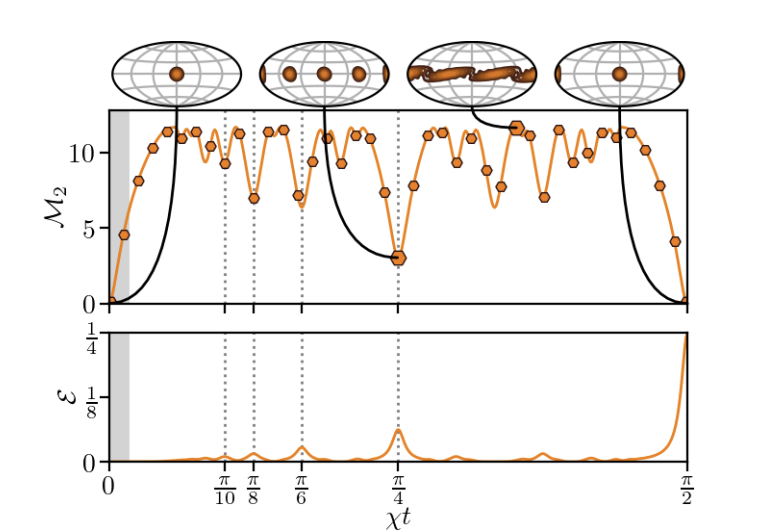
Quantum metrology promises enhanced precision in sensing and measurement, but achieving this requires exploiting uniquely quantum resources, and a key characteristic of these resources is ‘non-stabilizerness’, a measure of how far a quantum process deviates from easily simulated operations. Tanausú Hernández-Yanes from Uniwersytet Jagielloński, Piotr Sierant from Barcelona Supercomputing Center, and Jakub Zakrzewski from Uniwersytet Jagielloński, alongside Marcin Płodzień, demonstrate that this complex property can be surprisingly simplified for many-particle systems, depending on only a few measurable quantities. The team reveals that while generating optimal spin-squeezing, a technique used to enhance precision, leads to a dramatic increase in non-stabilizerness, carefully crafted quantum states known as ‘kitten’ states exhibit strong quantum correlations alongside a manageable level of this property. This discovery establishes a clear link between non-stabilizerness, multipartite entanglement, and the potential for improved precision sensing, offering a practical pathway to quantify these crucial resources in experimental settings.
Spin Squeezing, Entanglement and Metrological Precision
This research investigates the connection between spin-squeezed states, entanglement, and the precision of measurements. Spin squeezing reduces quantum noise, improving measurement accuracy, and scientists are exploring its relationship to the Stabilizer Rényi Entropy, a measure of quantum entanglement, and many-body Bell correlations, which quantify entanglement in multi-particle systems. The study utilizes generalized GHZ states as a model system to explore these connections. Spin squeezing enhances measurement precision by reducing uncertainty in one direction at the expense of increasing it in another, while entanglement links particles such that measuring one instantly influences the others.
The Stabilizer Rényi Entropy is particularly useful for characterizing nearly separable states, and generalized GHZ states serve as a benchmark for studying entanglement and testing the foundations of quantum mechanics. The research analyzes generalized GHZ states, deriving formulas for calculating the Stabilizer Rényi Entropy and the many-body Bell correlator as a function of key parameters. Scientists determined how these measures scale with the number of particles, crucial for understanding system behavior as it grows, and compared the results with those obtained using different spin-squeezing techniques. The main findings demonstrate that the Stabilizer Rényi Entropy is a useful measure of entanglement for spin-squeezed states, and that both the entropy and the Bell correlator exhibit specific scaling laws with the number of particles. Generalized GHZ states provide a valuable model system for studying entanglement and spin squeezing, and the properties of squeezed states depend on the generation protocol used, ultimately improving measurement precision.
Stabilizer Entropy Simplifies Many-Body Magic Quantification
This study pioneers a new approach to quantifying “magic,” or non-stabilizerness, a crucial characteristic of quantum operations essential for advanced quantum technologies. Researchers demonstrate that, for systems exhibiting permutationally symmetric states, the complexity of describing this non-stabilizerness dramatically reduces with increasing system size, as the Stabilizer Rényi entropy depends only on a limited number of expectation values calculated from collective spin operators. Scientists employed one-axis twisting to generate spin squeezing and systematically analyze the resulting non-stabilizerness, revealing that optimal squeezing coincides with a logarithmic divergence of the Stabilizer Rényi entropy. Further investigation focused on creating “kitten” states, which exhibit strong many-body Bell correlations, demonstrating that these states possess a system-size-independent Stabilizer Rényi entropy that decreases with increasing Bell-correlation strength. The research involved precise calculations of expectation values for collective spin operators, allowing scientists to characterize the non-stabilizerness of various quantum states and providing a practical route to quantify non-stabilizerness in experimental settings. By connecting non-stabilizerness, multipartite correlations, and spin squeezing, the study establishes a framework for understanding and harnessing quantum resources for advanced technologies.
Stabilizer Rényi Entropy Simplifies Entanglement Quantification
Scientists have achieved a detailed understanding of “magic state resources,” or non-stabilizerness, within many-body quantum systems during the one-axis twisting protocol. This work reveals how non-stabilizerness emerges during the generation of highly entangled states, and researchers derived a closed-form expression for the Stabilizer Rényi Entropy, demonstrating that for sufficiently large systems, the entropy is determined by only six projections of the analyzed state. Experiments and calculations show that optimal spin squeezing is accompanied by a logarithmic divergence of the Stabilizer Rényi Entropy as the system size increases, indicating a strong connection between generating highly squeezed states and creating substantial non-stabilizerness. Furthermore, the team investigated the creation of “kitten” states, which exhibit many-body Bell correlations, confirming that these states possess a system-size-independent entropy that decreases with increasing Bell-correlation strength. The research demonstrates a clear relationship between non-stabilizerness, multipartite correlations, and quantum metrology, confirming the accuracy of their compact formula for calculating the entropy through measurements on 100 particles. This provides a practical route to quantify non-stabilizerness in experiments designed for precision sensing, offering a powerful tool for characterizing and optimizing quantum sensors based on many-body entanglement.
Stabilizer Rényi Entropy Quantifies Non-Stabilizerness
This research establishes a streamlined method for quantifying non-stabilizerness, a key characteristic of advanced quantum operations, using the stabilizer Rényi entropy. The team demonstrates that, for certain quantum states, this entropy can be determined by examining only a limited number of collective spin properties, greatly simplifying its experimental measurement and analytical calculation, and proving particularly useful in analysing spin-squeezing protocols. The investigation highlights a nuanced relationship between non-stabilizerness, quantum correlations, and the robustness of quantum states, revealing that highly squeezed states exhibit increasing non-stabilizerness alongside their enhanced metrological usefulness, while “kitten” states demonstrate limited non-stabilizerness.
🗞 Non-stabilizerness in quantum-enhanced metrological protocols
🧠 ArXiv: https://arxiv.org/abs/2510.01380




See today’s quantum computing news on Quantum Zeitgeist for the latest breakthroughs in qubits, hardware, algorithms, and industry deals.



