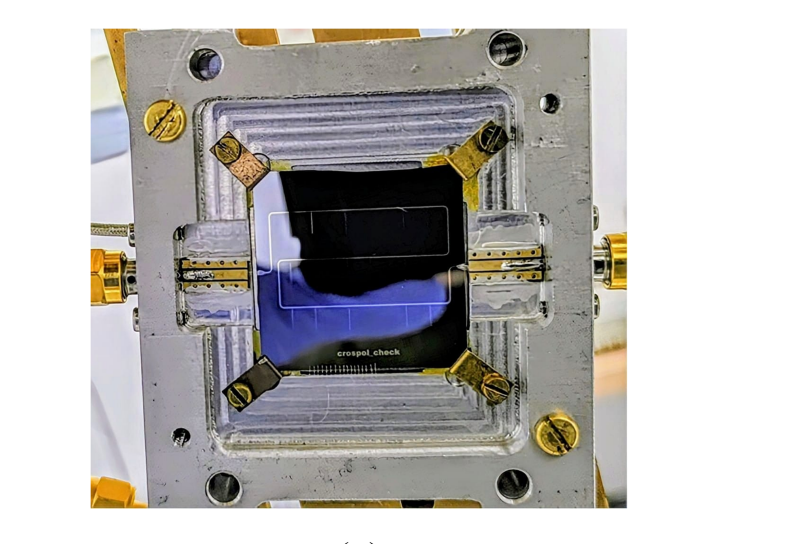
Kinetic Inductance Detectors (KIDs) currently lead the field in millimeter and submillimeter-wave astronomy, offering exceptional sensitivity and scalability, but a key limitation in polarization-sensitive applications, such as studies of the Cosmic Microwave Background, arises from unwanted responses to light polarization, known as cross-polarization. Victor Rollano, Martino Calvo, and Alejandro Pascual Laguna, alongside colleagues at their institutions, investigate the source of this effect in a common KID design, focusing on how electrical currents within the detector’s capacitor contribute to polarization leakage. Their research presents a comparison between standard KID designs and a new ‘quasi-lumped resonator’ approach, demonstrating that removing the capacitor element significantly improves the detector’s ability to distinguish between different polarizations, and confirming the capacitor’s role in reducing measurement fidelity. This advance promises to enhance the precision of future astronomical observations that rely on accurate polarization measurements.
Research focuses on improving KID performance through innovative designs and materials, including optimizing traditional Lumped Element KIDs and exploring hybrid designs combining materials like niobium and aluminum. Material selection, with frequent use of niobium and aluminum alongside aluminum oxide capacitors, is critical for maximizing quality factor, minimizing energy loss, and efficiently coupling signals. The team is developing innovative techniques to further improve detector performance, investigating sawtooth-shaped inductors to reduce unwanted signals and utilizing bi-layer detectors with two layers of superconducting material to enhance sensitivity.
Parallel-plate capacitors made of aluminum oxide achieve high quality factors, and researchers employ advanced analysis techniques, including Fourier optics and Circuit Quantum Electrodynamics, to characterize absorber and resonator performance. Phase-sensitive detection methods also improve signal-to-noise ratios. The research relies on sophisticated tools and methods, including electromagnetic simulations using software like Sonnet, cryogenic measurements at extremely low temperatures, and network analyzers to characterize resonant frequency, quality factor, and impedance. Optical techniques measure detector absorption efficiency, allowing scientists to thoroughly understand and optimize KID performance.
Promising results demonstrate improved detector sensitivity, enhanced quality
Promising results demonstrate improved detector sensitivity, enhanced quality factors, and efficient polarization detection, with some designs achieving broadband performance across a wider range of frequencies. Ongoing research focuses on scaling up KID technology to create large arrays for imaging, developing reliable fabrication processes, and exploring new superconducting materials with improved properties. The study focuses on meandered Lumped Element KIDs, addressing cross-polarization, an unintended response to orthogonal polarization that limits measurement accuracy. Researchers conducted a comparative study between conventional LEKIDs and a novel quasi-lumped resonator design to determine the contribution of the interdigitated capacitor to polarization leakage. To characterize the resonators, the team employed a Vector Network Analyzer to measure transmission data across resonant frequencies at extremely low temperatures.
Complex resonances were analyzed using a fitting model that accounts for signal attenuation and phase delay, determining key parameters like coupling rate and internal loss rate, providing a detailed understanding of resonator physics. Individual parameters, including resonance frequencies, quality factors, and internal loss rates, were obtained for each detector. Further characterization involved assessing the optical response of both detector types using a variable-temperature blackbody source, allowing scientists to measure frequency shifts under varying illumination conditions. A room-temperature interferometer characterized the polarimetric spectral response at cryogenic temperatures, providing insights into polarization discrimination. Ray-tracing software estimated absorbed power, enabling the calculation of responsivity, the change in frequency shift per unit of absorbed power. This work investigates the origin of cross-polarization in Lumped Element KIDs, focusing on parasitic currents within the interdigitated capacitor. A comparative study between conventional LEKIDs and a quasi-lumped resonator design demonstrates that removing the capacitive element improves polarization discrimination, confirming the capacitor’s contribution to polarization leakage. Researchers precisely characterized detector performance, determining that resonance frequency is defined by both inductance and capacitance, with the kinetic inductance of the superconducting material averaging a specific value.
Detailed analysis of resonance behavior, using a complex
Detailed analysis of resonance behavior, using a complex model to account for signal attenuation and phase delay, yielded crucial parameters for each detector. Data, including resonance frequencies, internal quality factors, and coupling quality factors, were obtained for all detectors, revealing consistent average values. Optical response characterization, using a variable-temperature blackbody source, revealed similar frequency shifts for both detector types under varying illumination. The observed frequency shifts directly measure detector responsivity, with both designs showing an average value, calculated from an estimated absorbed power difference. By comparing conventional lumped element detectors with a newly designed quasi-lumped resonator, scientists demonstrate that the interdigitated capacitor contributes to unwanted polarization leakage. Cryogenic and optical characterization confirms similar optical absorption between the two designs, yet the quasi-lumped design achieves significantly improved cross-polarization discrimination. These findings confirm the hypothesis that parasitic currents within the capacitor lower polarization fidelity, introducing an undesired response to orthogonal polarization. While current performance still falls short of the level required for high-fidelity polarimetric cameras, future research directions include replacing segments of the detector’s inductor with a sawtooth structure, implementing hybrid resonators with alternative superconducting materials, or utilizing parallel plate capacitors to further enhance performance. Additionally, the team suggests exploring coupling systems to focus radiation and isolate co-polarized absorbing structures, minimizing unwanted cross-polarized responses.
🗞 Cross-Polarization Reduction in Kinetic Inductance Detectors Based on Quasi-Lumped Resonators
🧠 ArXiv: https://arxiv.org/abs/2510.01882
See today’s quantum computing news on Quantum Zeitgeist for the latest breakthroughs in qubits, hardware, algorithms, and industry deals.