Single photons carrying orbital angular momentum offer exciting possibilities for more secure communication, faster data processing, and improved imaging techniques, but creating these photons directly has proven challenging. Virginia Oddi, Darius Urbonas, and Etsuki Kobiyama, working at IBM Research Europe in Zurich, alongside colleagues including Ihor Cherniukh and Kseniia Shcherbak from ETH Zurich, now demonstrate a method for directly generating single photons with this crucial property. The team integrates tiny lead halide perovskite dots into a specially designed microcavity, achieving a significant acceleration in photon emission and enabling the selective generation of single photons carrying orbital angular momentum in distinct beam shapes. This achievement represents a substantial step towards brighter, more efficient sources of these advanced photons, paving the way for significant advances in quantum technologies and optical applications.
Single photons in Laguerre-Gaussian beams, which carry orbital angular momentum, offer exciting possibilities for robust and efficient photonic quantum communication, information processing, and enhanced sensitivity in quantum metrology and imaging. Scientists are increasingly focused on directly generating these photons, and colloidal lead halide perovskite quantum dots have emerged as a promising material for producing indistinguishable single photons.
Tunable Microcavity Enhances Quantum Dot Emission
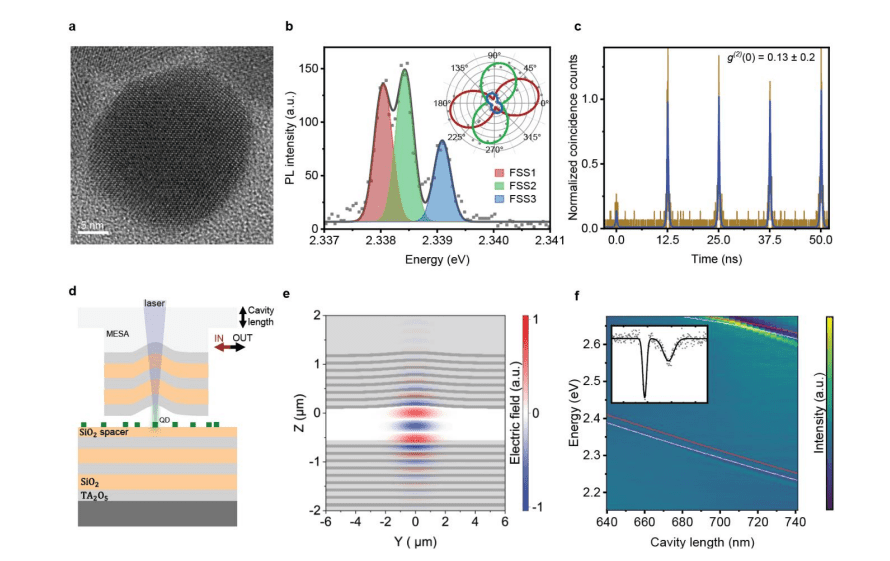
Researchers have demonstrated significant Purcell enhancement of single quantum dots within a tunable open Fabry-Perot microcavity. This enhancement, achieved by carefully designing a microcavity that supports specific light modes, accelerates the emission of photons. The team used single cesium lead bromide perovskite quantum dots as light emitters and fabricated a microcavity with a Gaussian-shaped deformation to control the spatial and polarization properties of the light. Through precise measurements, they observed substantial increases in emission speed and confirmed the excitation of different Laguerre-Gaussian modes.
Crucially, the team verified the single-photon nature of the emission and monitored its stability over time. The results show a maximum Purcell enhancement of 4. 2 at 6 Kelvin and a more substantial 18. 1 at 50 Kelvin, demonstrating a significant acceleration of photon emission. This increased acceleration was particularly pronounced at the higher temperature, where the natural decay time of the perovskite dots is longer. This comprehensive characterization, coupled with precise control over cavity modes, represents a significant achievement in the field.
Perovskite Microcavity Generates Orbital Angular Momentum Photons
Scientists have achieved a breakthrough in generating single photons with orbital angular momentum by integrating perovskite quantum dots into an open Fabry-Perot microcavity. This innovative approach leverages Purcell enhancement to accelerate the emission of single photons, reducing decay times to as little as tens of picoseconds. The microcavity, engineered with a nanofabricated Gaussian-shaped deformation, supports Laguerre-Gaussian modes, enabling the generation of photons carrying orbital angular momentum. Detailed measurements revealed a high cavity quality factor, indicating efficient light confinement. By carefully tuning the cavity resonance, the researchers selectively coupled single perovskite dots to different Laguerre-Gaussian modes, directly observing the characteristic spatial patterns of the emitted single-photon beams. These results pave the way for high-rate single-photon sources that directly generate Laguerre-Gaussian beams, opening new possibilities for advanced photonic technologies.
Purcell Enhancement of Single Perovskite Photons
Researchers have successfully coupled single colloidal perovskite quantum dots to specific modes within an open Fabry-Perot microcavity, demonstrating a significant advancement in single-photon generation. By engineering a Gaussian-shaped deformation into the microcavity, the team achieved Purcell-enhanced emission, accelerating the decay of single photons to as little as 30 picoseconds and observing Purcell factors up to 18. 1. This enhancement enables the direct generation of single photons carrying orbital angular momentum, specifically within Laguerre-Gaussian modes, and allows for control of the generated photons through tuning of the cavity resonance. The findings represent a viable strategy for creating high-efficiency single-photon sources suitable for quantum applications, leveraging the additional dimensions offered by these unique light states. Future work will likely focus on optimizing these parameters and exploring the full potential of this approach for complex quantum systems.
🗞 Purcell-enhanced single-photon generation from CsPbBr quantum dots in in-situ selected Laguerre-Gaussian modes
🧠 ArXiv: https://arxiv.org/abs/2510.01837
See today’s quantum computing news on Quantum Zeitgeist for the latest breakthroughs in qubits, hardware, algorithms, and industry deals.