Quantum simulation holds immense promise, but building practical quantum computers requires overcoming the challenges posed by inherent errors in quantum systems. Dawei Zhong from the University of Southern California, William Munizzi from the University of California, Los Angeles, and Huo Chen, alongside Wibe Albert de Jong, present a new approach that combines the strengths of both error detection and error mitigation techniques. Their hybrid protocol integrates Pauli twirling, probabilistic error cancellation, and error detecting codes to suppress errors without the demanding requirements of full fault tolerance. This work significantly advances the field by reducing the overhead typically associated with error mitigation, and demonstrates improved performance on complex quantum circuits, bringing practical quantum simulation closer to reality.
However, quantum error mitigation has emerged as a promising approach for improving the performance of noisy quantum simulations. This work introduces a hybrid protocol that combines the strengths of both error detection and error mitigation techniques, aiming to achieve more accurate results with fewer resources. The protocol leverages error detection to identify potentially erroneous outcomes, while simultaneously employing error mitigation strategies to reduce the impact of noise on the remaining data. This approach provides a more robust and efficient method for extracting meaningful results from noisy quantum simulations, particularly when full quantum error correction is not yet feasible.
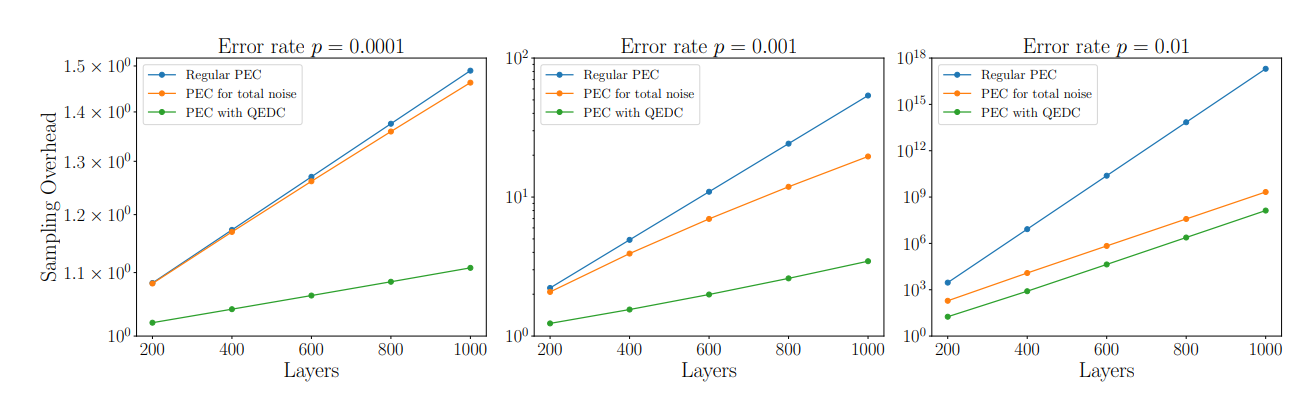
This research develops a hybrid error suppression protocol that integrates Pauli twirling, probabilistic error cancellation, and the [[n, n−2, 2]] quantum error detecting code. To reduce computational overhead, the team modified Pauli twirling by decreasing the number of Pauli operators used in the twirling set, and applied probabilistic error cancellation at the end of the encoded circuit to remove undetectable errors. The protocol’s performance was demonstrated on a non-Clifford variational quantum eigensolver circuit, estimating the ground state energy of a hydrogen molecule using qiskit AerSimul.
Energy Level Measurements Show Continuous Variation
The provided data consists of numerical values arranged in columns, likely representing scientific or engineering measurements. The first column contains a continuously increasing number, while subsequent columns contain corresponding values, potentially representing energy levels, molecular dynamics, spectroscopic data, or the result of mathematical function evaluations. This data could also represent physical properties of a material as a function of a specific parameter. Several analyses can be performed on this data, including data cleaning to address missing or duplicate values, calculating descriptive statistics, identifying correlations between columns, performing regression analysis, creating data visualizations, identifying trends, and detecting outliers.
Data transformation techniques, such as normalization, standardization, and feature engineering, can also be applied. To provide more specific assistance, understanding the data’s representation, units of measurement, and the desired outcome of the analysis is crucial. For example, the data can be parsed into a list or dictionary, and basic statistics like the mean and standard deviation of each column can be calculated, or a scatter plot of the first two columns can be created. While the amount of data is substantial, breaking it down into smaller chunks or utilizing powerful data analysis tools like Python with libraries such as Pandas, NumPy, and Matplotlib may be necessary for more complex analyses.
Hybrid Error Suppression Improves Quantum Accuracy
This work demonstrates a hybrid error suppression protocol that integrates Pauli twirling, probabilistic error cancellation, and a quantum error detecting code, offering a pathway towards improved performance on near-term quantum computers. By strategically combining these techniques, and modifying Pauli twirling to reduce computational overhead, the team achieved a reduction in undetectable errors within encoded circuits, ultimately enhancing the accuracy of quantum computations. The researchers successfully implemented this protocol on a variational eigensolver circuit, estimating the ground state energy of a molecule and observing a significant improvement in the measured expectation value, marking the first hardware implementation of this type of hybrid error suppression. The team acknowledges limitations related to the classical computational cost of probabilistic error cancellation, particularly for larger circuits, and the potential for bias when employing simplified noise models. Future work should focus on developing sparse noise models to reduce the classical resources required for error mitigation, while carefully considering the trade-off between computational cost and the introduction of bias as circuit size increases. This research establishes a framework where quantum error detection and error mitigation techniques mutually reinforce each other, paving the way for more reliable quantum computations with currently available hardware.
🗞 Combining Error Detection and Mitigation: A Hybrid Protocol for Near-Term Quantum Simulation
🧠 ArXiv: https://arxiv.org/abs/2510.01181
See today’s quantum computing news on Quantum Zeitgeist for the latest breakthroughs in qubits, hardware, algorithms, and industry deals.