

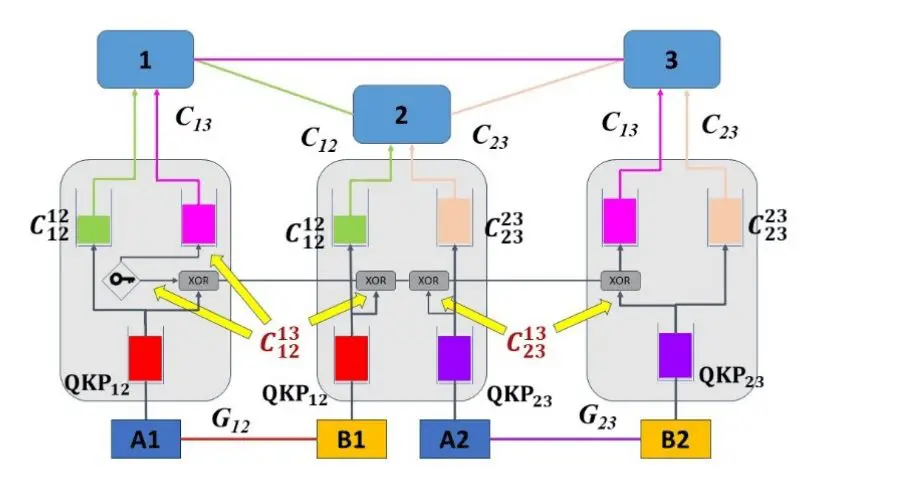
Quantum key distribution (QKD) promises secure communication, but extending its reach beyond point-to-point links remains a significant challenge. Antonis Selentis, Nikolas Makris, and Alkinoos Papageorgopoulos, along with Persefoni Konteli, Konstantinos Christodoulopoulos, and George T. Kanellos, investigate two potential solutions, relayed and switched network architectures, to address this limitation. Their work represents a crucial step towards practical, wide-area quantum communication networks, as they demonstrate how to optimise key distribution across multiple nodes. By combining experimental benchmarking of commercial QKD modules with detailed theoretical modelling, the researchers reveal the strengths and weaknesses of each approach, showing that switched networks excel in dense configurations while relayed networks perform better over longer distances, and highlighting the importance of module compatibility in network performance.
Relayed Versus Switched Quantum Key Distribution
Scientists developed a comprehensive methodology to evaluate two distinct architectures for network-wide quantum key distribution, namely Relayed QKD and Switched QKD. The study initially focused on experimental benchmarking of commercial prepare and measure QKD modules from three vendors, assessing performance in both matched and unmatched module pairs to simulate configurations found within a Switched QKD network. This revealed notable variations in the generated secret key rate between matched and unmatched pairs, prompting a detailed theoretical analysis of network-wide performance. Researchers constructed a theoretical framework based on uniform ring networks, deriving optimal key management configurations and analytical formulas to determine the achievable consumed secret key rate.
The team systematically compared network performance under varying conditions, including ring sizes, QKD link losses, and receivers’ sensitivity, incorporating performance penalties associated with unmatched QKD modules, a key factor in the efficiency of the Switched QKD architecture. This approach enabled a precise quantification of the trade-offs between the two architectures. Scientists modeled key relaying chains within the Relayed QKD architecture, accounting for key consumption at each relay node and its impact on the achievable secret key rate, while simultaneously simulating the dynamic reconfiguration of optical switches within the Switched QKD network to assess the efficiency of establishing direct QKD links between node pairs. The study demonstrated that Switched QKD performs optimally in dense rings with short distances and large node counts, while Relayed QKD proves more effective over longer distances and with fewer nodes. These findings provide valuable insights into the design and deployment of future quantum networks, highlighting the importance of considering network topology and module matching.
Commercial QKD Performance Across Network Architectures
This work presents a comprehensive evaluation of two network-wide quantum key distribution (QKD) architectures, Relayed and Switched, focusing on their performance under varying network conditions and module capabilities. Experiments were conducted using commercial QKD modules from three vendors, Toshiba, ID Quantique, and Think Quantum, employing phase encoding, time-bin phase encoding, and polarization-based encoding technologies, respectively. Initial measurements characterized the secret key rate (SKR) generation as a function of link attenuation for each vendor, establishing baseline performance for matched module pairs. These tests revealed that the Toshiba modules operate effectively between -6 dBm and -22 dBm, while ID Quantique modules require 10 dB attenuation and Think Quantum modules have no attenuation requirement.
Further experiments compared SKR generation for matched and unmatched module pairings, crucial for the Switched architecture which relies on arbitrary module connections. Using the Toshiba modules, tests were conducted over 6. 4km and 8km links with 6 dB attenuation, first in a matched configuration and then in an unmatched configuration. Results demonstrate a significant impact of unmatched modules on SKR, highlighting the need for modules capable of maintaining performance with arbitrary connections. Theoretical analysis, based on uniform ring networks, derived optimal key management configurations and analytical formulas for achievable SKR consumption, revealing that the Switched architecture achieves significantly higher SKR consumption for small distances and large node counts, while the Relayed architecture performs better for large distances and medium to large node counts. The findings confirm that penalties associated with unmatched QKD modules significantly degrade the efficiency of the Switched architecture, emphasizing the importance of developing modules capable of arbitrary connections with minimal performance loss. The team’s work establishes a clear path forward for optimizing QKD network performance and realizing the full potential of secure quantum communication.
Relayed and Switched Quantum Key Distribution Compared
This research comprehensively evaluates two architectures for establishing network-wide quantum key distribution: Relayed and Switched. The Relayed approach transmits keys across multiple links, while the Switched architecture utilizes optical switches to create direct connections between modules, offering end-to-end key distribution without reliance on trusted nodes. Through experimental analysis of commercially available quantum devices, the team observed variations in secret key rates when pairing modules from different vendors, highlighting the importance of compatibility. The study employed theoretical modelling to compare the performance of both architectures under various network conditions, including ring size, link losses, and receiver sensitivity.
Results indicate that the Switched architecture excels in dense networks characterized by short distances and numerous nodes, while the Relayed approach proves more effective over longer distances. Notably, the research demonstrates that even with performance penalties arising from mismatched module pairings, the Switched architecture remains competitive and can benefit from flat secret key rate generation at low attenuation. The authors acknowledge that inconsistencies between quantum modules significantly impact the efficiency of the Switched architecture, and minimizing these penalties is crucial for realizing its full potential. They suggest that a hybrid approach, combining the strengths of both Relayed and Switched architectures, could further enhance network security and efficiency. Future work could focus on addressing module incompatibility and optimizing hybrid network designs for improved performance and scalability.
🗞 Evaluating Relayed and Switched Quantum Key Distribution (QKD) Network Architectures
🧠 ArXiv: https://arxiv.org/abs/2509.24440



See today’s quantum computing news on Quantum Zeitgeist for the latest breakthroughs in qubits, hardware, algorithms, and industry deals.



