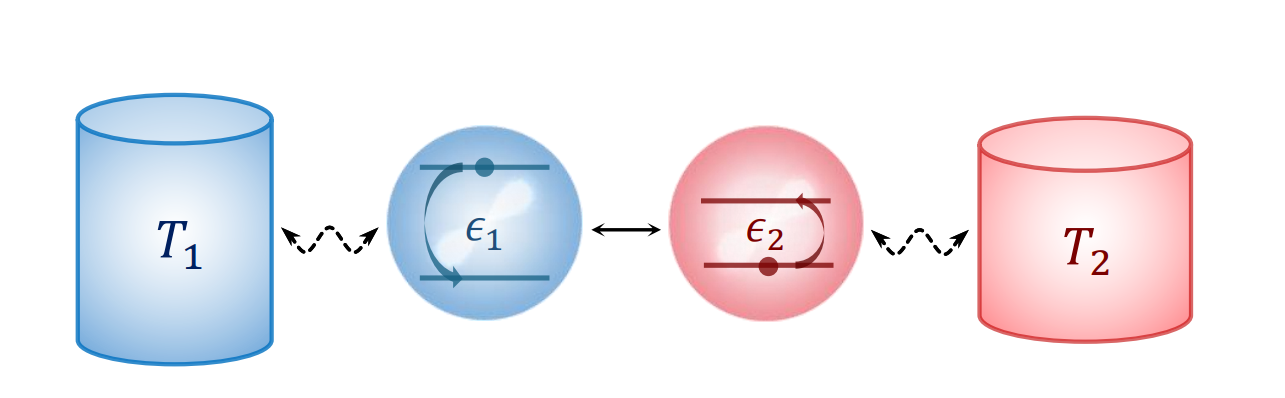
The subtle energy shifts known as the Lamb shift, typically considered a minor effect in quantum systems, unexpectedly play a critical role in determining how heat flows. Zi-chen Zhang from Dalian University of Technology and Chang-shui Yu investigate this phenomenon by modelling heat transport through coupled atoms, revealing that the Lamb shift dramatically alters the behaviour of heat current. Their work demonstrates that at low temperature differences, the Lamb shift actually reduces heat flow, but at higher differences, it prevents heat current from becoming infinitely large, a limitation not present when the shift is ignored. This research not only highlights the importance of accounting for the Lamb shift in understanding heat transfer, but also expands our knowledge of its broader impact on quantum thermodynamics.
Quantum Thermodynamics, Engines and Refrigerators Explored
Research at the intersection of quantum mechanics, thermodynamics, and nanotechnology explores the fundamental limits of energy conversion and information processing in the quantum realm. Scientists investigate quantum heat engines, refrigerators, and the theoretical limits of thermodynamic efficiency, focusing on systems not in thermal equilibrium. This work examines how quantum mechanics impacts concepts like heat, work, and efficiency, and how to build better quantum information processing and communication systems. Investigations include the behavior of quantum systems interacting with their environment, and the role of quantum entanglement in enhancing thermodynamic behavior.
Researchers also study thermal transport and rectification, aiming to control heat flow at the nanoscale using devices that allow heat to flow preferentially in one direction. Specific areas of study encompass finite-time thermodynamics, analyzing processes occurring in limited time, and the development of quantum analogues of classical engines like the Otto cycle. Scientists are designing and analyzing quantum heat engines and refrigerators using qubits as the working substance, and investigating the behavior of coupled quantum systems. Theoretical work focuses on non-equilibrium entanglement, thermal rectification, and different approaches to describing open quantum systems using master equations. This vibrant field seeks to develop new quantum devices with enhanced performance and functionality, potentially leading to technological breakthroughs.
Lamb Shift Impacts Atomic Heat Currents
Scientists have revealed the significant influence of the Lamb shift, an energy correction arising from interactions with the environment, on heat transport through coupled two-level atoms. The study employed established theoretical methods to describe the dynamic evolution of this open system, acknowledging that all physical systems exchange energy with their surroundings. Researchers meticulously calculated the Lamb shift resulting from the interaction between the atoms and their respective thermal reservoirs, recognizing its potential to modify energy levels and impact heat transfer. This involved constructing a theoretical model of two coupled atoms, each connected to a distinct heat bath, and deriving master equations to describe the system’s evolution while accounting for environmental effects.
Calculations comparing heat currents with and without the Lamb shift revealed a substantial deviation from conventional behavior. Without the Lamb shift, the heat current approached an upper bound as the temperature difference between the reservoirs increased. However, when the Lamb shift was considered, the heat current continued to increase monotonically with increasing temperature difference, demonstrating a significant enhancement of energy transfer. This difference persisted even with varying system parameters, confirming the robustness of the findings. The study demonstrates that accurately accounting for the Lamb shift is critical for predicting heat currents and understanding energy shifts in quantum thermodynamic systems.
Lamb Shift Suppresses Heat Current at Low Gradients
Research demonstrates the significant influence of the Lamb shift, an energy correction arising from environmental interactions, on heat transport through coupled two-level atoms. Researchers found that the Lamb shift suppresses the steady-state heat current at small temperature gradients, indicating a reduced flow of energy when temperature differences are minimal. However, the team discovered a dramatic shift in behavior at larger temperature gradients. Without accounting for the Lamb shift, the heat current reaches an upper bound, effectively limiting the maximum rate of energy transfer. In stark contrast, including the Lamb shift allows the heat current to increase monotonically with increasing temperature difference, removing this upper limit and enabling potentially unbounded energy flow. This breakthrough delivers a deeper understanding of quantum heat transport and its dependence on environmental factors, with implications for quantum thermodynamics and the design of efficient energy transfer systems.
Lamb Shift Governs Quantum Heat Transport
This research demonstrates a significant role for the Lamb shift in influencing heat transport at the quantum level, challenging the conventional assumption that it represents a negligible correction. Researchers found that the Lamb shift suppresses the steady-state heat current at small temperature differences, while allowing the current to increase monotonically at larger temperature differences, unlike systems where the current saturates. These findings reveal how quantum coherence and interactions between a system and its environment collectively govern heat flow, providing fundamental insights into quantum heat transport mechanisms. Researchers suggest future work could explore the implications of the Lamb shift in areas such as cavity quantum electrodynamics and the quantum description of thermodynamic cycles, potentially informing the development of quantum materials with tailored thermal properties and improved quantum technologies.
🗞 Dual effects of Lamb Shift in Quantum Thermodynamical Systems
🧠 ArXiv: https://arxiv.org/abs/2509.25710
See today’s quantum computing news on Quantum Zeitgeist for the latest breakthroughs in qubits, hardware, algorithms, and industry deals.