Quantum computing with light, or photonics, holds immense promise, but building stable and reliable quantum circuits remains a significant challenge. Jonatan Piasetzky, Amit Rotem, and Yuval Warshavsky, all from Tel Aviv University, alongside Yehonatan Drori, Khen Cohen, and Yaron Oz, now demonstrate a crucial advance in this field. The team designed and built a new type of component, called a composite segmented directional coupler, to create a fundamental quantum gate, the controlled-NOT gate. This innovative design dramatically improves the stability and accuracy of the gate, reducing errors by nearly half and making the technology far less sensitive to the inevitable imperfections of the manufacturing process, paving the way for more robust and scalable quantum photonic circuits.
Silicon Photonic CNOT Gate Demonstration
Researchers have made significant progress in quantum computing by developing a silicon-on-insulator (SOI) photonic chip that implements a controlled-NOT (CNOT) gate, a fundamental component for processing quantum information. Their work demonstrates improved performance compared to previous designs, largely due to the innovative use of a segmented composite design for the couplers, which enhances robustness and reduces sensitivity to variations in the chip’s structure. The research combines detailed simulations with experimental validation, with a strong emphasis on identifying and modeling sources of noise that can degrade performance. The core innovation lies in the segmented composite design of the directional couplers, improving resilience against fabrication errors and minimizing sensitivity to variations in waveguide parameters.
The segments are connected by smooth transitions that minimize signal loss, ensuring efficient transfer of quantum information. Scientists developed a comprehensive model that incorporates errors in the splitting ratios of the directional couplers, allowing them to predict and mitigate the impact of fabrication imperfections. This detailed modeling enabled the team to achieve improved CNOT gate performance. The chip is fabricated on a silicon-on-insulator (SOI) platform, a common choice for integrated photonics due to its low optical loss and compatibility with existing manufacturing techniques. The research combines classical light characterization of individual couplers with quantum measurements of the CNOT gate performance, providing a comprehensive understanding of the device’s behavior.
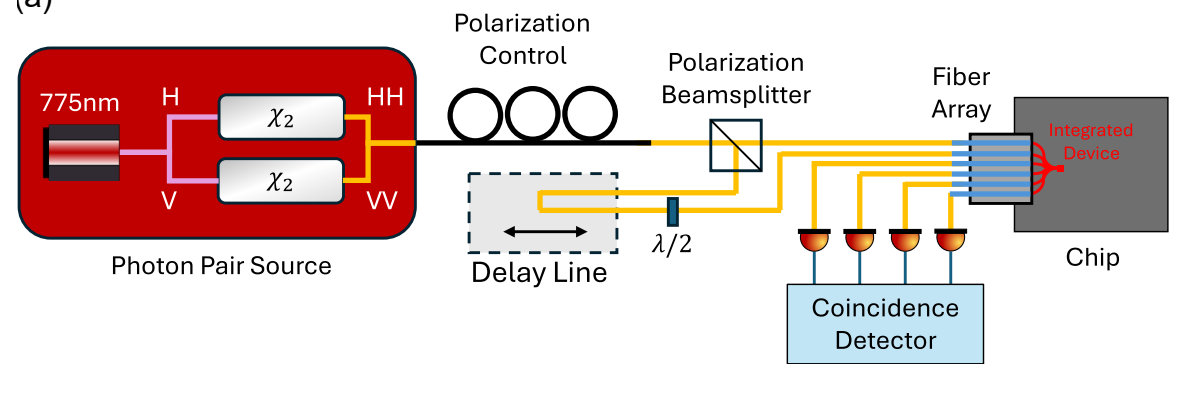
Waveguide parameters, including width, gap, and height, were optimized through simulations to maximize performance. The experimental setup utilizes a photon pair source based on type-0 spontaneous parametric down-conversion (SPDC) at 1550nm. Signal and idler photons are directed into polarization-maintaining fibers, separated using a polarization controller and beam splitter, and then coupled into the CNOT chip. A motorized delay stage and half-wave plate maximize the interference visibility, while superconducting nanowire single-photon detectors (SNSPDs) from Quantum Opus detect the output states.
Coincidence detection, performed using a TimeTagger 11 with a 500ps coincidence window, records data over 4000-second intervals. Further research will focus on quantifying the achieved CNOT gate fidelity, a crucial metric for evaluating performance. Scaling up to larger numbers of qubits and gates remains a key challenge, and the scalability of this design needs to be investigated. A more detailed analysis of the impact of different types of fabrication variations would also be valuable. Comparing the performance of this design to other CNOT gate implementations, and exploring error correction techniques, will further advance the field of quantum computing.
Integrated CNOT Gate with Segmented Directional Couplers
Scientists have achieved a significant breakthrough in quantum photonics by demonstrating a fully integrated controlled-NOT (CNOT) gate built entirely from composite segmented directional couplers (CSDCs). This work establishes CSDCs as robust, passive building blocks for scalable quantum circuits, surpassing conventional uniform directional couplers in performance and reproducibility. The team designed and fabricated a CNOT gate, replacing all directional couplers with their CSDC counterparts, and rigorously tested its performance through numerical simulation, classical characterization, and quantum two-photon experiments. Results demonstrate a substantial improvement in gate fidelity with the CSDC design achieving a mean error probability of 3.
01% ±0. 47%, compared to 5. 5% ±2. 1% for the legacy uniform design. This nearly halves the average error rate, representing a critical step towards reliable quantum computation.
Furthermore, the CSDC design exhibits significantly reduced variability, establishing a more consistent and predictable gate operation. The research team employed coupled-mode theory simulations, utilizing silicon-on-insulator waveguides at a wavelength of 1550nm with a 220nm thickness and 650nm center-to-center gap. To characterize single-coupler performance, researchers fabricated approximately 150 isolated directional couplers, extracting splitting ratios with classical light and approximating error distribution using a noisy gate model. This model accounted for variations in the gate parameters, allowing scientists to predict and evaluate the overall CNOT performance.
🗞 High fidelity CNOT gates in photonic integrated circuits using composite segmented directional couplers
🧠 ArXiv: https://arxiv.org/abs/2509.25505


See today’s quantum computing news on Quantum Zeitgeist for the latest breakthroughs in qubits, hardware, algorithms, and industry deals.