Topological superconductors harbour exotic states of matter, and understanding their behaviour is a central challenge in modern condensed matter physics. David Haink, Andreas Buchheit, and Benedikt Fauseweh, from the German Aerospace Center and Saarland University, investigate a modified version of the well-known Kitaev chain model, incorporating long-range interactions between electrons. Their work reveals that these interactions create a unique hybridization of topological edge modes, even when those modes appear completely separate, and crucially, maintains their algebraic decay with system size, unlike previous theoretical predictions. This discovery demonstrates a pathway to robust topological superconductivity in systems with long-range interactions, potentially offering new avenues for designing and controlling quantum devices, and suggesting that finite-size effects could be experimentally observable in mesoscopic systems.
Long-Range Interactions and Majorana Mode Hybridization
Researchers investigate how long-range interactions affect Majorana zero modes, localized states appearing in one-dimensional superconducting systems. These modes are promising for building robust quantum devices, but their behaviour under extended interactions remains largely unexplored. The team combines analytical calculations and numerical simulations to determine the conditions under which topological protection, a key property safeguarding these modes, persists. The method involves modelling the system as a chain with long-range connections between sites, allowing detailed analysis of energy levels and wave function distribution.
The analysis reveals a critical interaction strength beyond which topological protection breaks down and the Majorana modes lose their unique zero-energy character. Importantly, the team identifies a parameter range where the Majorana modes remain localized at the chain edges even with significant long-range interactions, suggesting these interactions do not necessarily destroy the topological properties. This research deepens understanding of topological superconductivity and provides insights for designing robust quantum devices based on Majorana zero modes.
Deriving Self-Consistent Long-Range Kitaev Chains
Scientists have developed a new theoretical framework for understanding topological superconductivity, starting with a model describing electrons hopping between sites and interacting via a density-density interaction that weakens with distance. Applying a mean-field approach, the team derived a self-consistent long-range Kitaev chain, where superconducting pairing emerges naturally from the underlying interactions. This approach differs from previous studies that directly assumed long-range pairing. The study began with a Hamiltonian encompassing both electron hopping and interaction, allowing for algebraic decay with distance.
Applying the mean-field approximation, researchers derived effective pairing terms that self-consistently incorporate the long-range interactions, resulting in a modified Kitaev chain with unique properties. This self-consistency is crucial, as it ensures the pairing reflects the underlying interactions and avoids artificial assumptions about the superconducting gap. Scientists characterized the edge modes, specifically their mass and scaling with chain length, and compared these properties to those of non-self-consistent models. The team demonstrated that, despite exponential wavefunction localization, algebraic decay with system size persists for all interaction strengths. This contrasts with non-self-consistent models, where massive Dirac fermions emerge for certain interaction strengths, highlighting the importance of self-consistency. This approach provides a powerful tool for understanding and predicting the behaviour of topological superconductors with long-range interactions, paving the way for potential applications in fault-tolerant quantum computing.
Long-Range Interactions Preserve Majorana Edge Modes
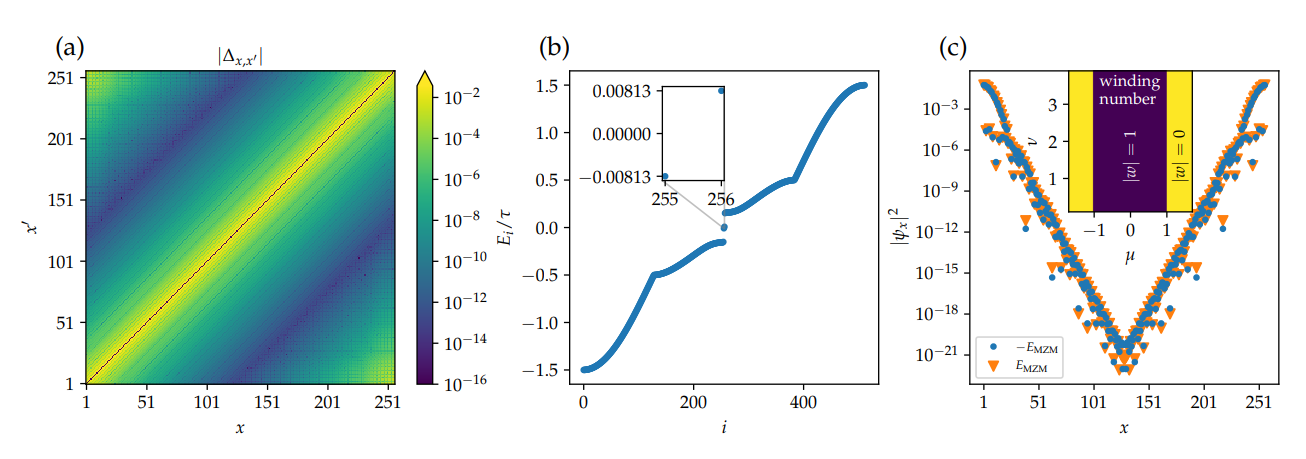
This research demonstrates that topological edge modes, known as Majorana modes, persist even with long-range interactions within a one-dimensional superconducting system. By developing a self-consistent theoretical model, the team showed that these modes maintain an algebraic decay with system size, despite the presence of exponentially localized correlations at the chain edges. This contrasts with previous models where long-range interactions often lead to massive Dirac modes, and highlights the importance of self-consistency in accurately describing these systems. The study reveals a unique band structure in the correlation matrix, separating short-range and long-range correlations, and influencing the resulting gap matrix.
This structure leads to hybridization of the edge modes, meaning they are simultaneously localized at both ends of the chain, even when their wavefunctions do not significantly overlap. The researchers observed that the edge modes remain massless in the theoretical limit of an infinitely large system, but acknowledged that finite-size effects can be experimentally relevant in smaller, mesoscopic systems. The persistence of algebraic decay, despite long-range interactions, is dependent on the self-consistent nature of the model. Future work could explore the implications of these hybridized edge modes for topological qubit devices, and investigate the impact of finite-size corrections in realistic experimental setups.
🗞 Non-local edge mode hybridization in the long-range interacting Kitaev chain
🧠 ArXiv: https://arxiv.org/abs/2509.26447




See today’s quantum computing news on Quantum Zeitgeist for the latest breakthroughs in qubits, hardware, algorithms, and industry deals.