The pursuit of practical quantum computation faces significant hurdles from the inherent noise present in current hardware, demanding the development of algorithms that can withstand these imperfections. Maria Dinca from the University of Oxford, David J. Luitz and Maxime Debertolis from the University of Bonn, lead a team that investigates how to improve the reliability of quantum computations by comparing different methods for evolving quantum states. They employ advanced techniques called quantum process tomography to meticulously characterise the noise affecting superconducting quantum processors during operation, and then compare a standard approach to simulating quantum evolution with a more compressed circuit design. The results demonstrate that this compressed circuit consistently exhibits greater resilience to noise, achieving stronger signal preservation during computation and representing a promising step towards building more robust quantum computers.
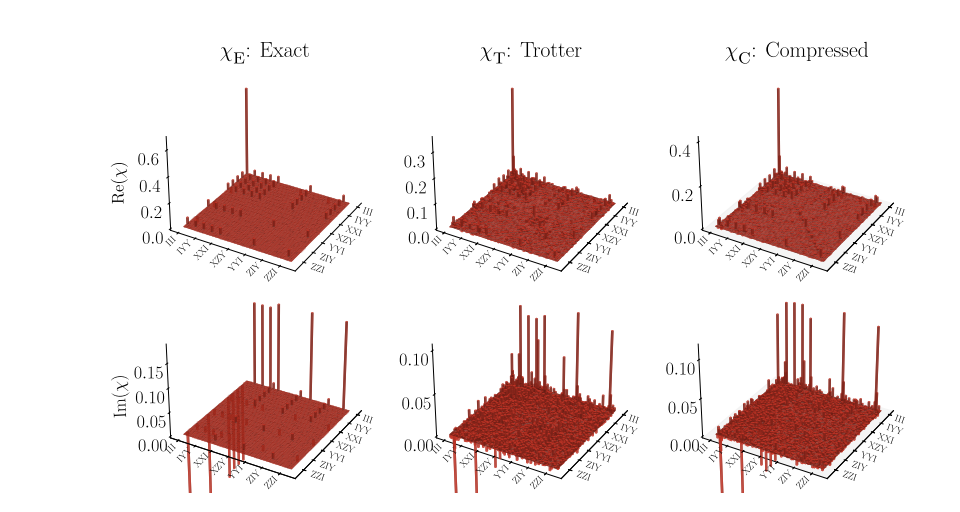
The team meticulously characterised these circuits on superconducting quantum processors, reconstructing the quantum process to precisely evaluate its fidelity and identify the dominant sources of error. By analysing circuits with varying numbers of compressed steps, ranging from one to eight, the researchers demonstrated a significant reduction in gate count compared to standard time evolution implementations, while maintaining comparable accuracy. The results reveal that the primary source of error is not the compression itself, but rather imperfections in the underlying single and two-qubit gates. The team then developed a method to mitigate these gate errors, substantially improving the overall circuit fidelity, representing a crucial step towards realising fault-tolerant quantum simulation on near-term quantum hardware.
Selective Tomography with Mutually Unbiased Bases
This research explores advanced techniques for quantum process tomography, the task of fully characterising a quantum process. Traditional methods require substantial resources, so scientists investigated selective quantum process tomography and Pauli twirling to reduce this overhead. Selective quantum process tomography leverages mutually unbiased bases and cleverly designed measurements to extract information about the process, while Pauli twirling simplifies the description of a quantum process by averaging over random Pauli conjugations. Selective quantum process tomography relies on the relationship between the elements of the process matrix and the average survival probability of specific quantum processes, calculated using a sum over a set of states forming a 2-design.
Mutually unbiased bases are crucial, providing maximal information about a quantum state and enabling efficient measurement strategies. Pauli twirling simplifies the description of a quantum process by averaging over random Pauli conjugations, effectively diagonalising the process in the Pauli basis. The researchers demonstrate that combining selective quantum process tomography and Pauli twirling offers a more efficient and comprehensive method for quantum process tomography. Selective quantum process tomography reconstructs the off-diagonal elements of the process matrix, while Pauli twirling reconstructs the diagonal elements. This combined approach reduces the number of measurements and simplifies the experimental setup.
Compressed Circuits Resist Quantum Noise Effectively
This research demonstrates that compressed quantum circuits outperform standard Trotter circuits in simulating quantum systems, even with realistic noise present in current quantum hardware. Scientists characterised the behaviour of both circuit types on superconducting quantum computers, using advanced process tomography techniques to simulate the time evolution of three- and four-qubit wave functions. The results show that compressed circuits maintain higher process fidelity at comparable levels of approximation error, suggesting they are more robust against noise during computation. Analysis of the circuits revealed that compressed circuits exhibit greater resilience to depolarizing noise, a common source of error in quantum computers, than their Trotter counterparts.
This advantage stems from the design of compressed circuits, which prioritises minimising approximation errors within the constraints of hardware connectivity and circuit depth. While implementing selective process tomography on larger systems required additional gates, the underlying trend of improved noise resilience in compressed circuits remained consistent. These findings reinforce the value of exploring variational approaches and developing noise-resilient algorithms to overcome the limitations of near-term quantum devices and enable longer, more accurate simulations. Continued development of compressed circuits and similar noise-resilient algorithms will be crucial for advancing the field of quantum simulation.
🗞 Quantum process tomography of a compressed time evolution circuit on superconducting quantum processors
🧠 ArXiv: https://arxiv.org/abs/2509.25342


See today’s quantum computing news on Quantum Zeitgeist for the latest breakthroughs in qubits, hardware, algorithms, and industry deals.