

Geofences, virtual boundaries used to trigger events based on location, are becoming increasingly important for managing spatial information and engaging users, but traditional designs often lack the flexibility needed for complex urban environments. Keisuke Otaki, Akihisa Okada, and Tadayoshi Matsumori, along with Hiroaki Yoshida, all from Toyota Central R and D Labs., Inc., address this challenge by developing a new method for automatically designing geofences from human mobility data. Their work moves beyond simple circular boundaries, which struggle to align with real-world features like roads and district lines, and instead formulates the problem as a binary quadratic optimisation. This innovative approach allows for the efficient creation of arbitrarily shaped geofences, offering a significant improvement in flexibility and accuracy for location-based applications and enabling more targeted and effective spatial experiences.
Systems can create spatially triggered events, including notifications about points of interest within a defined area, by sharing location information with user devices. Traditionally, creating these virtual boundaries, known as geofences, has been a manual process. However, recent advances in collecting human movement data now enable the automatic and data-driven design of geofences, addressing a significant challenge in the field.
Encoding Combinatorial Problems for Quantum Annealers
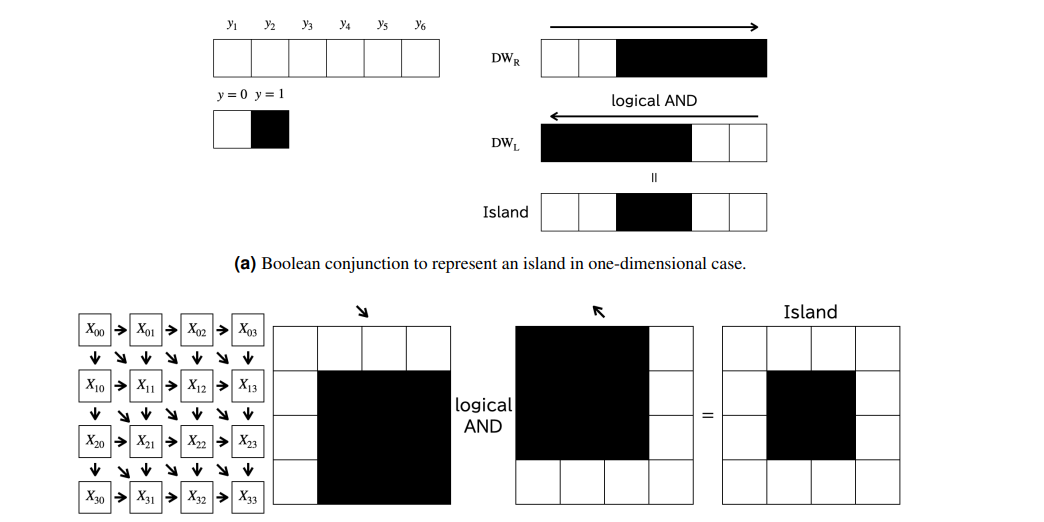
This research details a method for translating complex optimization problems into a format suitable for quantum computers, specifically quantum annealers, and other solvers. Many real-world problems involve vast numbers of potential solutions, and quantum annealers offer a potential pathway to finding the best one by identifying the lowest energy state of a system. A crucial step in this process is encoding, which involves representing variables as discrete values and defining their relationships. The authors propose a new encoding method called Domain Wall Encoding, which maps the problem onto the quantum annealer’s hardware.
They demonstrate how to formulate various optimization problems, such as rectangle packing and noise filter design, using this encoding. By comparing the performance of their method with existing techniques using both quantum annealers and classical solvers, they reveal its potential advantages. The results suggest that Domain Wall Encoding shows promise for certain problems, and combining quantum annealing with classical solvers can further improve performance. This research contributes to the field of quantum computing by providing a novel encoding method that could unlock the potential of quantum computers for solving real-world optimization challenges.
Data-Driven Geofences Using Quadratic Optimization
Scientists have developed a new method for designing geofences, moving beyond traditional circular shapes to create arbitrary forms that better reflect real-world environments. Existing systems often rely on circular geofences that overlap or fail to align with features like roads and district boundaries, particularly in dense urban areas. The team formulated the geofence design problem as a mathematical optimization problem, enabling the creation of flexible, data-driven geofence shapes. Experiments using both simulated and real-world movement data demonstrate the effectiveness of this new approach.
Analyzing data from the movements of 46 users, researchers successfully designed geofences that more accurately reflect the spatial distribution of activity. The team employed a powerful solver to handle the complex mathematical relationships inherent in the optimization process, achieving results not possible with traditional circular geofence designs. Detailed analysis reveals how specific parameters influence geofence shape, allowing scientists to precisely control the resulting geometry and tailor designs to specific needs.
Flexible Geofences From Mobility Data
This research addresses limitations in current geofence design, which traditionally relies on simple circular shapes that struggle to accurately represent complex urban environments. The team developed a new approach that models geofences using a grid of spatial cells, enabling the creation of arbitrary shapes from human movement data. By formulating the design problem as a mathematical optimization, they achieved efficient solutions even with complex geometries. The results demonstrate that this new modeling technique allows for flexible geofence design, automatically configuring meaningful notification areas and improving the delivery of location-based information. This advancement has potential applications in mobile notifications, regional information delivery, and the design of urban navigation systems. Further extensions could also incorporate dynamic points of interest and pedestrian accessibility into the model, establishing a foundation for future practical applications.
🗞 Data-Driven Discrete Geofence Design Using Binary Quadratic Programming
🧠 ArXiv: https://arxiv.org/abs/2509.24679

See today’s quantum computing news on Quantum Zeitgeist for the latest breakthroughs in qubits, hardware, algorithms, and industry deals.



