The emergence of magnetism without traditional magnetic materials represents a significant frontier in materials science, and recent research focuses on inducing magnetic order in layered graphene structures. Kilian Krötzsch, Kenji Watanabe, Takashi Taniguchi, Arnaud Magrez, and Mitali Banerjee, from institutions including École Polytechnique Fédérale de Lausanne and the National Institute for Materials Science, now demonstrate electrical control of magnetism in a unique form of graphene called rhombohedral hexalayer graphene. The team observes a switchable magnetic order, evidenced by a measurable electrical response, that can be repeatedly toggled using either electrical fields or by altering the number of charge carriers within the material. This achievement is particularly noteworthy because the magnetism arises from the material’s inherent electronic structure, not from external magnetic influences, and reveals a competition between different magnetic states under small magnetic fields, establishing rhombohedral graphene as a promising platform for exploring novel magnetoelectric phenomena and symmetry-breaking phases in materials.
Rhombohedral Graphene’s Anomalous Hall Response
This research focuses on the electrical properties of twisted few-layer graphene, specifically crystalline structures with rhombohedral stacking. Researchers carefully fabricate these samples and use Raman spectroscopy to confirm the desired stacking order, then isolate regions with this arrangement using advanced microscopy techniques. A central observation is the anomalous Hall resistance, a phenomenon where a voltage appears perpendicular to both current and magnetic field, suggesting broken time-reversal symmetry. The team observes hysteresis in this resistance, meaning its value depends on the history of the applied magnetic field, suggesting a switching or memory effect within the material.
Crucially, the anomalous Hall resistance changes with both the number of charge carriers and the electric displacement field, which is controlled by applying a voltage. The team demonstrates that they can manipulate this resistance using the electric displacement field, effectively tuning the material’s properties. Detailed measurements map the resistance as a function of carrier density and magnetic field, revealing the anomalous Hall resistance behavior at various electric displacement fields. This data suggests that researchers have created a system where they can control the electronic properties of twisted few-layer graphene using electric and magnetic fields, opening possibilities for future electronic devices.
Electric Control of Orbital Magnetism in RHG
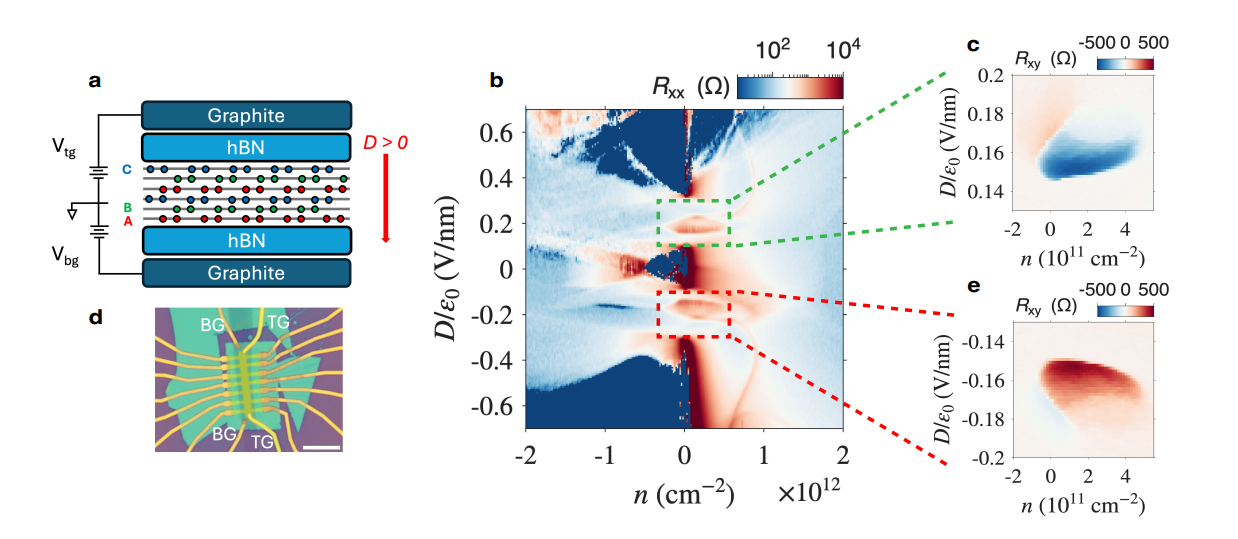
This study demonstrates a method for electrically controlling orbital magnetic order in crystalline rhombohedral hexalayer graphene without relying on twisted moiré superlattices, achieving non-volatile and hysteretic anomalous Hall resistance. Researchers mapped the transverse resistance as a function of both carrier density and electric displacement field, revealing tunability in both positive and negative displacement field regimes. To ensure the reliability of their findings, the team repeated measurements after initializing the magnetic field state and reversing the sweep direction, confirming the electric tunability remained consistent. The experimental setup involved precise control over both carrier density and displacement field while monitoring the resulting transverse resistance, allowing the team to observe a double sign reversal of the anomalous Hall resistance upon application of small perpendicular magnetic fields. These magnetic fields induced competition between distinct magnetic ground states, as evidenced by the observed changes in anomalous Hall resistance. Researchers further investigated this interplay by creating two-dimensional maps of transverse resistance, systematically varying carrier density and displacement field under a fixed magnetic field, and comparing the results obtained in different displacement field regions.
Electrically Toggled Anomalous Hall Effect in Graphene
This work details a breakthrough in controlling magnetic order within crystalline rhombohedral hexalayer graphene, achieving electrically toggled anomalous Hall resistance without relying on twisted moiré superlattices. Researchers fabricated a device fully encapsulated between layers of hexagonal boron nitride, employing dual graphite gates to independently control both the electric displacement field and carrier density within the graphene stack. Measurements of longitudinal resistance reveal distinct transport characteristics differing markedly from those of typical Bernal-stacked few-layer graphene. Focusing on regions of moderate positive and negative electric displacement fields, the team mapped transverse resistance as a function of carrier density and displacement field.
At zero magnetic field, sweeping the carrier density revealed almost complete reversal of the Hall resistance sign, demonstrating robust, non-volatile switching. This electrically controlled sign switching is attributed to the unique orbital magnetism within the rhombohedral hexalayer graphene. Analogous behavior was observed in regions with negative electric displacement fields, demonstrating full control over the magnetic order.
Electrically Controlled Magnetism in Graphene Layers
Researchers have demonstrated electrically switchable magnetism in crystalline rhombohedral hexalayer graphene, a material exhibiting a unique flat-band electronic structure. The team observed a finite Hall conductance even without an applied magnetic field, indicating the presence of intrinsic magnetic order arising from orbital magnetism and valley polarization within the material. Critically, they achieved non-volatile switching of this anomalous Hall resistance by manipulating either the carrier density or an applied electric displacement field, effectively controlling the magnetic order electrically. Further investigation revealed a complex interplay between different magnetic ground states, evidenced by a characteristic double sign reversal of the anomalous Hall resistance upon application of a small perpendicular magnetic field.
This behavior suggests a competition between the intrinsic orbital magnetization and the field-induced magnetism. The ability to tune this competition offers a pathway to control the magnetic properties of the material. This work establishes crystalline rhombohedral hexalayer graphene as a promising platform for investigating symmetry-breaking phases and emergent magnetism in flat-band systems.
🗞 Magnetoelectric Switching of Competing Magnetic Orders in Rhombohedral Graphene
🧠 ArXiv: https://arxiv.org/abs/2509.24672




See today’s quantum computing news on Quantum Zeitgeist for the latest breakthroughs in qubits, hardware, algorithms, and industry deals.