Controlling light at the nanoscale presents significant challenges, particularly in the mid-infrared spectrum where current materials often limit performance, hindering advances in areas such as free-space communication and thermal radiation management. Now, Felix Ulrich Brikh, Aleksei Ezerskii, Olesia Pashina, and colleagues demonstrate a breakthrough in dynamically tunable metasurfaces that overcomes these limitations. The team, spanning the École Polytechnique Fédérale de Lausanne, ITMO University, and Harbin Engineering University, fabricated silicon membrane metasurfaces exhibiting record-high quality factors and strong light manipulation capabilities. This innovative platform supports both electrically and optically driven modulation, achieving speeds compatible with modern electronics and opening new avenues for active control of mid-infrared light.
Dynamic Metasurfaces for Light Manipulation
This body of work centers on the design, fabrication, and control of metasurfaces, artificial materials engineered to manipulate light at the nanoscale. The overarching goal is to move beyond static optical elements towards dynamic and programmable optical systems, achieved through various tuning mechanisms and novel material combinations, opening new possibilities for light-based technologies. Key concepts include metasurfaces, 2D arrays of subwavelength structures controlling light’s amplitude, phase, and polarization, and quasi-bound states in the continuum (Quasi-BICs), resonant states highly sensitive to environmental changes and ideal for sensing and nonlinear optics. Researchers are exploring tunable metasurfaces, dynamically changing optical properties using electric fields, heat, mechanical deformation, liquid crystals, and phase-change materials.
Phase-change materials, capable of switching structural states upon heating, offer significant changes in optical properties. Exploiting the nonlinear response of materials within the metasurface generates new frequencies of light and advanced optical effects. All-dielectric metasurfaces, made entirely from dielectric materials, offer lower losses and suitability for high-power applications, while utilizing topological concepts creates robust and resilient optical resonances. Anapole states, possessing unique field distributions, further expand the possibilities for light manipulation. Research areas include highly sensitive molecular detection using the sharp resonances of quasi-BICs, fast and efficient optical modulators and switches for communication, new imaging techniques with enhanced resolution, and dynamic holograms with precise light beam steering.
Researchers are manipulating thermal radiation, creating new nonlinear optical devices, developing reconfigurable optical systems, and advancing metasurfaces for mid-infrared applications like spectroscopy and thermal imaging. Efficient generation of high-order harmonics of light is also being demonstrated, alongside the creation of actively responding metasurfaces. Specific materials utilized include graphene for tunable conductivity, yttrium hydride for active plasmonics, phase-change alloys for tunable optical properties, dielectric materials for low-loss metasurfaces, and liquid crystals for polarization control. Key trends include integrating multiple tuning mechanisms, utilizing artificial intelligence and machine learning for design and optimization, developing scalable fabrication techniques, exploring 3D metasurfaces, and discovering new materials with unique optical properties.
High-Q Metasurfaces via Quasi-BIC Engineering
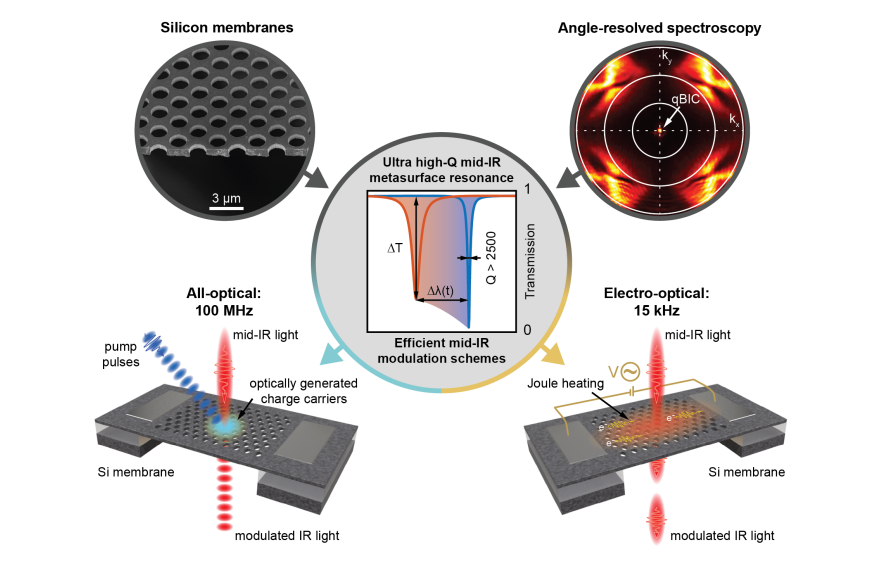
Scientists engineered high-performance metasurfaces using single-crystalline silicon membranes to overcome limitations in mid-infrared nanophotonics. They achieved record-high quality factors and dynamic tunability by pioneering a fabrication process utilizing CMOS-grade silicon-on-insulator substrates with wafer-scale techniques. This process creates 1-micrometer thick membranes perforated with hexagonally arranged 3. 3-micrometer holes. Numerical optimization guided the design of circular holes to support symmetry-protected bound states, transforming these non-radiative states into high-Q resonances using the quasi-BIC principle.
To control radiative losses and fine-tune the Q-factor, researchers introduced ellipticity to the holes while maintaining a constant area. Measurements reveal a maximum Q-factor of 3000. Unlike designs with small features, these metasurfaces feature large critical dimensions, making them robust and compatible with high-throughput fabrication methods like nanoimprint lithography and direct laser writing. A 4-inch wafer was fabricated using direct laser writing, demonstrating scalability for manufacturing. The crystallinity of the silicon and the absence of a substrate further minimized optical losses, enabling ultra-high Q-factors in the mid-infrared range.
To accurately measure these high Q-factors, the team developed a custom FTIR microscope accessory with spatial filtering, limiting the angular spread of incident light. Transmission spectra revealed a sharp resonance with a Q-factor of 2505 and an amplitude contrast approaching 50%, representing a significant improvement over previous mid-infrared metasurfaces. Further characterization utilized a mid-IR back focal plane open optics imaging setup, enabling detailed analysis of angular and polarization dispersion.
High-Q Metasurfaces Enable Mid-Infrared Light Control
Scientists have achieved a breakthrough in mid-infrared nanophotonics with the development of actively tunable metasurfaces fabricated from single-crystalline silicon membranes. These metasurfaces overcome limitations of previous designs by simultaneously delivering high-Q resonances, strong amplitude contrast, and compatibility with wafer-scale manufacturing. Experiments reveal record-high measured Q-factors up to 3000 in the mid-infrared spectrum, demonstrating a significant advancement in light control at the subwavelength scale. The team fabricated metasurfaces consisting of 1-micrometer thick silicon membranes perforated with hexagonally arranged holes.
Through precise numerical optimization and control of hole ellipticity, they created structures supporting symmetry-protected bound states in the continuum, transforming them into high-Q resonances. Measurements demonstrate that by tuning the ellipticity while maintaining a constant hole area, the Q-factor can be controlled across a broad range, reaching a maximum of 3000. Structures fabricated using direct laser writing achieved comparable Q-factors of up to 2000, showcasing the versatility of the fabrication process. This work showcases two distinct methods for dynamic modulation. The first involves on-chip electro-thermal tuning using a CMOS-compatible voltage, sustaining greater than 50% absolute signal variation at speeds up to 14. 5kHz. The second method utilizes ultrafast all-optical modulation via carrier generation in silicon, reaching estimated sub-GHz modulation rates and nanosecond response times.
🗞 Mid-IR Light Modulators Enabled by Dynamically Tunable Ultra High-Q Silicon Membrane Metasurfaces
🧠 ArXiv: https://arxiv.org/abs/2509.23167