The quest to translate the power of quantum nonlocality into practical cryptographic devices receives a significant boost from research led by Matilde Baroni of Sorbonne Université, Igor Klep of the University of Ljubljana, and Dominik Leichtle of the University of Edinburgh, along with their colleagues. Their work addresses a critical challenge in compiling multi-player quantum games for single devices, a process that replaces physical separation with complex computational methods. The team demonstrates, for the first time, a quantifiable level of security, known as soundness, for all such compiled games, moving beyond previously established asymptotic results. This achievement is particularly important because multipartite quantum games exhibit unique behaviours not found in simpler two-player scenarios, and this research establishes concrete security bounds essential for real-world cryptographic implementations. The researchers also introduce a new framework for understanding the capabilities of these devices and develop innovative techniques for analysing the strategies they employ, potentially opening new avenues for future investigation.
Sequential Non-Signaling Correlation Certification Approaches
Protocols for Certifying Sequential Quantum Correlations
Certifying Quantum Behavior in Sequential Protocols
Scientists are developing techniques to understand quantum correlations in sequential protocols, where players act in a specific order and information can only flow forward in time. This research aims to certify the presence of quantum behavior in these scenarios. Two recent studies offer distinct methods for achieving this goal, one focusing on a Schrödinger picture approach and the other on a Heisenberg picture approach. The first study constructs a sequential version of the Non-commutative Polynomial (NPA) hierarchy, analyzing how the quantum state changes after each player’s action. While effective, this approach is limited to scenarios involving only two players due to increasing complexity with additional participants.
The second study takes an algebraic approach, utilizing C-algebras to model the sequential protocol from the Heisenberg picture. This method defines a universal C-algebra that captures the structure of sequential measurements, allowing for generalization to scenarios with multiple players. This framework simplifies analysis by defining all player strategies within a single algebra, making it easily scalable and offering a versatile solution for complex, multi-player games.
Multipartite Game Soundness via Sequential NPA Hierarchy
Quantifying Soundness in Multipartite Nonlocal Games
Quantifying Soundness for Multipartite Nonlocal Games
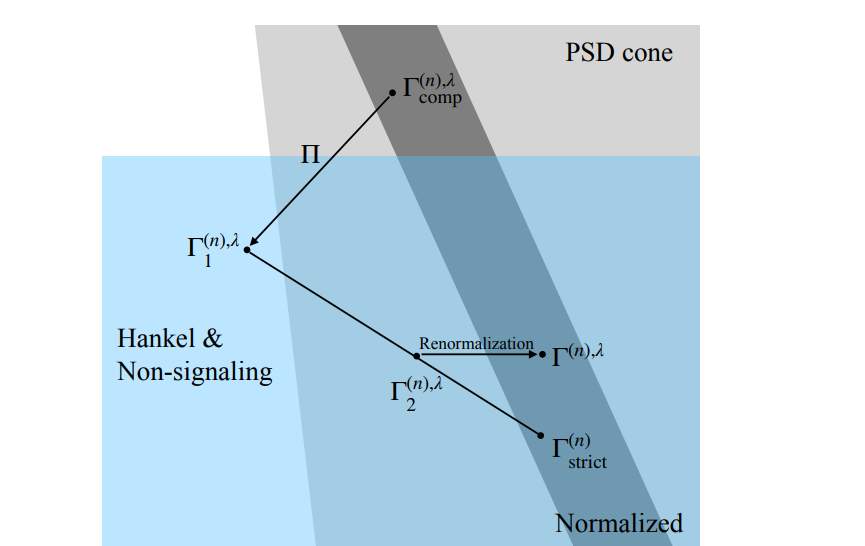
Scientists have developed a new method to establish the quantitative soundness of compiled nonlocal games, extending this crucial property to scenarios involving any number of players. This research demonstrates that strategies derived from complex games do not exceed the inherent limits set by the original game’s rules, even with finite cryptographic security. To achieve this, the team engineered a composable multipartite sequential NPA hierarchy, grounded in the Heisenberg picture of quantum mechanics. The study pioneered a new geometric proof technique, demonstrating that solutions derived from compiled strategies closely approximate feasible solutions within the newly developed NPA hierarchy. Researchers extracted a mathematical representation from the compiled strategy and applied a transformation to obtain a feasible solution. By adapting the NPA hierarchy and introducing the new geometric proof, scientists successfully demonstrated quantitative soundness for compiled games with any number of players, representing a significant advancement in quantum information science.
Finite Security for Multipartite Nonlocal Games
Scientists have achieved a breakthrough in the security of compiled nonlocal games, establishing quantitative soundness for all multipartite scenarios, a significant advancement over previous work limited to asymptotic guarantees or bipartite games. The research team demonstrated that for any k-partite nonlocal game and a given security parameter, an efficient prover cannot exceed the optimal quantum score by more than a negligible amount, ensuring the compiled game remains secure against dishonest provers. The team’s theorem establishes a bound on the compiled Bell score, showing it remains close to the optimal quantum score. Furthermore, the research introduces a novel NPA-like hierarchy, designed to model the sequential application of quantum instruments, which accurately captures the complex interactions in multipartite games.
This hierarchy converges to the optimal quantum score as the level increases, providing a robust framework for analyzing security. Experiments revealed that the compiled game’s score is bounded by the optimal quantum score plus a negligible function, ensuring a quantifiable level of security. This research delivers a significant step forward in the development of secure cryptographic protocols based on nonlocal games.
Implementing Nonlocal Games on Physical Quantum Devices
Compiling Nonlocal Games into Physical Quantum Devices
Multipartite Nonlocal Games Securely Compiled to Devices
This research successfully establishes quantitative soundness for compiling multipartite nonlocal games into single-device protocols, a significant advance in quantum cryptography. Prior work demonstrated this for simpler, bipartite games, but extending it to multipartite scenarios presented a substantial challenge. The team overcame this hurdle by developing a novel analytical framework and demonstrating that the KLVY compiler maintains its security guarantees even with multiple players. A key achievement lies in the introduction of a new hierarchy for analyzing instruments, proving its completeness and characterizing correlations arising from operationally-non-signaling sequential strategies.
This hierarchy, alongside innovative geometric arguments for decomposing strategies, provides a powerful tool for understanding and verifying the security of compiled games. The researchers acknowledge that their current model analyzes a linear sequence of players, and future work could extend this to more complex interaction structures, potentially offering insights into broader interactive quantum protocols relevant to quantum complexity theory and cryptography. This work strengthens the foundations of single-device quantum cryptography and provides new capabilities for the study of quantum information protocols.
🗞 Quantitative quantum soundness for all multipartite compiled nonlocal games
🧠 ArXiv: https://arxiv.org/abs/2509.25145