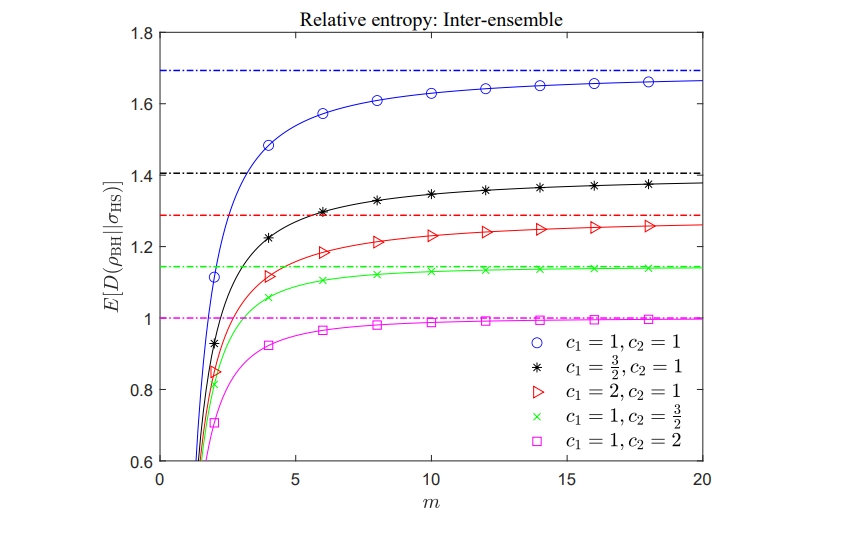
Relative entropy, a fundamental concept in information theory and quantum physics, quantifies the difference between two probability distributions, and Lu Wei investigates this property for random states, which are essential for modelling complex quantum systems. This research develops precise, explicit formulas for calculating the average relative entropy of independent states drawn from both identical and distinct ensembles, such as the Hilbert-Schmidt and Bures-Hall models. The team’s calculations reveal a surprising factorization within the ensemble averages, simplifying the complex unitary integrals required for the analysis, and these results complement earlier work that relied on approximations, providing an exact solution for states of arbitrary dimensions. This achievement advances our understanding of quantum information processing and the behaviour of complex quantum systems, offering a powerful tool for analysing and predicting their properties.
The research centres on analysing random states, which have diverse applications in modern quantum science including quantum circuit complexity, quantum device benchmarking, and entanglement estimation. The study investigates these states using both a single ensemble and two distinct ensembles, with a key finding being the observed factorization of ensemble averages after evaluating the necessary unitary integrals. The derived exact formula, specifically in the context of the Hilbert-Schmidt ensemble, complements previous work that obtained approximate solutions for states of equal dimensions using advanced mathematical techniques, and provides a more precise understanding of these systems. Different assumptions regarding the structure of Hilbert space lead to differing results and are a central focus of this investigation.
Random State Entanglement Entropy Calculations
This document presents a research paper focusing on the statistical properties of entanglement entropy, particularly when dealing with random states drawn from the Hilbert space of quantum systems. The core of the work investigates the connection between random matrix theory, specifically the Hilbert-Schmidt and Bures-Hall ensembles, and the statistical behaviour of entanglement entropy. A central goal is to calculate various statistical moments, including the mean, variance, skewness, and kurtosis, of the von Neumann entanglement entropy for subsystems of random quantum states. The research builds upon and extends existing knowledge of the Page curve, which describes the average entanglement entropy of a subsystem as a function of its size.
The team considered the Hilbert-Schmidt ensemble, representing random states with independent Gaussian-distributed matrix elements, and the more complex Bures-Hall ensemble, which arises in the context of random pure states. They also investigated fermionic Gaussian states. The authors relied on techniques from random matrix theory to calculate the statistical properties of entanglement entropy, employing Jacobian determinants and special functions like the Psi function. They utilized cumulant expansion to analyse the statistical properties of entanglement entropy. The paper derives exact formulas for the mean, variance, skewness, and kurtosis of the von Neumann entanglement entropy for both the Hilbert-Schmidt and Bures-Hall ensembles.
The authors verify several existing conjectures regarding the statistical behaviour of entanglement entropy, including those related to the Page curve and the fluctuation of entropy. The research extends previous results to include higher-order statistical moments and considers more general ensembles. These findings are significant because they provide insights into the behaviour of quantum systems exhibiting chaotic behaviour, and are relevant to the black hole information paradox. Understanding the fluctuations of entanglement entropy can be important for designing efficient quantum error correction codes, and contributes to the fundamental understanding of entanglement and its role in quantum information processing.
Precise Entropy Formulas for Random Quantum States
Scientists have achieved exact formulas for calculating the average relative entropy of random states drawn from key models in quantum information theory, specifically the Hilbert-Schmidt and Bures-Hall ensembles. This work addresses a fundamental challenge in quantifying the distinguishability of quantum states, providing a precise measure of how different two random states are from one another. The team derived these formulas by leveraging a factorization observed during the evaluation of complex unitary integrals, a crucial step in their calculations. The research builds upon existing knowledge of random state models, which are essential for applications including quantum circuit complexity, quantum device benchmarking, and entanglement estimation.
The team calculated the average relative entropy by determining the expected value of the trace of a density matrix multiplied by the natural logarithm of that matrix, minus the trace of the matrix multiplied by the natural logarithm of another density matrix. Results demonstrate that for Hilbert-Schmidt ensembles of dimension m with parameters n1 and n2, the average relative entropy is given by a precise formula involving the digamma function and various parameters defining the ensembles. Furthermore, in the limit where m, n1, and n2 approach infinity under specific conditions, the average relative entropy simplifies to a logarithmic form, offering valuable insight into the behaviour of these ensembles at large scales. These findings are significant because they provide a precise tool for characterizing quantum states and understanding their distinguishability, with implications for improving quantum technologies and advancing our understanding of quantum information processing. The team’s work establishes a solid foundation for future research into the properties of random states and their applications in diverse areas of quantum science.
Exact Entropy Formulas for Quantum States
This research establishes precise mathematical formulas for calculating the average relative entropy of random quantum states drawn from key ensemble models, specifically the Hilbert-Schmidt and Bures-Hall ensembles. Scientists derived these exact formulas for states of arbitrary dimension, whether originating from the same or different ensembles, building upon previous work that provided approximate solutions. A crucial step in achieving these results involved identifying a factorization property within the ensemble averages after evaluating necessary unitary integrals, simplifying complex calculations. The findings complement existing theoretical frameworks, refining earlier approximations obtained using advanced mathematical techniques, and provide a more complete understanding of the statistical properties of quantum states. These precise formulas have implications for diverse areas of quantum information theory, potentially aiding in the characterization of quantum systems and the development of quantum technologies. The authors acknowledge that their work focuses on average properties and does not address fluctuations or higher-order statistical features, suggesting that future research could explore these aspects to gain a more comprehensive picture of quantum state behaviour.
🗞 Average relative entropy of random states
🧠 ArXiv: https://arxiv.org/abs/2509.21846




See today’s quantum computing news on Quantum Zeitgeist for the latest breakthroughs in qubits, hardware, algorithms, and industry deals.