The pursuit of dissipationless electronics has led researchers to explore the quantum spin Hall effect, a phenomenon promising spin-polarized current flow without energy loss. Manuel Meyer, Jonas Baumbach, and Sergey Krishtopenko, alongside colleagues at their institutions, now demonstrate this effect in a novel material system at significantly higher temperatures than previously achieved. Their work focuses on a specifically engineered InAs/GaInSb/InAs structure, exhibiting robust quantum spin Hall behaviour up to 60 Kelvin, and suggesting potential for even higher temperature operation. The team confirms the effect through precise measurements of resistance, independent of device size, establishing this material as a strong candidate for building the next generation of topological electronic devices and bringing practical, low-power electronics closer to reality.
InAs/GaSb Quantum Wells for QSH Effects
Scientists are actively investigating InAs/GaSb quantum wells as a platform for realizing the quantum spin Hall (QSH) effect, a state of matter characterized by dissipationless edge states. These materials possess an inverted band structure, crucial for achieving the QSH effect, where electrons flow along the edges of the material without losing energy. Researchers focus on controlling and optimizing this band inversion to create more robust QSH states. Several challenges exist in realizing a clean QSH state, including unwanted bulk conduction, disorder scattering edge state electrons, localized conductance from charge puddles, and the need for high-quality interfaces.
Achieving low-resistance electrical contacts is also essential for accurate measurements. Significant effort focuses on optimizing the growth of InAs/GaSb heterostructures using molecular beam epitaxy, allowing precise control over layer thickness and composition. Scientists are developing methods to reduce defects, achieve sharp interfaces, and overcome lattice mismatch between materials. Precise control of doping is also critical, requiring careful consideration of dopant types and the use of semi-insulating substrates to minimize unwanted electrical currents. Researchers employ various transport measurements, including four-terminal measurements and low-temperature studies, to characterize the QSH state and probe the behavior of edge states.
Surface and interface characterization techniques, such as atomic force microscopy and transmission electron microscopy, are used to assess material quality and identify defects. Theoretical calculations complement experimental work, predicting band structures and understanding transport properties. Current research explores advanced concepts, including higher-order topological insulators exhibiting even more exotic edge and corner states. Applying strain to quantum wells can modify the band structure and enhance the QSH effect. Combining InAs/GaSb quantum wells with other two-dimensional materials, like graphene or hexagonal boron nitride, offers additional control over electronic properties.
Inducing superconductivity or magnetism near QSH edge states could lead to novel phenomena, such as Majorana fermions. Scientists are also investigating potential device applications in spintronics, quantum computing, and low-power electronics. Future work will focus on mitigating disorder through interface passivation and topological protection, understanding edge state scattering mechanisms, and improving contact quality. This vibrant field of research promises to unlock the full potential of QSH insulators for advanced technologies.
InAs/GaInSb QSHE Device Fabrication and Testing
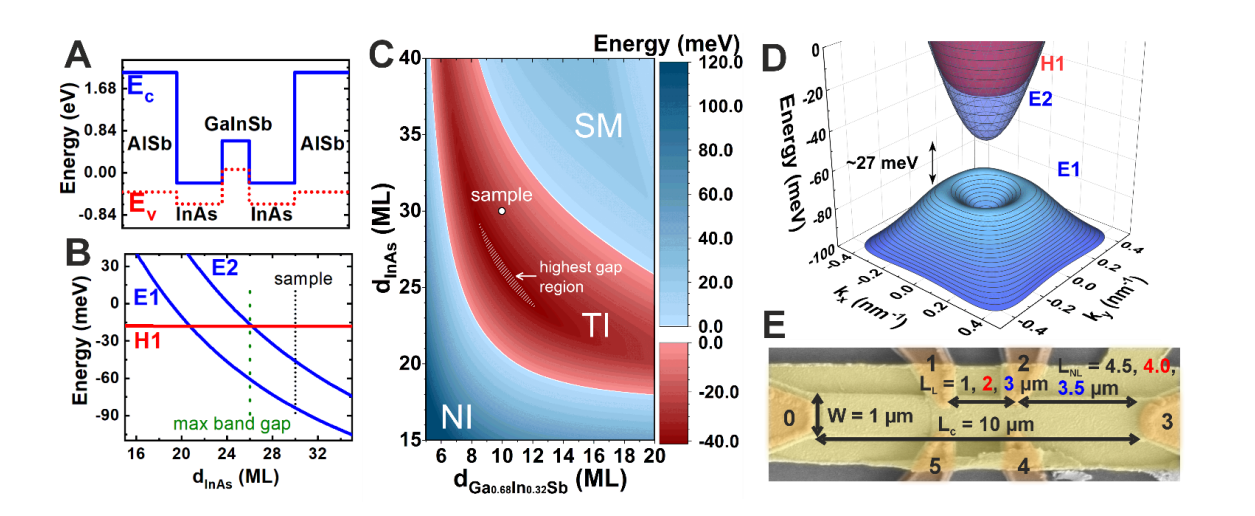
Scientists engineered a novel platform for observing the quantum spin Hall effect (QSHE) using an InAs/GaInSb/InAs trilayer well structure, achieving stable helical edge transport up to 60 Kelvin. This research addresses limitations of previous topological insulator implementations by creating a system suitable for device integration. The team fabricated Hall bar devices with a total length of 10 micrometers and a width of 1 micrometer, employing six symmetrically arranged contacts. Variations in contact separation lengths were systematically introduced to investigate length-dependent behavior in both local and nonlocal measurement configurations.
To confirm the QSHE, the researchers performed precise measurements in both local and nonlocal geometries, utilizing a four-probe configuration to eliminate contact resistance. In the local configuration, the top-gate voltage was swept across the energy gap while monitoring the resistance between specific contacts, with a 100 nanoampere current applied. The team observed peak resistance values coinciding with the expected quantized value, independent of the contact separation length, providing strong evidence for ballistic transport through one-dimensional edge channels. Further analysis involved nonlocal measurements, applying current from one set of probes and measuring the voltage from another.
These experiments consistently demonstrated peak resistance values aligning with the quantized resistance, confirming the QSHE and the robustness of the helical edge transport. The study involved detailed characterization of approximately 20 devices, with reproducible results observed across different thermal cycles and consistent performance between devices. These findings establish the InAs/GaInSb system as a promising material for next-generation topological electronic devices.
Stable Helical Edge Transport Observed in Trilayer Well
Scientists have demonstrated the quantum spin Hall effect (QSHE) in a specifically engineered InAs/GaInSb/InAs trilayer well structure, achieving stable helical edge transport at temperatures up to 60 Kelvin. This breakthrough utilizes a unique material combination and layer design to realize dissipationless, spin-polarized electron flow, a hallmark of topological insulators. The team fabricated devices with layer thicknesses of 30 monolayers of InAs and 10 monolayers of GaInSb, resulting in a moderate inverted band gap energy of approximately 27 meV. This carefully controlled structure creates a topological band structure essential for observing the QSHE.
Experiments revealed quantized resistance values independent of device length in both local and nonlocal measurement configurations, definitively confirming the presence of the QSHE. Hall bar devices were fabricated with contact separations of 1, 2, and 3 micrometers, ensuring measurements were taken within the system’s phase coherence length, where dissipationless transport prevails. The team studied approximately 20 devices, consistently observing robust results across multiple thermal cycles, demonstrating the reproducibility of the findings. Measurements confirm that the quantized resistance in the band gap remains stable up to 60 Kelvin, suggesting the potential for even higher-temperature operation. The devices exhibited consistent performance, with no top-gate leakage current observed within a voltage range of +10 to -10 volts. These results establish the InAs/GaInSb system as a promising platform for developing next-generation topological electronic devices, paving the way for innovative applications in spintronics and quantum computing.
Stable Quantum Spin Hall Effect Demonstrated
Researchers have demonstrated the quantum spin Hall effect (QSHE) in a novel material system, achieving stable, dissipationless edge transport at temperatures up to 60 Kelvin. This achievement overcomes limitations previously hindering practical applications of the QSHE, such as the need for extremely low temperatures and difficulties in scaling up production. The team fabricated devices from a specifically engineered InAs/GaInSb/InAs trilayer well structure, which exhibits robust electronic properties and allows for precise control through electric fields. Crucially, the researchers observed quantized resistance values, independent of device length, in both local and nonlocal measurement configurations, providing strong evidence for the presence of the QSHE.
This stable quantized resistance, maintained up to 60 Kelvin, confirms that electronic transport is dominated by helical edge channels, offering a pathway towards non-cryogenic topological electronics. While observations at even higher temperatures were limited by hysteresis effects and the material’s band gap energy, the authors suggest that improvements in material quality and increased band gap energy could enable operation at temperatures exceeding that of liquid nitrogen. This work establishes the InAs/GaInSb system as a promising platform for integrating topological functionalities into future devices, potentially enabling compatibility with existing silicon technology.
🗞 Quantum spin Hall effect in III-V semiconductors at elevated temperatures: advancing topological electronics
🧠 ArXiv: https://arxiv.org/abs/2509.22185



See today’s quantum computing news on Quantum Zeitgeist for the latest breakthroughs in qubits, hardware, algorithms, and industry deals.