Understanding how charge carriers travel through materials is fundamental to developing next-generation electronic devices, and spin diffusion length, a measure of how far these carriers can travel before losing their spin information, plays a critical role. Junqing Xu and Weiwei Chen, from Hefei University of Technology, along with their colleagues, now present a new theoretical approach to calculating spin diffusion length in solids, moving beyond the limitations of conventional models. Their work demonstrates that electric fields can dramatically alter spin diffusion length in materials like gallium nitride and hexagonal boron nitride, an effect often missed by simpler calculations. This achievement provides a more accurate way to predict and control spin transport, paving the way for improved spintronic devices and a deeper understanding of material properties.
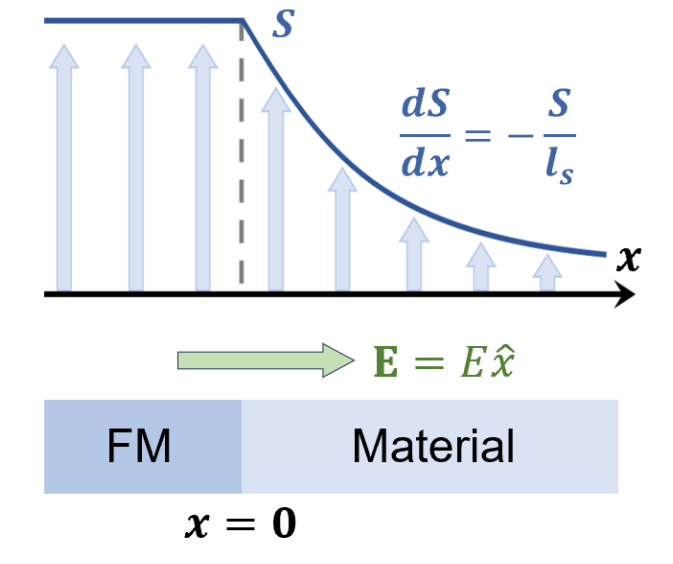
Scientists have extended a computational method to accurately model spin diffusion length (ls) in solid materials, a crucial parameter for next-generation, low-power electronics known as spintronics. This work builds upon existing techniques to incorporate the effects of electric fields applied within the material, a capability previously challenging to simulate accurately. The team’s approach utilizes a quantum mechanical framework, treating electron scattering processes with high fidelity and implementing a novel mathematical formulation to model the electric field’s influence. Calculations reveal that ls can be significantly enhanced or suppressed by the application of even moderate electric fields, depending on the field’s direction.
Density-Matrix Calculations of Spin Dynamics in Solids
This research focuses on developing and applying a first-principles method to calculate spin relaxation, dephasing, and diffusion in solid-state materials. The key innovation is a density-matrix approach combined with calculations based on localized electron wavefunctions, allowing for accurate prediction of spin transport properties and how electric fields and material properties influence spin dynamics. This method is computationally intensive but provides a detailed understanding of spin behavior at the atomic level. The research employs a density-matrix formalism to describe the quantum state of the spin system, capturing many-body effects, and utilizes localized, orthonormal functions to represent the electronic band structure for efficient and accurate calculations.
Mathematical tools called Lindblad superoperators model the dissipation and decoherence of spin states. The research demonstrates how electric fields modulate spin transport, crucial for spintronic devices. The substrate on which a material is grown affects spin relaxation, and the interaction between spin and lattice vibrations (phonons) is accurately captured, as phonons are a major source of spin relaxation. The method has been applied to various materials, including graphene, halide perovskites, and semiconductors, providing insights into their spin properties.
Electric Fields Control Spin Diffusion Length
Scientists have developed an advanced computational method to accurately model spin diffusion length (ls) in solid materials, a crucial parameter for next-generation, low-power electronics known as spintronics. This work extends existing techniques to incorporate the effects of electric fields applied along a periodic direction within the material, a capability previously challenging to simulate accurately. The team’s approach utilizes a quantum mechanical framework, treating electron scattering processes with high fidelity and implementing a novel mathematical formulation to model the electric field’s influence. Experiments reveal that ls can be significantly enhanced or suppressed by the application of even moderate electric fields, depending on the field’s direction.
Specifically, the team investigated monolayer WSe2, bulk GaAs, bulk GaN, and graphene-h-BN heterostructures, demonstrating the method’s versatility across diverse materials. Importantly, this work reveals limitations in the widely used drift-diffusion model, which can produce substantial errors when predicting the electric-field-induced changes in spin diffusion length for certain materials, notably gallium nitride and hexagonal boron nitride. The team found that in hexagonal boron nitride, the electric field not only directly affects spin movement but also alters the fundamental distribution of electron energies, further influencing spin diffusion. This highlights the need for more sophisticated, first-principles methodologies to accurately capture these complex interactions and paves the way for the design and optimization of advanced spintronic devices and materials with tailored properties.
🗞 Electric-field effect on spin diffusion length in solids: An \textit{ab initio} study beyond the drift-diffusion model
🧠 ArXiv: https://arxiv.org/abs/2509.21962
See today’s quantum computing news on Quantum Zeitgeist for the latest breakthroughs in qubits, hardware, algorithms, and industry deals.