Imaging individual atoms presents a significant challenge in materials science and nanotechnology, but researchers are now demonstrating a powerful new technique to visualise these fundamental building blocks of matter. Tatiana Latychevskaia from the Paul Scherrer Institute, along with colleagues, outlines the conditions under which single, isolated atoms can be imaged using coherent low-energy electron holography. This method exploits the unique properties of low-energy electrons, minimising damage to delicate samples while maintaining high sensitivity to atomic potentials, and produces interference patterns that reveal the presence of even single atoms. The team’s work demonstrates that the diffraction angle of these patterns predictably changes with distance, offering a pathway to accurately image and characterise isolated atoms of various elements, and represents a substantial step towards routine atomic-resolution imaging.
Gabor’s Reconstructed Wavefront Microscopy Foundations
This work consolidates the foundational principles of reconstructed wavefront microscopy, a technique with significant implications for high-resolution imaging. The research builds upon the pioneering work of Dennis Gabor and extends it with modern advancements in electron microscopy and image reconstruction algorithms. Scientists meticulously reviewed key developments, establishing a comprehensive understanding of the technique’s theoretical underpinnings and practical applications, highlighting the importance of spatial coherence in electron beams and its impact on image resolution. This comprehensive overview serves as a valuable resource for researchers seeking to advance the field and apply it to a wider range of scientific problems.
The research also acknowledges the contributions of E. J. Kirkland, whose work on advanced computing in electron microscopy has been instrumental in developing the computational tools necessary for image reconstruction, and Latychevskaia and Fink, who demonstrated the importance of understanding the relationship between spatial coherence, electron beam properties, and the resolution of imaged objects. This provides a solid foundation for future research, paving the way for new discoveries in materials science, biology, and nanotechnology.
Visualizing Single Atoms with Electron Holography
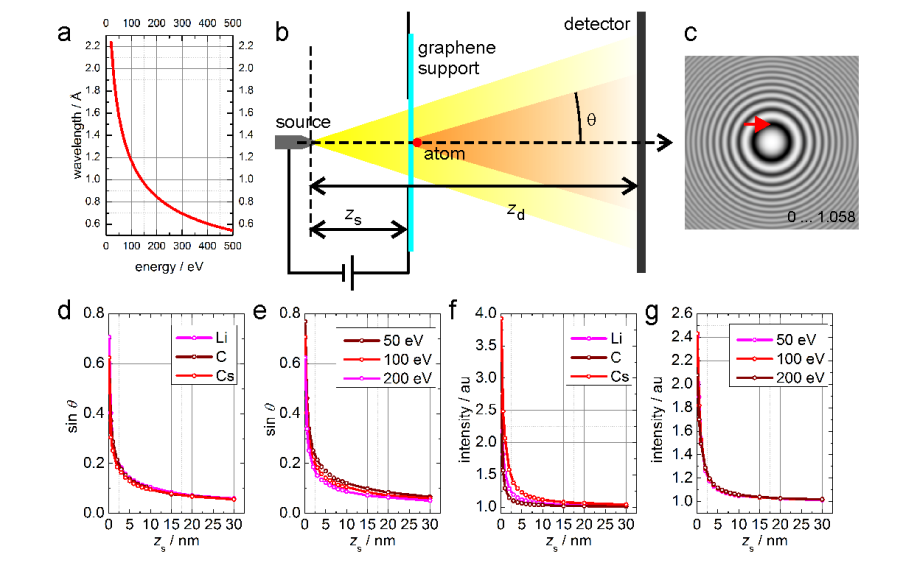
Scientists have developed a groundbreaking method for imaging single, isolated atoms and biomolecules using low-energy electron holography, minimizing damage while maximizing sensitivity to local potentials. This establishes conditions for visualizing atoms without perturbing their natural state, a significant advancement in structural biology and materials science. Researchers engineered a system employing low-energy electrons, at energies of 50, 100, and 200 eV, to create interference patterns from single atoms, revealing their presence through concentric fringes. The team meticulously characterized the relationship between the diffraction angle, theta, and the source-to-sample distance, zs, finding a consistent dependency described by the equation sin(theta) ~ 0.
3/sqrt(zs), which holds true across different electron energies and for atoms of varying elements. Researchers developed a cryogenic low-energy electron point source microscope to facilitate these observations, delivering a highly coherent electron beam crucial for generating high-resolution holograms. Furthermore, the study expanded beyond single atoms to encompass biomolecules, successfully imaging individual proteins and DNA strands with minimal damage, allowing for the direct visualization of charge transport within suspended DNA strands. Researchers also applied this method to study complex materials like graphene, mapping unoccupied electronic states and observing Moiré structures in twisted bilayer graphene with unprecedented detail. This innovative approach promises to revolutionize structural biology and materials science by enabling the non-destructive imaging of matter at the single-molecule level.
Isolated Atom Imaging via Electron Holography
Scientists have demonstrated the imaging of single, isolated atoms using low-energy electron holography, utilizing the wave-like properties of electrons to visualize materials at the nanoscale. This establishes conditions for observing individual atoms without charge, opening new avenues for studying atomic structures and potentials. Experiments reveal that a single atom produces a distinct interference pattern consisting of concentric fringes. The team measured the diffraction angle, theta, generated by the interference pattern as the first minimum of the concentric rings, demonstrating a consistent relationship between this angle and the source-to-sample distance, zs, following the equation sin(theta) ~ 0.
3/sqrt(zs). This dependency holds true for electrons of varying energies, 50, 100, and 200 eV, and when scattering off different elements including lithium, carbon, and cesium. This breakthrough delivers a method for imaging atoms without inducing charge, a significant advantage for studying delicate materials. The research establishes that the visibility of fine interference fringes in the hologram determines the achievable resolution, with a shift of just one Angstrom in the object or electron source causing a measurable shift in the hologram. Scientists found that sample vibrations and structural changes can blur the interference pattern, limiting resolution, but by carefully controlling experimental parameters, they were able to observe and characterize the interference patterns created by single atoms, paving the way for atomically resolved imaging with low-energy electrons.
Single Atom Imaging via Electron Interference
This research demonstrates the feasibility of imaging single, isolated atoms using low-energy electron holography, utilizing the wave-like properties of electrons to create images with minimal damage to delicate samples. Scientists successfully generated interference patterns from individual atoms, appearing as concentric fringes, and established a relationship between the diffraction angle of these patterns and the distance between the electron source and the sample. These findings confirm that low-energy electrons are sensitive to the local potential around individual atoms, enabling their detection. Reconstructed images revealed elongated, bow-tie-like shapes for clusters of adsorbed atoms, though these shapes were distorted and varied with position, likely due to local electric or magnetic potentials. Simulations accurately reproduced these holographic patterns for very short distances, and the researchers developed methods to extrapolate these results to more realistic, larger distances. This advancement paves the way for detailed studies of materials at the atomic scale with reduced radiation damage, offering potential benefits for fields like materials science and biology.
🗞 How to image single isolated atoms by using coherent low-energy electrons
🧠 ArXiv: https://arxiv.org/abs/2509.22586
See today’s quantum computing news on Quantum Zeitgeist for the latest breakthroughs in qubits, hardware, algorithms, and industry deals.