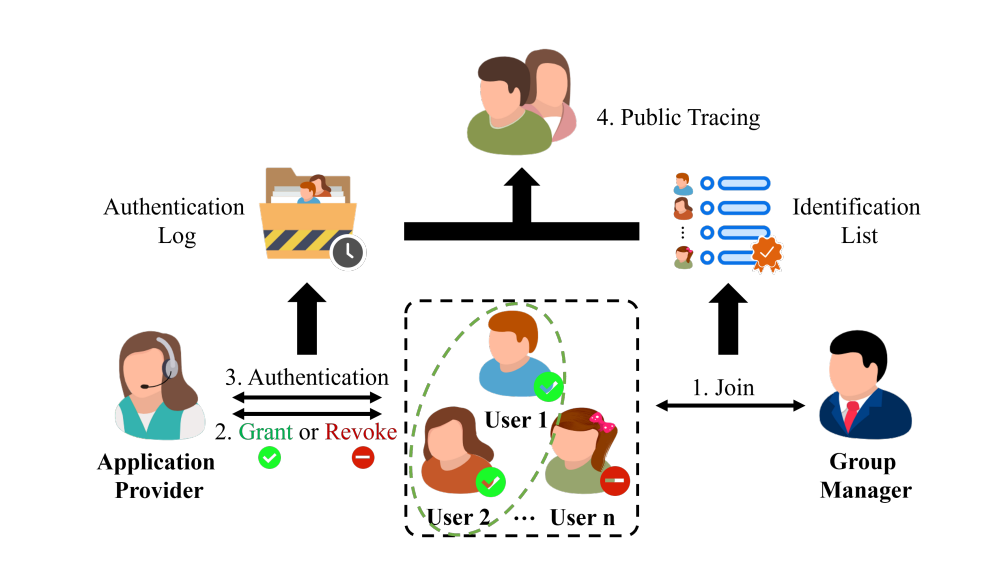
Privacy concerns are escalating alongside the growth of the internet, and anonymous authentication is becoming increasingly vital for protecting user data. Junjie Song, Jinguang Han, and Man Ho Au, alongside Rupeng Yang and Chao Sun, address a critical limitation in current systems by developing the first lattice-based dynamic -times anonymous authentication scheme. Existing methods struggle to manage groups where members join and leave frequently, but this new approach offers both anonymity and the ability to dynamically grant and revoke user access. The team’s construction not only provides post-security, meaning it remains secure even after potential compromises, but also achieves greater efficiency compared to previous lattice-based methods, representing a significant step forward in practical privacy-preserving technologies.
Group Authentication, Privacy and Detectability
This research details a system designed for group-based authentication, prioritizing user privacy and security. The goal is to allow users to authenticate to service providers while protecting their anonymity, ensuring malicious behavior can be detected, and providing a means to prove innocence in case of security breaches. The system achieves these goals through a combination of cryptographic techniques and a carefully designed protocol, focusing on defining the security requirements necessary for a secure system. The security analysis involves defining a series of games where an adversary attempts to compromise the system.
If the adversary succeeds with a non-negligible probability, it indicates a vulnerability. Key components include group-based authentication, where users belong to groups managed by a central entity, application providers who require authentication, and a group manager responsible for key management. Security games define specific attack scenarios the adversary attempts to win. The system defines four main security requirements: D-Anonymity, ensuring user identities remain hidden, D-Detectability, enabling the detection of malicious behavior, D-Exculpability for Users, allowing users to prove their innocence, and D-Exculpability for the Group Manager, allowing the group manager to prove their innocence. Each requirement is tested through a corresponding game. This system provides privacy-preserving authentication, protecting user identities, and accountability and detectability, allowing for the identification of compromised users or services.
Lattice-Based Anonymous Authentication with Zero-Knowledge Proofs
Scientists developed a novel approach to anonymous authentication, addressing limitations of existing systems by enabling dynamic user management and post-security features. Central to this work is the construction of a lattice-based dynamic authentication scheme, offering enhanced privacy and flexibility. To achieve this, the team designed zero-knowledge arguments of knowledge, allowing them to prove relationships between secret information and public values without revealing the secrets themselves. These arguments form the foundation for secure communication within the authentication protocol. The team meticulously constructed these arguments by reducing complex relations to simpler instances, leveraging techniques for handling vectors and matrices over finite fields.
A key innovation involved converting equations over smaller moduli to equations over a larger modulus, simplifying the overall computation. This process involved carefully transforming vectors into binary representations and defining gadget matrices to ensure accuracy. The size of the witness and the size of the matrix were carefully optimized to minimize computational overhead. Further refinements involved constructing arguments for various scenarios, including proving knowledge of a weak pseudorandom function’s preimage, key, and output, both individually and in combination. These arguments built upon the foundational principles of reducing complex relations and transforming vectors, but with tailored adjustments to accommodate the specific information being proven. The team also integrated existing accumulator schemes, building upon prior work to further enhance the security and efficiency of the authentication process. Through these carefully designed arguments, the research demonstrates a significant advancement in secure and dynamic anonymous authentication.
Post-Quantum Dynamic Anonymous Authentication Demonstrated
Scientists have developed the first dynamic anonymous authentication scheme secure against attacks from quantum computers, addressing a critical need for enhanced privacy in online systems. This work introduces a system where users can authenticate themselves anonymously up to a specified number of times, while also allowing service providers to dynamically grant or revoke user access. The breakthrough delivers a concrete construction based on lattice cryptography, offering a robust solution to the challenges of maintaining privacy in the face of increasingly powerful computing threats. Experiments demonstrate that the scheme achieves anonymity, accountability, dynamicity, exculpability, and efficiency, all while maintaining post-quantum security.
Specifically, the system ensures a user’s identity remains private as long as they authenticate no more than the allowed number of times, and can be revealed if they exceed this limit. The service provider retains the ability to independently and dynamically grant or revoke user access, even during authentication sessions. Tests confirm that honest users cannot be falsely accused of exceeding their authentication limit. The research team achieved higher efficiency compared to existing lattice-based anonymous authentication schemes in terms of communication costs. The security of the system is formally proven to rely on well-established complexity assumptions on lattices, ensuring its resilience against attacks from both classical and quantum computers. This advancement represents a significant step forward in protecting user privacy and enabling flexible access control in a wide range of applications, from secure online transactions to private communication networks. Measurements confirm the system’s ability to manage user access dynamically, a feature absent in previous post-quantum anonymous authentication schemes.
Dynamic Anonymous Group Authentication with Lattice Cryptography
This research presents the first lattice-based cryptographic scheme supporting dynamic anonymity for group authentication. The team constructed a system enabling anonymous authentication of group members up to a specified number of times, while also allowing for the addition and removal of users from the group. This addresses a significant limitation of previous lattice-based anonymous authentication schemes, which lacked dynamic member management capabilities. The achievement lies in providing a secure and efficient method for anonymous authentication with a practical level of flexibility. The system’s security is formally reduced to well-established complexity assumptions, bolstering confidence in its robustness against attack.
Importantly, the scheme demonstrates improved efficiency compared to existing lattice-based approaches. The researchers rigorously evaluated the system’s security properties, including detectability and exculpability for both users and the group manager, demonstrating its resistance to various adversarial strategies. Future research directions might focus on extending the system to support more complex group structures or integrating it with other privacy-enhancing technologies. However, this work represents a substantial advance in the field of privacy-preserving authentication, offering a practical solution for secure and dynamic anonymity in group settings.
🗞 Lattice-Based Dynamic -times Anonymous Authentication
🧠 ArXiv: https://arxiv.org/abs/2509.21786




See today’s quantum computing news on Quantum Zeitgeist for the latest breakthroughs in qubits, hardware, algorithms, and industry deals.