

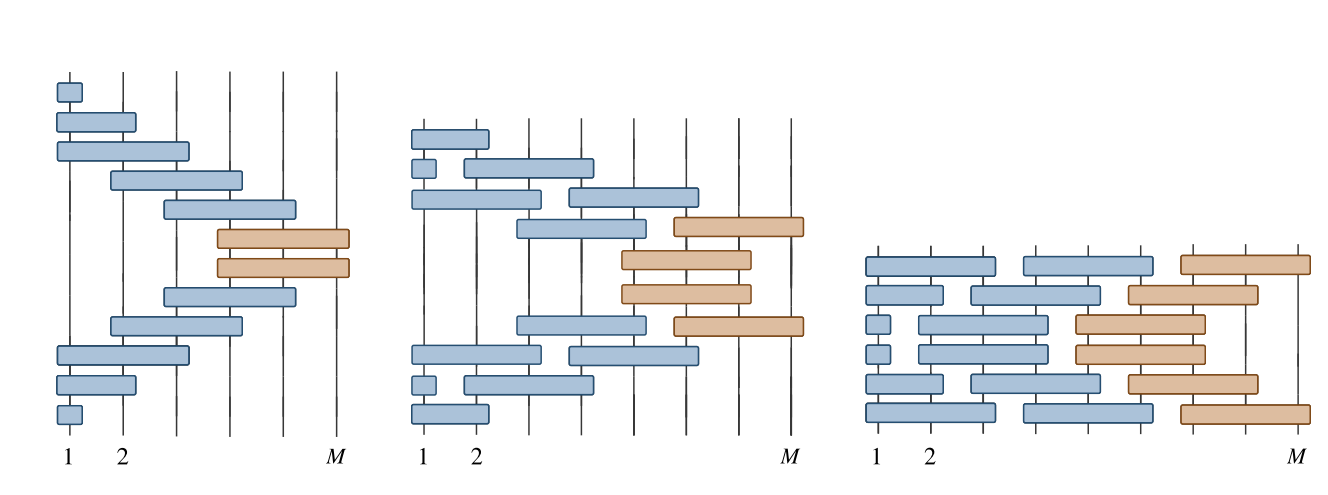
Quantum circuits that mimic the behaviour of free fermions hold immense promise for advancing quantum computation, yet determining their true computational power remains a significant challenge. Dávid Szász-Schagrin, Daniele Cristani, Lorenzo Piroli, and Eric Vernier now present a systematic method for constructing such circuits, specifically those with common staircase and brickwork arrangements. Their work establishes that these circuits possess a free-fermionic spectrum, despite resisting standard methods of analysis, and crucially, demonstrates that the evolution of specific measurable properties within these circuits can be efficiently simulated using classical computers. This achievement confirms existing theoretical predictions and opens new avenues for understanding the limits of classical simulation in the realm of quantum systems that cleverly disguise their free-fermionic nature.
These circuits, similar to a foundational model previously introduced, are characterised by an evolution operator that resists standard analysis techniques, yet still possesses a free-fermionic spectrum. The construction relies on carefully designed transfer matrices which interact predictably with the circuit’s evolution operator, thereby establishing this free-fermionic spectrum. Furthermore, the team investigated the dynamics of these circuits when initialised in arbitrary product states, demonstrating that the evolution of specific local properties can be simulated efficiently.
Free Fermions Simplify Complex Quantum Systems
This research delves into the fascinating world of quantum many-body systems, focusing on solvable models, efficient simulation techniques, and the connection between seemingly disparate areas of physics. The core of the work revolves around free fermions, which are relatively easy to solve and therefore a powerful tool for analysing more complex systems. Scientists are actively searching for efficient mappings to free fermions, going beyond standard methods to improve applicability. A central theme is the discovery and exploration of models that appear complex but can be cleverly transformed into free fermions, a powerful approach for finding new solvable models.
The research also touches upon parafermionic systems, which are generalizations of fermions and bosons, and their potential for creating solvable models. Powerful numerical methods, such as matrix product states and projected entangled pair states, are used for simulating quantum many-body systems. Systems described by Gaussian states, like free fermions, are particularly amenable to efficient simulation using techniques like the density-matrix renormalization group. The exploration of parafermions and alternative mappings to free fermions suggests a search for new and more general solvable models. The work alludes to the connection between quantum quenches, entanglement entropy, and information scrambling, highlighting the ongoing quest for a deeper understanding of the quantum world.
Free Fermionic Behaviour in Complex Quantum Circuits
Scientists have successfully constructed a method for building quantum circuits that, despite their complex structure, behave as if governed by the simpler rules of free fermions. These circuits, built with either a staircase or brickwork architecture, possess a unique property: while standard methods cannot easily describe them, they still exhibit the characteristics of free fermionic systems. The construction relies on identifying and utilizing specific transfer matrices that interact predictably with the circuit’s evolution operator, allowing researchers to demonstrate the underlying free fermionic behaviour. This achievement confirms recent theoretical predictions regarding the solvability of these circuits and opens new avenues for understanding how complex quantum systems can mimic simpler ones. Furthermore, the team proved that tracking the evolution of certain properties within these circuits can be efficiently simulated using classical computers, suggesting a surprising connection between these quantum and classical computational approaches.
🗞 Construction and simulability of quantum circuits with free fermions in disguise
🧠 ArXiv: https://arxiv.org/abs/2509.22585



See today’s quantum computing news on Quantum Zeitgeist for the latest breakthroughs in qubits, hardware, algorithms, and industry deals.



