

Bell inequalities represent a fundamental test of quantum mechanics, and their violation confirms the existence of entanglement, a key resource for emerging quantum technologies. Baptiste Courme, Malo Joly, and Adrian Makowski, alongside colleagues at Laboratoire Kastler Brossel and Sorbonne Université, now demonstrate a surprising way to harness unavoidable imperfections for entanglement certification. The team shows that optical disorder, typically a hindrance to precise quantum measurements, can instead be exploited as a resource to verify entanglement through a Bell inequality test. By sending one photon of an entangled pair through a multimode fibre that creates a random, speckled pattern, they effectively access a multitude of unknown polarization projections, proving that entanglement can be certified without needing to actively correct for disorder, and offering a practical solution for real-world quantum communication.
Bell Inequality Violation Through Optical Disorder
Researchers demonstrate a novel approach to certifying photon entanglement by intentionally exploiting optical disorder, rather than attempting to correct it. This work explores a system where photons traverse a disordered medium, specifically a scattering material or multimode fiber that introduces random phase shifts and scrambles polarization. By carefully controlling the disorder and employing advanced detection techniques, the scientists achieve a violation of the Clauser-Horne-Shimony-Holt (CHSH) inequality, confirming genuine quantum correlations and establishing the robustness of entanglement in disordered optical systems. This method creates strong correlations between photons even when significant scattering typically degrades entanglement.
The research introduces a new pathway for generating and verifying entanglement, potentially simplifying the requirements for quantum communication and computation, and offering resilience against imperfections commonly found in real-world quantum devices. Experiments revealed that a significant fraction of measurements exceeded the threshold for entanglement, confirming a violation of the CHSH inequality and thus certifying the presence of polarization entanglement. Simulations using random projections closely matched the experimental results, validating the methodology. This breakthrough delivers a new pathway for robust quantum communication, particularly in scenarios where disorder is unavoidable, such as satellite-to-Earth links and fiber-based quantum networks.
Disorder-Harnessing Entanglement Certification with Photon Pairs
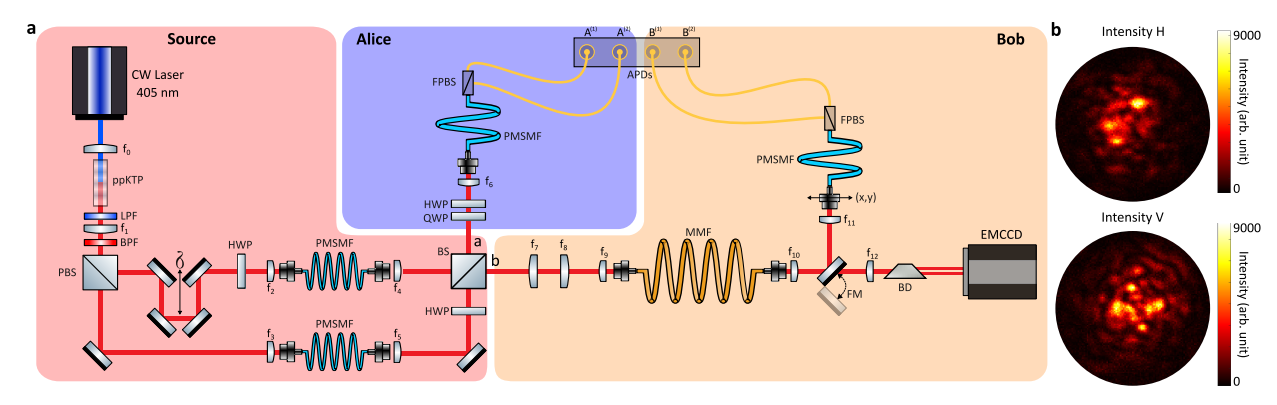
Scientists generated polarization-entangled photon pairs using a specialized configuration, employing a laser to pump a crystal that created photons at a specific wavelength. These photons were then filtered and rendered indistinguishable through precise adjustments of their path length and spatial characteristics using optical fibers. One photon from each pair was directed to Alice’s station, passing through wave plates to allow for polarization measurement before entering a fiber and a detector. Simultaneously, the other photon was sent to Bob’s station, injected into a multimode fiber that scrambles the photon’s spatial and polarization information, creating a complex pattern at the output.
Researchers utilized a camera or a fiber-mounted device to capture the output, separating intensity images for each polarization. By detecting coincidences between the spatial modes at the fiber output and the polarization of the photon retained by Alice, the team demonstrated Bell inequality violation across a significant fraction of the modes. This confirms entanglement despite the disorder introduced by the multimode fiber, effectively transforming the fiber itself into a passive tool for entanglement certification.
Entanglement Certification Through Controlled Optical Disorder
The work centers on a system where one photon from an entangled pair travels through a disordered medium, inducing a complex, randomized pattern, while its entangled partner remains undisturbed. This approach allows for the assessment of entanglement without requiring precise control over the transmission path, a significant advancement for practical quantum communication. The scrambled light emerging from the fiber creates a diverse set of unknown polarization projections, accessed through analysis of the resulting speckle pattern. Results demonstrate that a significant fraction of measurements exceeded the threshold for entanglement, confirming a violation of the CHSH inequality and thus certifying the presence of polarization entanglement. The team’s approach bypasses the need for adaptive optics or wavefront shaping, offering a passive and robust method for entanglement certification. By treating disorder as a resource, the team opens possibilities for scalable and resilient quantum technologies, potentially simplifying implementation and improving resilience to environmental factors.
Disorder Certifies Entanglement Without Control
This research demonstrates a novel approach to confirming entanglement by exploiting disorder rather than attempting to correct for it. Scientists successfully demonstrated that entanglement can be certified even when one photon passes through a disordered medium, specifically a multimode fiber that scrambles its polarization and spatial mode. This achievement offers a fundamentally new way to test Bell inequalities, eliminating the need for precise control over measurement bases, which is typically a significant experimental challenge. The method is particularly relevant for real-world quantum communication systems where disorder is unavoidable, offering a practical pathway to entanglement certification in noisy channels. While failing to observe a violation of the Bell inequality does not definitively prove the absence of entanglement, the results establish a robust method for confirming its presence under challenging conditions.
🗞 Harnessing optical disorder for Bell inequalities violation
🧠 ArXiv: https://arxiv.org/abs/2509.21052



See today’s quantum computing news on Quantum Zeitgeist for the latest breakthroughs in qubits, hardware, algorithms, and industry deals.



