

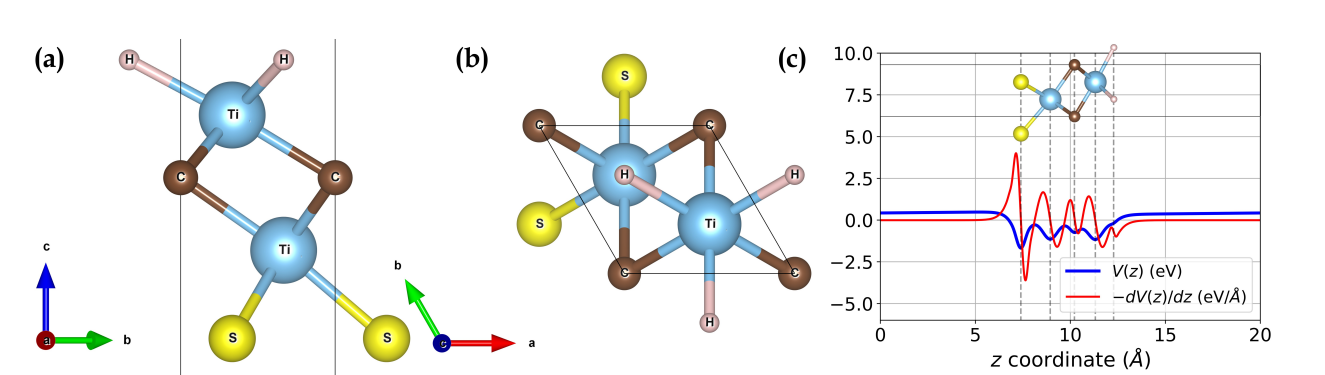
The search for two-dimensional superconductors continues to drive materials science, and recent research focuses on a particularly intriguing class of materials called Janus MXenes. Jakkapat Seeyangnok and Udomsilp Pinsook, from Chulalongkorn University, alongside their colleagues, now present a detailed theoretical prediction of superconductivity in the Janus Ti2CSH monolayer. Their calculations demonstrate that this material possesses both structural stability and, crucially, a strong mechanism for electron pairing, leading to a predicted critical temperature of 22. 6 Kelvin. This discovery establishes Ti2CSH as a promising candidate for future nanoscale technologies, potentially enabling the development of novel electronic devices and superconducting circuits.
Computational Prediction of 2D Superconductivity and Stability
This body of work details a comprehensive computational investigation into two-dimensional materials, with a strong emphasis on predicting and understanding superconductivity. Researchers employ advanced computational techniques to explore the electronic structure, stability, and potential for superconductivity in a range of materials, extending beyond well-studied graphene. The research focuses on transition metal dichalcogenides, MXenes, and Janus structures, such as TiSH, alongside hydrogenated materials and carefully constructed heterostructures. Density Functional Theory and related methods form the core of these investigations.
The studies encompass a wide range of materials, including molybdenum disulfide, tungsten disulfide, titanium carbon disulfide, and various Janus compounds like titanium, zirconium, and hafnium sulfides with hydrogen termination. Researchers also investigate the effects of hydrogenation on materials like copper hydride and titanium diborohydride. These computational efforts aim to identify materials with tailored properties and explore their potential for diverse applications. Calculations involve meticulous k-point sampling, carefully chosen plane-wave energy cutoffs, and the use of maximally localized Wannier functions to accurately describe electron-phonon coupling.
The Electron-Phonon Coupling code is central to determining the strength of interactions between electrons and lattice vibrations, a key factor in superconductivity. Researchers assess material stability through elastic criteria and employ optimization algorithms. Comparisons with data from the Open Quantum Materials Database validate the accuracy of the computational models. High-throughput computational screening is used to identify promising materials, guiding the design of new 2D materials with tailored properties for specific applications. Janus materials, like TiSH, emerge as promising candidates due to their unique electronic structure and potential for high transition temperatures.
Janus Ti2CSH Exhibits Stability and Superconductivity
This research establishes the Janus Ti2CSH monolayer as a promising two-dimensional material, demonstrating both structural and thermal stability alongside the prediction of superconducting properties. Calculations reveal a negative formation energy, indicating the feasibility of synthesizing this material. Ab initio molecular dynamics simulations, conducted at room temperature, confirm the material’s resilience. Mechanical stability is further confirmed by calculated in-plane stiffness values. The phonon spectrum demonstrates dynamical stability across the Brillouin zone, with no imaginary frequencies present.
Analysis reveals three acoustic and six optical branches, adhering to expected symmetry, and a softening of a specific vibrational mode, suggesting strong electron-phonon interaction. Electronic structure calculations confirm the metallic character of Ti2CSH, with bands crossing the Fermi energy primarily contributed by titanium orbitals. Crucially, theoretical modelling predicts a single-gap superconducting state with a critical temperature of 22. 6 K, establishing Ti2CSH as a compelling candidate for nanoscale technologies.
Ti2CSH Predicts Promising Two-Dimensional Superconductivity
This research presents a comprehensive investigation into the properties of a single-layer material, titanium-carbon-sulfur-hydrogen (Ti2CSH), revealing its potential as a two-dimensional superconductor. Calculations demonstrate the material’s structural stability and confirm that it exhibits dynamically stable vibrations. Detailed analysis indicates a strong interaction between electrons and phonons, suggesting superconductivity is mediated by these lattice vibrations. The team’s modelling predicts a superconducting state with a critical temperature of approximately 22. 6 Kelvin, a value notably above the boiling point of liquid hydrogen. This relatively high critical temperature, coupled with the material’s two-dimensional nature, positions Ti2CSH as a promising candidate for advanced low-dimensional superconducting devices and quantum technologies. This work contributes to the growing field of hydrogenated Janus superconductors and establishes Ti2CSH as a stable platform for multifunctional material development.
🗞 Theoretical prediction of Structural Stability and Superconductivity in Janus Ti2CSH MXene
🧠 ArXiv: https://arxiv.org/abs/2509.19907




See today’s quantum computing news on Quantum Zeitgeist for the latest breakthroughs in qubits, hardware, algorithms, and industry deals.



