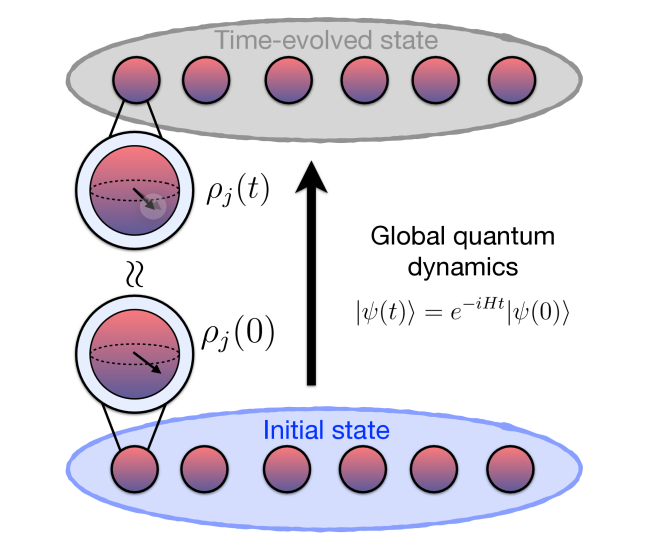
The behaviour of complex quantum systems often defies simple prediction, yet understanding how these systems evolve is crucial for advancements in quantum technology. Francesco Perciavalle, Gian Marco Rizzo, and Francesco Plastina, all from the Dipartimento di Fisica at the Università della Calabria, alongside Nicola Lo Gullo, investigate the emergence of ‘local reminiscence’ within the PXP model, a system increasingly realised using arrays of Rydberg atoms. Their work reveals that, despite a tendency towards predictable thermalisation, certain specific configurations within the model retain a surprising memory of their initial state, exhibiting remarkably stable local behaviour even as the system evolves. This discovery challenges conventional understanding of complex dynamics, demonstrating that non-ergodic regimes can sustain stable local memory, and offers new insights into the nature of quantum ‘scars’ and constrained dynamics within these systems.
Many-Body Localization and Thermalization Breakdown
This collection of research papers explores the fascinating world of many-body quantum systems, focusing on areas like quantum computation and the behaviour of matter under extreme conditions. A central theme is many-body localization, a state where quantum systems resist reaching thermal equilibrium due to strong disorder. Researchers investigate how entanglement, a key quantum phenomenon, plays a role in these systems and how they differ from typical thermalizing behaviour. The work delves into the foundations of thermalization and ergodicity, examining the conditions under which quantum systems reach equilibrium.
Studies on quantum entanglement provide tools to characterize these complex systems and understand their properties. A significant focus lies on neutral atom quantum computing, with researchers developing and testing methods to build and control quantum computers using neutral atoms. Quantum many-body scars, special energy states that defy typical thermalization rules, are another prominent area of investigation. Researchers explore Rydberg atoms, highly excited atoms with strong interactions, as ideal candidates for building quantum simulators and studying many-body physics. This work suggests several key research areas, including understanding the interplay between many-body localization, quantum scars, and thermalization. Researchers are actively building and characterizing neutral atom quantum simulators to explore complex quantum phenomena and develop new quantum control techniques for precise manipulation of quantum systems.
PXP Dynamics and Emergent Local Memory
Researchers are uncovering how localized memory emerges within the PXP model, a constrained quantum system realized using arrays of Rydberg atoms. By modelling the time evolution of quantum states, they investigate how systems with strong constraints behave. The PXP Hamiltonian, which describes the interactions between Rydberg atoms, limits the system to a specific configuration, reducing the complexity of the quantum state. Scientists characterize the system’s dynamics by calculating the fidelity and entanglement entropy. They distinguish between ergodic behaviour and scarred behaviour. A central focus is exploring local reminiscence, where subsystems retain memory of their initial configuration even as the entire system evolves. Researchers compare the reduced density matrices of initial and time-evolved states to identify conditions where local memory is preserved, examining the dynamics of local observables and quantifying the overlap between initial and time-evolved reduced density matrices.
Local Reminiscence in Constrained Quantum Systems
Scientists have demonstrated robust local memory retention in a constrained quantum system, the PXP model, challenging conventional understanding of thermalization. This work investigates how specific initial states preserve information at the local level, even while exhibiting complex global dynamics. Researchers focus on two states, a θ-symmetric state and a blockaded state, to explore this phenomenon, termed local reminiscence. Experiments reveal that the θ-symmetric state stably retains local memory of its initial configuration despite lacking global memory preservation. Measurements of local fidelities consistently approach unity, indicating strong memory retention.
Furthermore, the blockaded state also exhibits strong local reminiscence, with fidelity measurements remaining near unity as the system size increases. The team measured the dynamics of local observables, confirming that both states maintain stable local information despite differing global behaviours. Analysis of local fidelities demonstrates suppressed fluctuations as the system grows, indicating the robustness of this local memory effect. These findings suggest that non-ergodic regimes can sustain stable local memory while still allowing for complex global dynamics, providing new insights into quantum many-body scars and constrained dynamics. Researchers discovered that the observed local reminiscence correlates with the system’s spectral properties, specifically a larger overlap with the pure point spectrum of the Hamiltonian, suggesting a link between local memory and special eigenstates that resist thermalization.
Fibonacci-Constrained Memory in Rydberg Atom Arrays
This research demonstrates the existence of stable, localized memory within a constrained quantum system, specifically a Rydberg atom array governed by the PXP Hamiltonian. While most initial states exhibit chaotic dynamics consistent with established principles of quantum thermalization, certain configurations, notably symmetric and blockaded states, retain a remarkable fidelity to their initial condition even as the system evolves. The team found that these states preserve memory through dynamics constrained to a reduced, Fibonacci-scaling subspace, while still allowing for complex behaviour across the entire system. The significance of this work lies in revealing that non-ergodic regimes are not necessarily characterized by complete stagnation, but can instead support stable local memory alongside broader, dynamic behaviour. Researchers connected this local reminiscence to the system’s spectrum, finding it occurs in states that overlap strongly with the pure point spectrum of the Hamiltonian, including those associated with scarred many-body states. Future research directions include exploring other initial states and expanding the understanding of the interplay between local memory and global dynamics in constrained quantum systems.