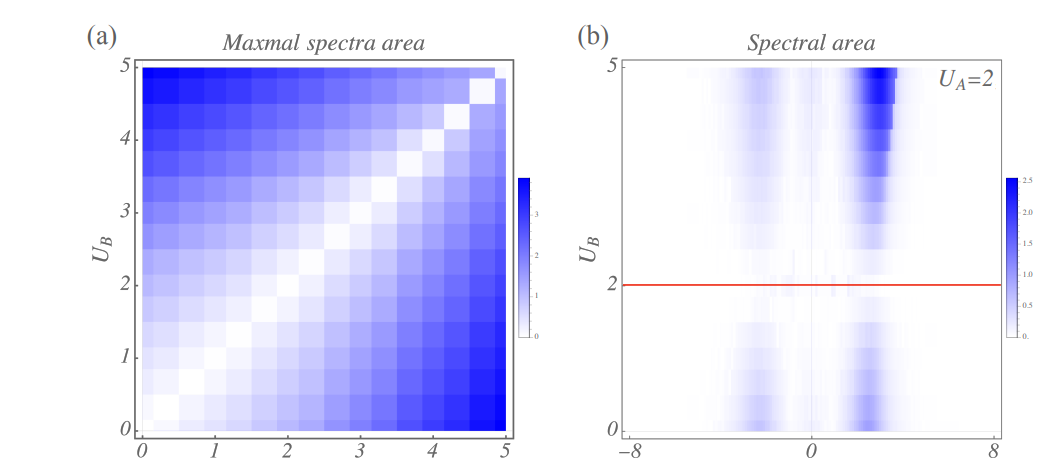
The way a system responds to external stimuli reveals fundamental properties of its internal structure, and scientists are now using these responses to characterise complex materials. Zhesen Yang, Zihan Wang, and Juntao Huang, all from Xiamen University, alongside Zijian Zheng and Jiangping Hu, have developed a new method to analyse these responses, termed the complex frequency fingerprint. This technique allows researchers to identify and separate different behaviours within a system, demonstrating that interactions between components can independently cause both unique topological properties and the non-Hermitian skin effect, a phenomenon where states accumulate at the boundary of the material. Crucially, this research reveals that this interaction-driven skin effect changes with frequency, offering a new way to control and understand the behaviour of these complex systems and potentially leading to advances in areas like wave manipulation and materials design.
Topological Matter and Non-Hermitian Physics
Recent research explores the interplay between topology, non-Hermitian physics, and strongly correlated electron systems. Investigations focus on materials exhibiting unusual electronic properties, such as topological insulators and Weyl semimetals, where electrons behave uniquely due to the material’s structure. A key area of study involves systems where the Hamiltonian is not Hermitian, leading to phenomena like exceptional points and non-unitary evolution. Researchers also investigate systems with broken time-reversal symmetry and disordered systems where randomness plays a crucial role, as well as driven systems subjected to time-periodic forces. Current research combines topological and non-Hermitian effects to create new phases of matter and device functionalities, and explores higher-order topology, which involves topological states localized on lower-dimensional boundaries.
Interaction Defines Topology and Skin Effect
This work presents a systematic investigation into how interactions and non-Hermitian topology combine within a model exhibiting broken time-reversal symmetry. Researchers developed a method centered on analyzing complex frequency fingerprints to characterize the system’s response and reveal its underlying physical behaviour. Key findings demonstrate that asymmetric interactions between sublattices can induce a gap in the system’s energy spectrum under periodic boundary conditions, simultaneously giving rise to a pronounced non-Hermitian skin effect under open boundary conditions. The team quantified this interaction-induced topological behaviour using a frequency-dependent commutator norm, which measures the degree of non-commutativity between the non-interacting Hamiltonian and the interaction-induced self-energy.
This approach provides a general framework for studying interaction effects from a single-particle perspective, applicable to both quantum and classical systems, and establishes a new way to understand strongly correlated systems by linking effective non-Hermitian descriptions with many-body physics. The authors note that their conclusions regarding skin modes specifically apply to one-dimensional, non-reciprocal systems, and future research will explore higher dimensions and other symmetry classes, aiming for a more complete understanding of topology and interactions in both equilibrium and non-equilibrium settings. Proposed experimental diagnostics, such as measurements of complex frequency local and tunneling densities of states, offer concrete strategies for distinguishing between different types of localized modes.
👉 More information
🗞 Complex Frequency Fingerprint: Interacting Driven Non-Hermitian Skin Effect
🧠 ArXiv: https://arxiv.org/abs/2509.18828
See today’s quantum computing news on Quantum Zeitgeist for the latest breakthroughs in qubits, hardware, algorithms, and industry deals.