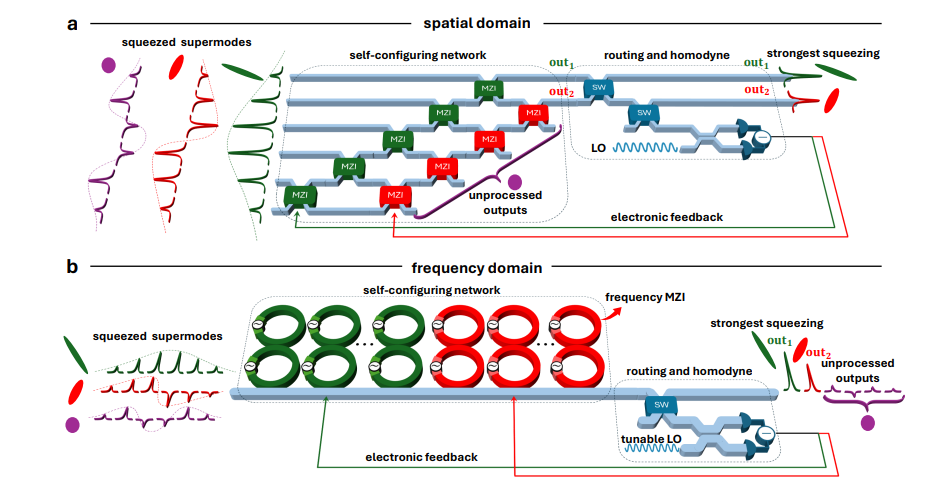
Multimode optics holds great promise for advancing continuous-variable technologies, but efficiently processing the complex patterns of light within these systems presents a significant challenge. Aviv Karnieli, Paul-Alexis Mor, and Charles Roques-Carmes, working with colleagues at Stanford University and the Massachusetts Institute of Technology, now demonstrate a new approach to overcome this limitation. The team develops a variational scheme using self-configuring photonic networks that learns to identify and extract the most strongly squeezed patterns of light, dramatically reducing the size and complexity of the required optical circuits. This innovative method achieves near-perfect fidelity in identifying these crucial light patterns, even when accounting for practical limitations such as optical loss and detection noise, and paves the way for compact, resource-efficient processing units with applications in communication, sensing, and quantum computation.
Integrated Photonics Synthesises Complex Quantum States
Researchers are advancing continuous-variable quantum technologies by manipulating multimode squeezed light, a powerful resource for quantum information processing. They have demonstrated a method for preparing and controlling complex quantum states of light using integrated photonic circuits and a technique called variational quantum circuits, effectively mapping a desired quantum state onto the available properties of the squeezed light. This approach employs a data-driven optimisation algorithm, using homodyne measurement to minimise the difference between the generated state and the target state, enabling the creation of complex states that are difficult to achieve with traditional methods.
Instead of processing all relevant “supermodes”, which dramatically increases circuit complexity, the team introduced a variational scheme based on self-configuring photonic networks. These networks learn and extract the most strongly squeezed supermodes sequentially, significantly reducing both the size of the photonic circuit and the experimental demands. The method uses homodyne measurement as a guide, allowing a sparse network to identify and utilise the most important supermodes with a manageable number of physical elements and optimisation steps.
Chip-Based Photonics and Quantum Circuits
A comprehensive body of research focuses on building and controlling light on chips for quantum technologies, encompassing integrated photonics, quantum information science, and related fields, with a strong emphasis on silicon photonics and indium phosphide technologies. Researchers are developing programmable photonic circuits, allowing for flexible and reconfigurable optical processing, and exploring hybrid integration techniques to combine different materials for enhanced performance. Key areas of investigation include building core optical components, such as microring resonators and Mach-Zehnder interferometers, and developing methods for controlling their properties.
This research also delves into the theoretical foundations of quantum information processing with photons, including quantum entanglement, squeezed states, and continuous variable quantum information. Scientists are exploring quantum key distribution, quantum metrology, and the use of quantum microcombs as a resource for quantum applications. A significant focus lies on characterising and manipulating quantum states, with advancements in quantum state tomography and methods for measuring and processing partially coherent light. Researchers are also investigating frequency synthetic dimensions and temporal mode multiplexing for high-dimensional quantum encoding.
Error correction and improving the fidelity of quantum operations are crucial areas of investigation. Scientists are developing hardware error correction techniques and exploring methods for optimising gate fidelity. Furthermore, research extends to efficient numbering schemes for mapping optical connections in programmable photonic circuits and the application of machine learning algorithms for designing and controlling photonic circuits, benefiting from advancements in optimisation algorithms like Adam. This body of work demonstrates a strong commitment to building scalable and robust quantum technologies on chips.
Sequential Supermode Extraction Simplifies Multimode Optics
Researchers have developed a new technique for processing multimode squeezed light, a vital resource in continuous-variable quantum technologies. The team demonstrated a variational scheme using self-configuring photonic networks that learn and extract the most significant supermodes sequentially, substantially reducing the complexity of required photonic circuits. This approach addresses a major limitation in multimode optics, where processing demands increase dramatically with the number of modes, leading to rapidly increasing circuit size and measurement requirements.
Simulations in both spatial and frequency domains demonstrate high fidelity between the learned circuits and the ideal supermode decomposition, even when accounting for optical losses and detection noise. Notably, the team achieved significant reductions in circuit size, particularly in the frequency domain, by employing inverse-designed surrogate networks that emulate previously learned layers, reducing the required physical elements to linear or even constant values relative to the number of modes. Future research directions include extending the protocols to different encoding schemes and exploring non-uniform frequency bin encodings, with potential applications in quantum-enhanced sensing, quantum metrology, and frequency-bin quantum information processing, paving the way for scalable on-chip quantum processing units.
🗞 Variational processing of multimode squeezed light
🧠 ArXiv: https://arxiv.org/abs/2509.16753




See today’s quantum computing news on Quantum Zeitgeist for the latest breakthroughs in qubits, hardware, algorithms, and industry deals.